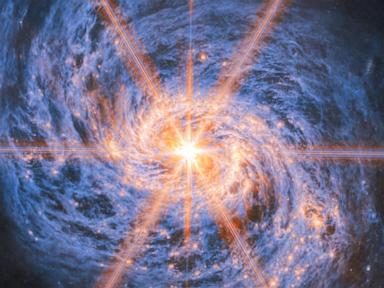
The James Webb Space Telescope (JWST) capture of the barred spiral galaxy NGC 1559 represents more than a visual achievement; it is a data-driven validation of mid-infrared instrumentation's ability to map the life cycle of stellar matter. By utilizing the Mid-Infrared Instrument (MIRI) and the Near-Infrared Camera (NIRCam), astronomers can now bypass the optical obscuration caused by interstellar dust, which acts as a high-pass filter in the electromagnetic spectrum, blocking shorter wavelengths while allowing longer infrared signatures to pass. This observation provides a structural blueprint for understanding how massive stars influence the chemical evolution of their host galaxies through feedback loops and radiative pressure.
The Architecture of NGC 1559
NGC 1559 is categorized as a barred spiral galaxy, a classification defined by a central bar-shaped structure composed of stars. This bar acts as a gravitational engine, funneling gas and dust from the spiral arms toward the galactic center. This mass transport is a primary driver of star formation rates (SFR). Unlike the Milky Way, NGC 1559 is a "lonely" galaxy, lacking the gravitational interactions of a local group to trigger star formation. Its evolution is almost entirely internal, making it a closed-system laboratory for studying galactic dynamics.
The galaxy is situated approximately 35 million light-years away in the Reticulum constellation. At this distance, the resolution provided by JWST’s 6.5-meter primary mirror allows for the identification of individual star-forming regions, known as H II regions, where ultraviolet radiation from young stars ionizes surrounding hydrogen gas.
The Infrared Advantage: MIRI and NIRCam Integration
The efficacy of the JWST imagery rests on the coordination of two distinct sensing technologies. Standard optical telescopes, such as Hubble, see the "glow" of existing stars but are blinded by the opaque clouds of soot-like dust particles that permeate spiral arms.
- NIRCam (Near-Infrared Camera): Operates between 0.6 and 5 microns. It detects the older, cooler stellar populations and the piercing light of stars just beginning to emerge from their birth cocoons. NIRCam provides the structural skeleton of the galaxy, mapping the distribution of stellar mass.
- MIRI (Mid-Infrared Instrument): Operates between 5 and 28 microns. MIRI is sensitive to the thermal emission of polycyclic aromatic hydrocarbons (PAHs)—complex organic molecules that reside in the interstellar medium. These molecules absorb ultraviolet light from stars and re-emit it in the mid-infrared, effectively "lighting up" the dust lanes that were previously dark.
By layering these datasets, analysts can determine the spatial relationship between the cold gas (fuel), the dust (the catalyst/shield), and the resulting stellar output.
The Lifecycle of Galactic Feedback
The "brilliant heart" referenced in qualitative reports is actually a high-density zone of energy exchange. This process follows a rigorous mechanical sequence:
- Gravitational Instability: Cold molecular clouds reach a Jeans mass threshold, collapsing under their own gravity to form protostars.
- Radiative Feedback: As stars ignite, they emit intense radiation and stellar winds. This creates "bubbles" in the surrounding gas, visible in MIRI data as dark voids surrounded by glowing filaments.
- Chemical Enrichment: The most massive stars end their lives in supernovae—NGC 1559 has hosted four documented supernova events in recent decades (SN 1986L, SN 2005df, SN 2009ib, and SN 2021dux). These explosions seed the galaxy with heavy elements (metals), which alter the opacity and cooling rates of future generations of gas clouds.
The observational data from JWST confirms that the distribution of dust is not uniform. It follows the density waves of the spiral arms, where the compression of gas is most intense. This creates a feedback loop: star formation creates turbulence, which prevents the remaining gas from collapsing too quickly, thereby regulating the galaxy’s long-term growth.
Quantifying the Scale of Observation
To understand the technical precision required for these images, one must consider the thermal constraints of the hardware. MIRI must be cooled to below 7 Kelvin (-266°C) using a cryocooler to prevent the instrument's own heat from drowning out the faint infrared signals from NGC 1559. The "brightness" in these images is a translated representation of photon counts; specifically, the mid-infrared data is often mapped to visible colors (reds and oranges) to indicate the presence of warm dust, while near-infrared data is mapped to blues to indicate stellar density.
The specific luminosity of the galactic core indicates a high concentration of older stars, while the periphery of the spiral arms shows the distinct, jagged morphology of active star-forming complexes. The absence of a large-scale active galactic nucleus (AGN) in NGC 1559 suggests that its central supermassive black hole is currently in a quiescent state, not actively consuming enough matter to generate a luminous accretion disk that would overshadow the surrounding stars.
Limitations of Current Interpretations
While the JWST data provides unprecedented clarity, it remains a "snapshot" of a 35-million-year-old state. The primary limitation in galactic analysis is the lack of temporal data; we see the results of star formation but must infer the velocity vectors of the gas. To solve this, researchers pair JWST's spatial data with spectroscopic data from ground-based arrays like ALMA (Atacama Large Millimeter/submillimeter Array), which can measure the Doppler shift of carbon monoxide gas to map the internal kinematics of the galaxy.
The data confirms that NGC 1559 is receding from the Milky Way. This radial velocity is a product of the expansion of the universe, but the galaxy's internal rotation remains the dominant factor in shaping its spiral structure. The "winding" of the arms is a result of differential rotation, where matter closer to the center completes an orbit faster than matter at the edge.
Strategic Direction for Extragalactic Research
The focus must shift from qualitative "pretty pictures" to the rigorous calibration of the star formation law (the Kennicutt-Schmidt law) in diverse environments. Because NGC 1559 is isolated, it serves as a baseline. Comparing its MIRI-derived dust maps to galaxies in dense clusters will reveal how external gravitational "harassment" strips a galaxy of its life-sustaining gas.
Future observations should prioritize deep-field spectroscopy of the supernovae remnants within NGC 1559. By analyzing the light echoes of past explosions against the backdrop of the new JWST maps, we can calculate the exact energy injection into the interstellar medium, providing the missing variables in current galactic evolution simulations. The objective is to move from mapping the current state of the galaxy to predicting its morphology 100 million years into the future, based on current gas consumption rates and gravitational torque within the central bar.