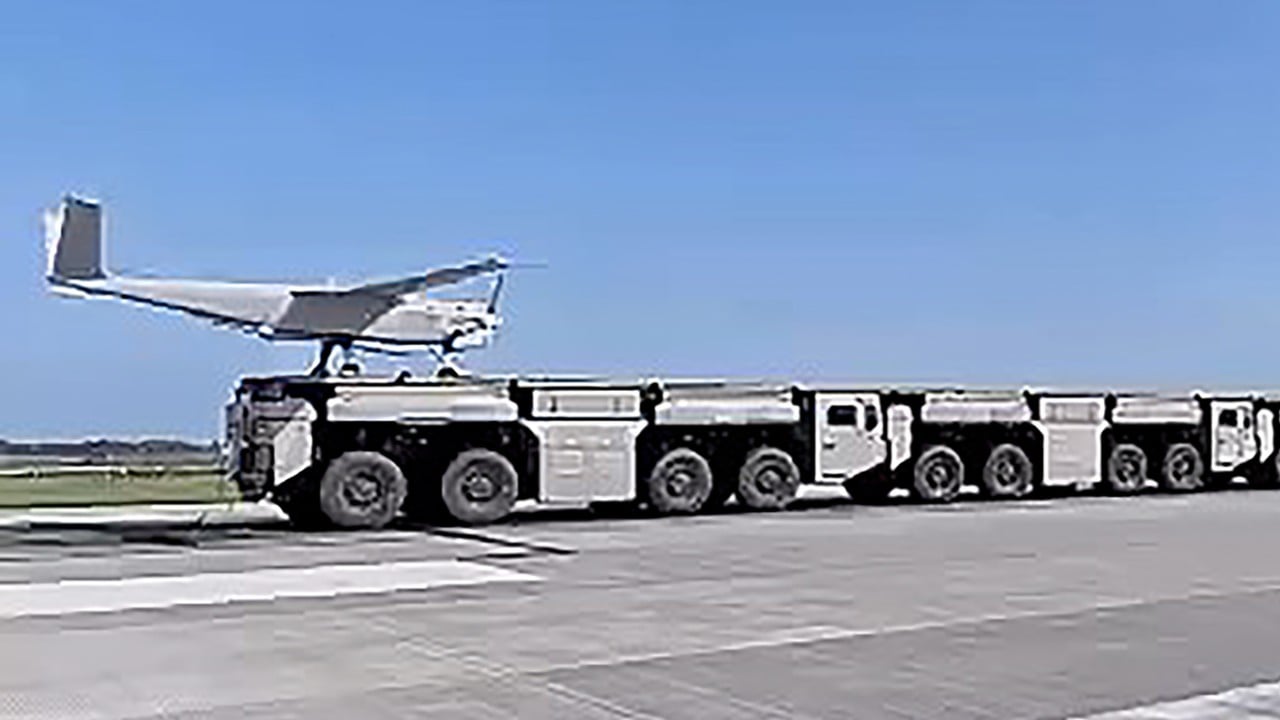
Fixed military architecture is failing under the weight of precision-guided saturation tracking. The modern peer-to-peer conflict environment penalizes permanent geographic installations; standard concrete runways and deep-water military ports represent highly predictable coordinates easily cataloged by synthetic aperture radar and targeted by long-range ballistic vectors. In response to this vulnerability, a distinct paradigm shift is occurring from monolithic, permanent defense assets toward distributed, modular, and dual-use capabilities.
The physical manifestation of this strategy is crystallized in recent trials involving the Chinese commercial feeder vessel Zhong Da 79. By integrating road-mobile electromagnetic aircraft launch systems (EMALS), modular vertical launching systems (VLS), and phased-array radar systems into standardized shipping container dimensions, the People's Liberation Army (PLA) has mapped out an architecture for rapid asset conversion. This system decouples specialized military capability from dedicated military hulls and fixed land bases, establishing a highly flexible force-multiplier framework.
The Distributed Catapult: Mechanics of Modular EMALS
The core technological bottleneck of distributed aviation has historically been the physical footprint required to accelerate fixed-wing aircraft to flight velocity. Standard rocket-assisted take-offs (RATO) yield high thermal signatures and steep operational costs, while hydraulic or pneumatic catapults impose prohibitive maintenance cycles and mass requirements.
The truck-mounted, containerized EMALS bypasses these constraints through a disaggregated linear induction motor architecture. The system distributes structural and electrical loads across a multi-vehicle convoy—typically three heavy, linked all-wheel-steering transport vehicles. When locked in sequence, these vehicles form a continuous launch rail scalable between 20 and 60 meters.
The operational physics relies on two primary subsystems:
Linear Synchronous Sequencing
Rather than maintaining a rigid, single-piece rail, the track is segmented into discrete magnetic coil blocks. Sophisticated control software tracks the position of the launch shuttle in real time, energizing independent electromagnetic coils sequentially ahead of the shuttle and de-energizing them immediately after passage. This localized wave of magnetic force bridges the physical coupling gaps between the separated truck beds, ensuring smooth, uninterrupted acceleration despite the disaggregated platform structure.
Under-Chassis Kinetic Storage
The instantaneous power drawdown required to accelerate a 2.2-ton airframe to a takeoff velocity of 50 meters per second exceeds the continuous output capacity of standard mobile diesel generators. The system solves this via Medium-Voltage Direct Current (MVDC) supercapacitor banks integrated into the undercarriages of the transport vehicles. These capacitors draw low-amplitude power continuously from onboard generators during transit or idle phases, then discharge the stored energy into the linear motor coils in a high-intensity pulse lasting less than three seconds.
This mechanical configuration yields specific operational advantages:
- Stress Reduction: Unlike the violent, non-linear acceleration curves of pneumatic or solid-rocket boosters, the electromagnetic pulse adjusts its force profile precisely to matches the real-time weight and aerodynamic profile of the specific unmanned combat aerial vehicle (UCAV) being launched.
- Vector Adjustment: The transport vehicles feature extreme all-wheel steering geometries, allowing the entire assembled rail assembly to rotate within a highly confined radius. This allows operators to align the track directly into the prevailing headwind on unimproved roads, lowering the ground-speed threshold required for aircraft lift-off and maximizing payload margins.
The Economics of Scale: Weapon Modules and VLS Integration
The modular transformation demonstrated on the Zhong Da 79 extends beyond aviation to offensive and defensive kinetic payloads. The vessel's configuration replaces traditional integrated deck space with standardized, containerized ISO weapon modules.
+-------------------------------------------------------------+
|               Zhong Da 79 Deck Configuration                |
+------------------------------+------------------------------+
| Forward Deck Area            | Midships & Starboard Space   |
|                              |                              |
| - Double-Stacked Containers  | - 24 to 60 VLS Launch Tubes  |
| - Type-1130 / LD-3000 CIWS   | - Scaled EMALS Catapult Rail |
| - Active Phased-Array Radars | - Stealth / ISR UCAV Berths  |
+------------------------------+------------------------------+
Midships space utilizes containerized vertical launch cells grouped in quad-launch configurations within 12-meter (40-foot) ISO shipping boxes. These cells are designed using a fold-down structure, maximizing missile length up to approximately 8 meters while conforming to standard shipping dimensions during transport. This geometric constraint allows the system to house diverse ordnance profiles, including long-range surface-to-air missiles (HHQ-9 equivalents), supersonic anti-ship cruise missiles (YJ-18 variants), and land-attack cruise missiles (CJ-10 class).
The defensive envelope is similarly modularized. Dual-stacked container configurations on the forward deck carry isolated close-in weapon systems (CIWS), specifically the 11-barrel 30mm Type-1130 naval variant alongside its land-based counterpart, the LD-3000. These kinetic interceptors operate concurrently with container-mounted, dual-face Active Electronically Scanned Array (AESA) and over-the-horizon (OTH) radars. This modular sensor-and-effector suite grants a standard 97-meter commercial cargo ship the local situational awareness and localized defense capabilities traditionally reserved for dedicated surface combatants like frigates.
Strategic Friction: Verification and the Laws of Naval Warfare
While the scalability of containerized systems offers immense asymmetric utility, the framework introduces severe structural friction within international legal and intelligence collection domains. The primary vulnerability of this strategy does not lie in its engineering, but in its systemic systemic complications.
Legal Status of the Hull
Under the 1907 Hague Convention VII, specific criteria dictate the conversion of merchant vessels into legitimate warships during international armed conflict. These rules mandate direct military command, visible external insignia distinguishing warships from merchant vessels, and strict adherence to the laws of war.
Operating heavily armed vessels like the Zhong Da 79 under nominal civilian status creates deep legal ambiguities. If a civilian-flagged vessel executes offensive strikes without undergoing formal naval commissioning, it risks classification as an unlawful combatant, exposing its crew to immediate prosecution and stripping the platform of standard sovereign immunities.
Target Verification Bottlenecks
The integration of lethal military assets into standard commercial logistics profiles presents an acute identification dilemma for opposing forces. When any standard ISO container could theoretically house a quad-cell cruise missile launcher or a disassembled EMALS system, the adversary's target selection calculus undergoes a destabilizing adjustment.
To mitigate risk, an adversary may feel compelled to classify a massive percentage of an actor's commercial merchant fleet—including Roll-On/Roll-Off (Ro-Ro) ferries and medium container feeders—as valid military objectives. This drastically expands the target zone of a conflict, jeopardizing global maritime trade lanes and complicating positive target identification.
Operational Constraints and System Limitations
The modular arsenal ship architecture is not an absolute replacement for dedicated blue-water navies or permanent airbases. It is a highly specialized, asymmetric supplement bounded by clear physical boundaries:
- Structural Rigidity vs. Payload Mass: The disaggregated EMALS track functions effectively because its current maximum launch capacity is capped at approximately 2.2 metric tons. This limits the deployed aviation wing to medium-altitude, long-endurance (MALE) reconnaissance platforms or lightweight, one-way strike munitions. Scaling this system to launch manned multi-role fighters weighing upwards of 15 to 20 tons would demand geometric increases in track rigidity, electromagnetic field intensity, and supercapacitor storage capacity, making a mobile truck-based configuration mathematically unfeasible.
- Sensor Blind Spots: Standard warships feature integrated superstructures engineered to optimize radar cross-sections and minimize RF interference. Containerized radars stacked on top of rectangular steel cargo units experience unavoidable blind spots and structural masking caused by adjacent container columns, reducing total sensor efficiency compared to a purpose-built combatant.
- The Logistics Tail: Launching an aircraft or firing a missile from a truck or cargo ship is a single event. Continuous operations require specialized cranes to reload heavy VLS cells, fuel storage modules, munitions management facilities, and dedicated maintenance personnel. A container ship lacks the internal passageways, automated ammunition hoists, and damage control routing built into a true warship, turning the reloading process into a slow, high-exposure logistical bottleneck.
The Strategic Play: Countering the Modular Threat
The deployment of modular, containerized strike and aviation systems shifts the focus of maritime interdiction from hull counting to supply-chain intelligence. To counter a distributed network of commercial vessels converted into tactical missile and drone platforms, defensive strategies must prioritize digital tracking and supply chain visibility over raw kinetic presence.
    [Raw Manufacturing / Depot Production]
                      │
                      ▼
        [Container Stuffing & Sealing]  ◄─── Intercept RFID / Digital Twin Data
                      │
                      ▼
         [Commercial Rail/Road Transit]
                      │
                      ▼
        [Port Facility / Crane Loading]  ◄─── Deploy Synthetic Aperture Radar (SAR)
                      │
                      ▼
         [Civilian Vessel At Sea]
The optimal counter-strategy requires a multi-layered verification framework:
- Digital Twin Ingestion: Western intelligence must integrate global bill-of-lading databases, radio-frequency identification (RFID) manifest logs, and port authority scheduling data to construct real-time digital twins of commercial maritime assets. Isolating anomalies—such as unmanifested weight discrepancies or irregular power-draw histories at dual-use facilities—allows for the pre-emptive flags of potentially converted hulls before they leave port.
- Persistent SAR Monitoring: Persistent constellation scanning via Synthetic Aperture Radar must be deployed to monitor known military-civil fusion shipyards. This enables automated detection of the characteristic structural footprints associated with containerized AESA radars and stacked CIWS platforms, bypassing the visual camouflage provided by standard merchant container paint schemes.
- Proportional Rules of Engagement: Operational doctrines must establish clear thresholds for classifying civilian vessels as active combatants based on electromagnetic signatures. Detecting distinct active radar frequencies associated with military systems (like the Type-366 or specific CIWS tracking arrays) originating from a commercial feeder hull must trigger immediate reclassification to a hostile military objective, eliminating the tactical advantage of visual deception before weapons release.