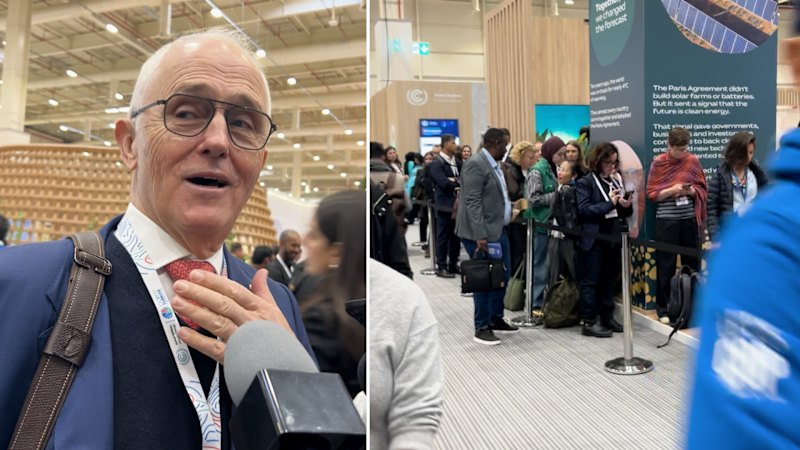
Outrage is cheap. Good espresso in the middle of a diplomatic warzone is not.
When former Australian Prime Minister Malcolm Turnbull defended spending $32,000 AUD on a coffee cart at a UN climate summit (COP), the media machine did what it always does. It went straight for the jugular of easy populism. Taxpayer money wasted on hipster lattes while the planet burns. It is a headline that writes itself, feeds the algorithm, and confirms every lazy bias the public holds about bloated government bureaucracy.
There is just one problem with that narrative. It is completely, dangerously wrong.
Critics who fixate on the sticker price of a mobile espresso bar are exhibiting a textbook case of Parkinson’s Law of Triviality—also known as "bike-shedding." Formulated by C. Northcote Parkinson in 1957, this principle explains why a finance committee will effortlessly approve a $10 billion nuclear reactor in five minutes, then spend three hours aggressively debating the cost of a $500 bike shed. People attack what they can visualize. You cannot easily picture the macroeconomic ROI of a bilateral carbon-credit framework, so you scream about the price of flat whites.
If you have ever actually worked inside high-stakes international trade pavilions, you know that $32,000 for a two-week global event is not an extravagance. It is an absurdly cheap customer acquisition cost.
The Economics of Pavilion Real Estate
To understand why a coffee cart is a tactical weapon rather than a bureaucratic indulgence, you have to understand the physical reality of a Conference of the Parties (COP) summit.
A COP venue is a sprawling, windowless labyrinth of convention halls packed with 50,000 to 80,000 exhausted delegates, heads of state, sovereign wealth fund managers, and lobbyists. The air is stale. The fluorescent lighting is brutal. And the catering inside the UN "Blue Zone" is notoriously terrible—overpriced, lukewarm, and guarded by 45-minute queues.
Countries spend millions of dollars just to secure square footage in this zone. Building a national pavilion—the physical booth where a nation pitches its green hydrogen projects, critical minerals, and climate tech to global capital—routinely costs between $500,000 and $3 million USD once you factor in floor space, custom fabrication, shipping, audio-visual setups, and security clearances.
I have watched national trade delegations blow seven figures on architectural pavilions equipped with massive LED walls and interactive touchscreens, only to watch delegates walk right past them without breaking stride. Nobody stops to read a brochure on a screen when they are running on four hours of sleep and severe jet lag.
They stop for caffeine.
When you drop $32,000 AUD (roughly $21,000 USD) on a commercial-grade coffee operation—covering equipment leasing, international freight, specialized union labor at the venue, electrical hookups, thousands of cups of milk, beans, and hygiene compliance—you are buying foot traffic. You are turning a sterile diplomatic booth into the unofficial town square of the summit.
The Math Nobody Wants to Do
Let’s look at the actual unit economics of that $32,000 spend over a standard 12-day COP schedule.
- Daily operational cost: ~$2,666 AUD per day.
- Average output: A single skilled barista on a commercial dual-group machine pulls roughly 60 to 80 shots an hour during peak conference traffic. Over an 8-hour window, that is 500+ coffees a day.
- Total impressions: 6,000 direct, face-to-face engagements over the life of the summit.
- Cost per engagement: $5.33 AUD.
Compare $5.33 per warm, face-to-face lead with a senior energy minister or institutional investor against the cost of running a single print ad in the Financial Times or hosting a private diplomatic dinner at a five-star hotel. A single closed-door dinner for 20 VIPs in Dubai, Baku, or Belém easily clears $15,000 in catering and security alone, and you only reach 20 people.
A coffee cart forces the most powerful people in the room to stand in a five-minute queue right inside your national branding. While they wait for their milk to steam, your trade commissioners, ambassadors, and startup founders have a captive audience. You cannot buy that kind of friction-free networking at any price.
Why "Taxpayer Waste" Is the Wrong Question
When the public asks, "Why are taxpayers funding free coffee for elites?", they are falling into a trap of false austerity. They view government expenditure through the lens of a household budget rather than a venture capital balance sheet.
In household accounting, every dollar spent is a dollar gone. In statecraft and trade promotion, expenditure is capital allocation designed to generate downstream tax revenue.
Australia, like Canada, Norway, or any resource-heavy export economy, does not send delegations to climate summits out of pure charity. They go to protect market access and attract foreign direct investment (FDI). When Australia pitches itself as a "renewable energy superpower," it is competing directly against the US Inflation Reduction Act, European subsidies, and Middle Eastern sovereign funds for billions of dollars in private infrastructure capital.
If a trade commissioner standing next to that $32,000 coffee cart initiates a conversation with a European pension fund manager that leads to a $50 million investment in an Australian solar or lithium refining project, the return on that coffee cart isn't just positive—it is exponential. The corporate tax revenue and local jobs generated by a single mid-sized deal pay for that coffee cart a thousand times over.
Malcolm Turnbull, whatever you think of his politics, spent decades in investment banking at Goldman Sachs before entering Parliament. He understands deal flow. He knows that deals do not happen on the main plenary stage during scripted speeches. Deals happen in the margins. They happen when two exhausted negotiators lean against a counter waiting for an espresso and say, "Look, forget the official communique—here is what our ministry actually needs to get this signed."
The Cultural Soft Power Nobody Measures
There is another layer to this that strict spreadsheet analysts miss: asymmetric branding.
Every country at a global summit tries to project dominance through scale. The superpowers build massive, intimidating pavilions that look like corporate headquarters. Smaller and middle-power nations cannot outspend the United States, China, or the Gulf states on square footage. If you try to compete on sheer size, you lose.
You compete on hospitality and cultural specificity.
Melbourne and Sydney have arguably the most fiercely independent, high-craft coffee culture on earth. It is one of the few things Australia exports culturally that commands instant global respect without feeling forced. By making world-class coffee the centerpiece of its diplomatic presence, a delegation signals competence, warmth, and attention to detail.
Contrast this with the standard diplomatic playbook: handing out cheap branded tote bags, plastic pens, and glossy reports that end up in hotel trash cans before the flights home even board. Those items cost tens of thousands of dollars to produce and ship, carry zero utility, and create instant landfill.
Hospitality creates memory. In diplomacy, being the place where people actually want to hang out is an unfair advantage. When journalists from Bloomberg, Reuters, and The Guardian gravitate to your pavilion every morning because yours is the only spot serving drinkable coffee, guess whose ministers get interviewed when breaking news drops? Yours. Earned media coverage from a single broadcast hit on a major network is worth hundreds of thousands of dollars in equivalent ad spend.
The Real Scandal Hidden Behind the Coffee Cart
If you want to get angry about taxpayer waste at international summits, stop looking at the $32,000 coffee cart. Look at the $320,000 spent on things that generate zero human connection.
I have seen government departments burn staggering sums on:
- Vanity Consulting Reports: Paying Big Four firms $250,000 to produce a 120-page PDF launched at a side event attended by 14 people—10 of whom work for the ministry that commissioned it.
- Bloated Entourages: Flying 40 mid-level bureaucrats in business class to "observe" negotiations they have no authority to influence, racking up $15,000 per person in flights, per diems, and surge-priced hotel rooms.
- Bespoke Digital "Metaverse" Experiences: Spending six figures on VR headsets and custom apps for a pavilion that break on Day 2 and sit untouched for the rest of the conference.
Attacking the coffee cart while ignoring the business-class travel bloat is like screaming at a surgeon for buying a $50 scalpel while ignoring the $50,000 hospital administration fee. It is performative outrage aimed at the most visible, easily mockable line item on the invoice.
The Downsides of Hospitality Diplomacy
Of course, weaponized hospitality is not a magic bullet, and pretending it has no flaws would be dishonest.
First, optics are a real political risk. In an era of high inflation and cost-of-living anxiety, any government expenditure that looks like a perk for insiders becomes radioactive ammunition for political opponents. Even if the ROI is 500x, you cannot fit a nuanced explanation of trade-show lead generation onto a bumper sticker or a 15-second TikTok clip. Communications teams routinely fail to frame these expenses proactively, leaving the floor wide open for bad-faith outrage.
Second, hospitality without execution is just a free cafe. If a delegation sets up a great coffee bar but staffs the pavilion with junior administrators who hide behind laptops instead of working the room, the entire investment is wasted. A coffee cart is a magnet, not a closer. If you do not put your sharpest commercial negotiators and technical experts within ten feet of the espresso machine, all you have done is subsidize caffeine for strangers.
Third, venue monopolies inflate costs artificially. The reason a coffee setup costs $32,000 instead of $8,000 is largely due to the predatory pricing of official convention center contractors. Exhibition organizers force delegations to use approved vendors for water lines, electrical drops, and food safety permits at 400% markups. That cartel pricing is a legitimate target for reform—but blaming the delegation for paying the going rate to operate inside the venue misses the real culprit.
How to Actually Audit Diplomatic Spending
If taxpayers and journalists want to hold governments accountable for summit spending, they need to throw away the receipt book and start demanding a Post-Event Commercial Ledger.
Stop asking how much the catering cost. Start asking these three questions:
- What is the pipeline value? How many qualified commercial introductions, Memoranda of Understanding (MOUs), or bilateral regulatory agreements were initiated inside that pavilion?
- What is the staffing-to-principal ratio? How many people on the taxpayer-funded manifest were actual decision-makers or trade specialists versus redundant administrative hangers-on?
- What was the cost per square meter versus footfall? Did the pavilion actually draw traffic, or was it an empty monument to bureaucratic ego?
When you measure diplomacy like a high-performing B2B enterprise instead of a charity soup kitchen, the numbers flip upside down.
The next time a politician or pundit waves an invoice for a $32,000 espresso machine in front of a camera to score cheap populist points, pay close attention. They are not protecting your tax dollars. They are advertising their own ignorance of how business actually gets done in the real world.
Keep the coffee cart. Fire the consultants who wrote the unread PDFs.


