Urban transportation networks are experiencing a structural mismatch between the physics of micro-mobility vehicles and the legacy infrastructure designed to support them. While municipal transit strategies increasingly rely on electric kick scooters to solve the first-mile/last-mile transit dilemma, the physical risk profile of these devices remains critically unmanaged.
Two recent incidents in Vancouver highlight this systemic vulnerability. On July 3, 2026, a 30-year-old female operator traveling westbound on Venables Street collided with the side of a vehicle near Commercial Drive, sustaining fatal head trauma upon ground impact. Nine days later, on July 12, a 54-year-old female rider was struck from behind by another e-scooter operator in Coal Harbour near Nicola Street, sustaining a head injury and a fractured collarbone. Neither rider wore a helmet.
While police warnings emphasize individual compliance with Section 19 of the Electric Kick Scooter Pilot Project Regulation under the BC Motor Vehicle Act, analyzing these events through a engineering and behavioral lens reveals that regulatory mandates alone cannot bridge the safety deficit.
The Physics of Micro-mobility Instability
The mechanical design of an electric kick scooter inherently elevates the probability of operator injury during a loss-of-control event compared to a standard bicycle. This elevated risk profile is governed by three physical vectors:
1. Center of Gravity and Pivot Mechanics
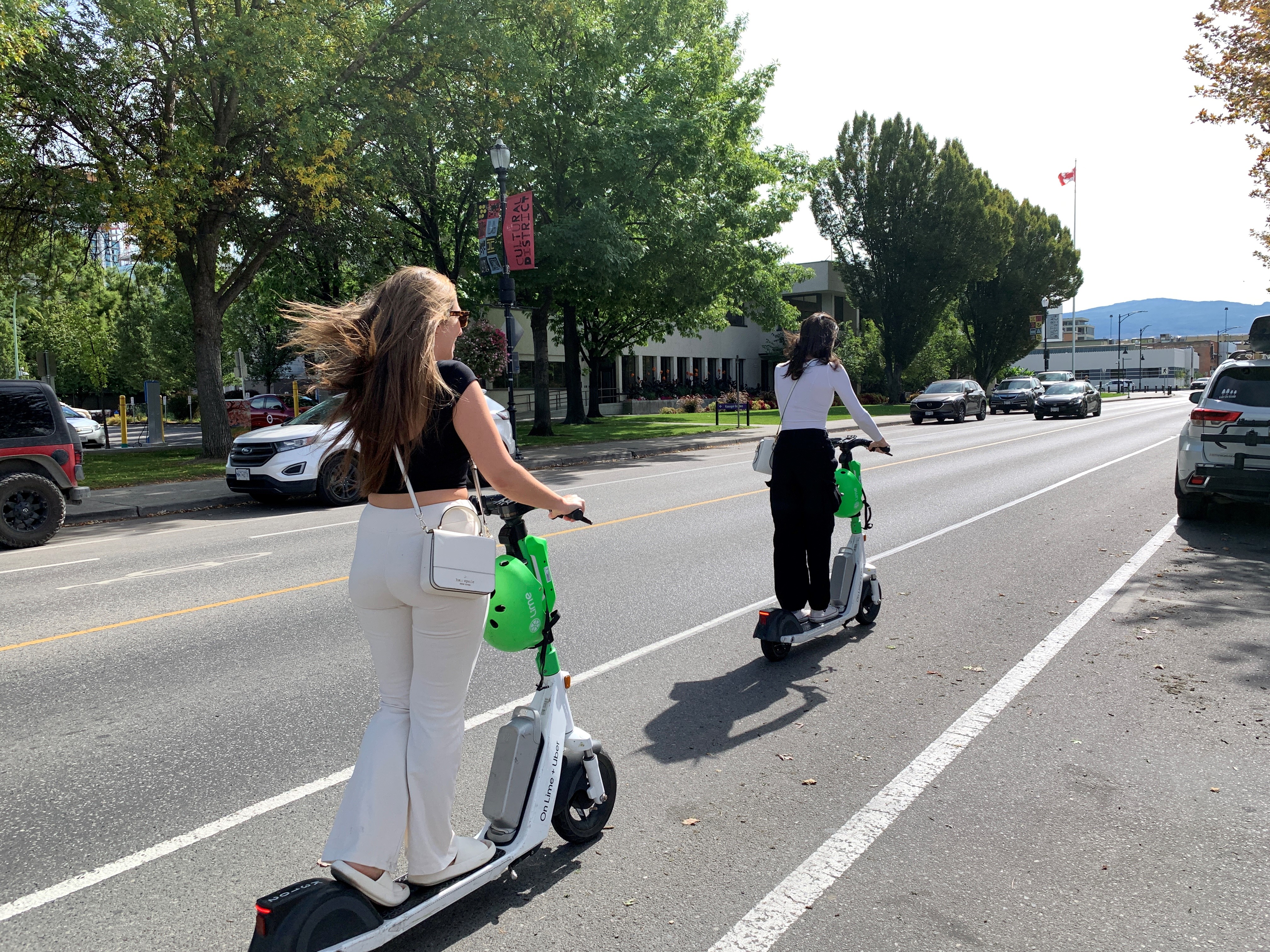
An e-scooter operator stands upright, raising the combined center of mass significantly higher than that of a seated cyclist. Because the wheelbase of a standard kick scooter is remarkably short—typically between 90 and 110 centimeters—the margin for pitching stability is narrow. During sudden deceleration, such as striking a vehicle or braking abruptly, the center of mass easily shifts forward of the front axle, pivoting the rider over the handlebars in a forward trajectory.
2. Wheel Diameter and Roadway Impedance
Most electric scooters utilize wheels measuring between 8 and 10 inches in diameter, compared to 26 to 29 inches for adult bicycles. The geometric relationship between wheel radius and obstacle height dictate that smaller wheels possess a much higher rolling resistance and are far more susceptible to catastrophic stopping when encountering minor road surface anomalies, such as potholes, utility grates, or debris.
3. Rotational Inertia and Steering Geometry
Due to narrow handlebars and a steep head tube angle, e-scooter steering assemblies exhibit low rotational inertia. This makes the steering highly sensitive to minor input errors. When a rider is struck from behind, as occurred in the Coal Harbour incident, the transfer of kinetic energy easily overcomes the rider's ability to maintain directional control, leading to immediate destabilization.
The Behavioral Bottleneck of Shared Micro-mobility Systems
The expansion of shared e-scooter fleets in urban centers introduces a distinct behavioral challenge: the separation of vehicle access from safety equipment availability.
[User App Registration] ──> [Instant Vehicle Unlock] ──> [Transit Initiation]
                                                               │
                                                 Critical Failure Point:
                                            No Integrated Helmet Requirement
While private e-scooter owners often invest in personal safety gear, casual users of shared fleets frequently make spontaneous transit decisions. The friction of acquiring, carrying, or sanitizing a helmet for a five-minute impromptu trip leads to widespread non-compliance with helmet laws.
This friction points to a systemic failure in the shared micro-mobility business model. Operators provide rapid, low-barrier vehicle access but rely entirely on municipal police forces to enforce the safety regulations required to operate those vehicles. The cost of enforcement is externalized onto public resources, while the physical liability is borne entirely by the consumer.
Structural Reforms for Urban Micro-mobility Integration
To mitigate these systemic risks, municipalities must move beyond punitive policing and address the root structural issues. This requires a two-pronged strategy focusing on hardware integration and infrastructure separation.
Hardware-Level Enforcement
Municipalities granting operating permits to shared micro-mobility providers must mandate technological solutions to ensure helmet compliance. Passive warnings within mobile applications are ineffective. Future operating agreements should require:
- Smart-Locking Helmets: Vehicles must be equipped with active-locking helmet cases that only release upon digital verification.
- Smart Chin-Strap Sensors: Integrated weight or optical sensors within the helmet to verify the strap is fastened before the scooter's motor engages.
- Computer Vision Verification: Requiring a brief selfie within the operator's app to confirm helmet use before unlocking the vehicle's throttle.
Protected Corridor Infrastructure
The fatal collision on Venables Street—an active arterial corridor—demonstrates the danger of mixing lightweight micro-mobility devices with multi-ton commercial and passenger vehicles. Painting a lane line on a high-speed roadway does not constitute safe infrastructure.
True safety integration requires physical separation. Placing grade-separated, protected micro-mobility lanes between the sidewalk and parked cars insulates vulnerable riders from direct vehicular contact. Where physical barriers are impossible, speed differentials must be managed by restricting e-scooters to low-speed local greenways or implementing automatic GPS-based geofencing to limit scooter speeds to walking pace in highly congested pedestrian zones like Coal Harbour.
Rather than treating these collisions as isolated incidents of rider negligence, municipal planners and micro-mobility operators must recognize them as predictable outcomes of a system that matches high-velocity, low-stability vehicles with legacy road designs and friction-heavy safety regulations. Until the hardware and physical infrastructure are redesigned to match the physical realities of these devices, warnings from law enforcement will remain an ineffective deterrent against preventable trauma.