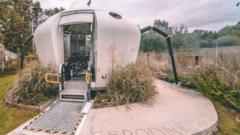
The commoditization of traditional short-term rental (STR) inventory has triggered a flight toward high-alpha architectural assets. While the broader hospitality market faces a supply glut of standardized suburban dwellings, "novelty rentals"—properties defined by extreme architectural divergence or thematic immersion—exhibit pricing power and occupancy rates that defy standard market cooling. This divergence is not a function of whim; it is a rational response to the diminishing marginal utility of the "home away from home" model. In a saturated digital attention economy, the physical asset now serves as the primary marketing vehicle, shifting the unit economics from a utility-based "bed-per-night" metric to an experiential "content-per-stay" valuation.
The Economic Drivers of Non-Standard Inventory
The surge in demand for UFO-shaped dwellings, converted fuselage, and modular subterranean pods is rooted in a fundamental shift in the consumer's cost-benefit analysis. Traditional travel involves a primary expense (the lodging) and secondary expenses (the experiences). Novelty stays collapse these categories into a single line item. Meanwhile, you can explore similar stories here: Saint Augustine Is Not Who You Think He Is And Neither Is Modern Algeria.
The Margin of Differentiation
Standardized rental units compete on price and location, two variables with high sensitivity and low defensibility. Novelty assets operate on a scarcity model. The supply curve for a mid-century A-frame in a forest is elastic; the supply curve for a structurally sound, livable "flying saucer" is almost perfectly inelastic. This inelasticity allows operators to capture a "novelty premium," often ranging from 150% to 300% over the localized average daily rate (ADR).
Asset-Light Adaptation vs. Purpose-Built Architecture
The market divides into two distinct operational strategies: To explore the bigger picture, we recommend the excellent report by Lonely Planet.
- Adaptive Reuse: This involves the conversion of existing non-residential hardware—grain silos, vintage trailers, or shipping containers—into habitable space. The primary challenge here is the "thermal envelope" and structural integrity. Steel structures like silos or containers require significant capital expenditure (CapEx) in insulation and HVAC integration to meet habitability standards, often offsetting the low initial acquisition cost of the shell.
- Purpose-Built Novelty: This involves ground-up construction using modular or bespoke architectural designs. While the initial investment is higher, these assets are engineered for guest throughput. They bypass the ergonomic failures of adaptive reuse, such as poor acoustic dampening or cramped bathroom configurations, leading to higher long-term retention and lower maintenance overhead.
The Psychological Infrastructure of Immersion
The boom in unusual stays is frequently mischaracterized as a search for "whimsy." A rigorous analysis suggests it is actually a search for "environmental decoupling." Modern work-from-home structures have blurred the boundaries between domestic and professional spaces, leading to a psychological phenomenon known as "place fatigue."
The Threshold of Displacement
To achieve true psychological displacement, the environment must provide a high degree of sensory contrast. A standard hotel room shares too many architectural DNA strands with a standard office or apartment—90-degree angles, drywall textures, and standard lighting fixtures. Unusual stays utilize "disruptive geometry." Curved walls, unconventional entry points (such as floor hatches), and varied tactile surfaces (raw timber, cold metal, or stone) force the brain to re-map its surroundings. This cognitive load prevents the guest from slipping into the routine thoughts associated with their standard environment.
The Social Currency Coefficient
The valuation of a rental is now intrinsically linked to its "shareability." In the current attention economy, a stay is an asset that produces social capital. The "content-per-stay" metric measures how effectively a physical space translates into digital engagement. Unusual stays provide a high density of unique visual data points, which reduces the effort required for a guest to generate high-performing social media content. The property, in effect, becomes a co-creator of the guest’s digital identity.
Structural Challenges in the Novelty Niche
Despite the high ADR potential, the operational complexity of unusual stays introduces specific friction points that standard STR operators often underestimate.
Regulatory and Permitting Bottlenecks
Traditional zoning laws are ill-equipped for non-traditional structures. A treehouse or a UFO pod often falls into a legal gray area between "temporary structure" and "permanent dwelling." Operators face significant hurdles in:
- Egress and Fire Safety: Circular or unconventional footprints often struggle to meet standard building codes for fire exits and ventilation.
- Utility Integration: Off-grid novelty stays (e.g., mirrored cubes in remote deserts) require sophisticated self-contained systems. The failure rate of composting toilets or solar-plus-storage arrays is significantly higher than grid-tied systems, necessitating a higher ratio of on-call maintenance staff per unit.
- Insurance Liability: Underwriting a stay in a converted aircraft or a glass-walled pod involves higher risk profiles. Premiums for novelty stays are typically non-standard and require specialized brokers, impacting the net operating income (NOI).
The Lifecycle of a Trend
Novelty assets are subject to "visual depreciation." A stay that is revolutionary in 2024 may feel derivative by 2028 as more competitors enter the niche. Maintaining the novelty premium requires a strategy of continuous aesthetic reinvestment or "phase two" development—adding secondary features like outdoor cedar tubs, observatory decks, or integrated smart-home narratives that evolve over time.
Strategic Allocation of Capital
For investors seeking to enter the novelty market, the "Goldilocks Zone" lies at the intersection of architectural uniqueness and operational scalability.
The Modular Solution
Bespoke one-off builds are difficult to scale. The emerging winner in this space is the "modular novelty" model. Companies are now producing high-end, architecturally distinct units—pre-fabricated in factories—that can be shipped and installed on remote land. This reduces the construction risk and allows for a standardized maintenance protocol across a portfolio of seemingly "unique" assets.
Geographic Arbitrage
The highest returns are currently found in "buffer zones"—areas within a 2-to-3-hour drive of major metropolitan hubs that offer total seclusion. The objective is to provide a "low-friction escape." The guest wants the feeling of being on another planet without the logistical burden of a long-haul flight. Land acquisition in these secondary and tertiary markets remains relatively low, allowing for a higher percentage of the total project budget to be allocated to the structure itself.
The Future of the Immersive Stay
The trajectory of the unusual stay market is moving toward "Total Narrative Immersion." We are seeing a shift from properties that merely look different to properties that function as an interactive environment.
Integration of Kinetic Architecture
The next generation of high-alpha rentals will likely incorporate kinetic elements—structures that rotate to follow the sun, retractable roofs for stargazing, or modular walls that alter the floor plan based on guest preference. These features move the asset from a passive shelter to an active participant in the experience.
Data-Driven Personalization
As the niche matures, the use of biometric and environmental data will allow these spaces to adapt to the occupant. Integrated sensors could adjust lighting, soundscapes, and even scent profiles based on the guest's circadian rhythms or stated goals for the stay (e.g., deep focus vs. recovery). This level of hyper-customization will justify even higher price points, effectively decoupling the stay from any remaining comparison to the traditional hotel market.
The strategic play is no longer about providing a place to sleep. It is about the acquisition and management of highly specialized, non-fungible physical assets that serve as the focal point of a temporary, curated reality. Success in this sector requires a pivot from hospitality management to "experience engineering," where the physical structure is the most powerful tool in the kit.
To capture the highest yield, operators must prioritize "architectural friction"—design choices that force the guest out of their habitual patterns—while simultaneously smoothing the operational friction of the underlying technology. The winner is the one who provides the most extreme visual and psychological departure with the least amount of logistical effort for the end user.