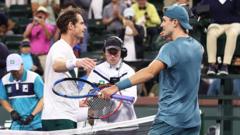
The air inside a professional tennis academy doesn't smell like victory. It smells like felt dust, industrial-grade floor wax, and the metallic tang of dried sweat. It is a quiet, rhythmic place, punctuated by the thwack-hiss of strings meeting yellow fuzz. For decades, that sound was the heartbeat of Andy Murray’s life. But when a legend walks away from the lines he spent thirty years defending, the silence that follows isn't peaceful. It’s heavy.
Andy Murray did not leave tennis because he wanted to. He left because his body became a biological map of a war zone. One metal hip, two Olympic golds, three Grand Slams, and a thousand miles of court covered on sheer, stubborn will. Most men with his bank account and his scars would be on a beach in the Maldives. Instead, Murray is standing on a practice court, squinting through the sun, watching a young man named Jack Draper swing a racket. For another look, consider: this related article.
This isn’t just a coaching appointment. It’s a transfusion.
The Weight of the Torch
British tennis is a strange, pressurized ecosystem. For seventy-seven years, the ghost of Fred Perry haunted Wimbledon, a specter of excellence that no one could touch until a scrawny kid from Dunblane decided he didn't care about ghosts. Murray became the sun around which the entire British game orbited. Now that the sun has set, there is a coldness in the air. Related analysis regarding this has been published by The Athletic.
Jack Draper is currently the British number two, a left-handed powerhouse who looks like he was carved out of marble but has occasionally played like he was made of glass. At 22, he carries the physical gifts Murray never had—raw, explosive power and a serve that sounds like a gunshot—but he lacks the one thing Murray had in excess. Scar tissue.
Not the physical kind. The mental kind. The ability to exist in the "hurt locker" for five hours and find a way to win when your legs feel like they are filled with wet concrete.
By stepping into Draper’s camp as a coach, Murray is doing something rare in the ego-driven world of elite sports. He is admitting that his own journey as a protagonist is over, but his role as a mapmaker has just begun. He isn't there to teach Draper how to hit a cross-court backhand; Draper already knows how to do that. Murray is there to teach him how to suffer.
A Marriage of Grit and Grace
Imagine a master carpenter who can no longer hold a hammer because his hands are too arthritic to grip the wood. He watches a young apprentice who has perfect vision and immense strength but doesn't understand the grain of the oak. The master doesn't take the hammer. He speaks. He points. He explains why the wood will splinter if you strike it from the left.
That is the metaphor for this partnership.
Murray’s game was always built on a foundation of "no." No, you will not hit a winner past me. No, I will not miss this return. No, I will not go away. Draper, by contrast, is a player of "yes." Yes, I can hit this at 120 miles per hour. Yes, I can end this point in three strokes.
The danger for a talent like Draper is that when the "yes" stops working—when the opponent is too fast or the wind is too high—he can vanish. He has struggled with mid-match collapses and fitness concerns that have seen him retire from matches while his body betrayed him. Murray, a man who once won a match at 4:00 AM in Melbourne while essentially hopping on one leg, finds the idea of "vanishing" offensive to his very DNA.
The Invisible Stakes
Why does this matter to anyone who doesn't own a tennis racket? Because we are witnessing a rare experiment in the transfer of human excellence.
Usually, when the greats retire, they go into broadcasting. They sit in air-conditioned booths and offer platitudes about "momentum swings" and "staying aggressive." They become observers of the flame rather than tenders of it.
Murray is choosing the mud. He is choosing the grueling travel schedule, the 6:00 AM warm-ups, and the agonizing frustration of watching someone else make mistakes he would have corrected decades ago.
Consider the psychological burden on Jack Draper. You are 22 years old. You are trying to find your own identity. And sitting in your player box is the greatest player your country has produced in a century. Every time you look over for advice, you see the man who literally gave his hip to the sport.
It could be crushing. Or, it could be the ultimate permission.
If Murray—the ultimate perfectionist, the man who shouted at his own shadow when he missed a first serve—believes Draper is worth his time, then Draper must be special. This isn't just a tactical hire. It is an endorsement of character. It is Murray telling the world, "I found the one who can carry the weight."
The Language of the Court
There is a specific dialect spoken between a player and a coach that the cameras never catch. It’s in the tilt of a head during a changeover. It’s in the way a coach stands up when the score reaches 30-30 in the fifth set.
In their first few sessions together, the reports coming out of the camp weren't about new techniques. They were about intensity. Murray doesn't do "light" practices. He treats a Tuesday afternoon drill in a rainy suburb with the same reverence a priest treats a Sunday mass.
Draper has already shown signs of the "Murray Effect." There is a new sharpness to his movement. A different look in his eyes when he’s down a break. He is starting to understand that a tennis match is not a beauty pageant; it is a war of attrition where the person who is most comfortable being uncomfortable usually walks away with the trophy.
The Ghost in the Corner
We often talk about "passing the torch" as if it’s a simple handoff, like a relay race. It isn't. It’s more like a heart transplant. The body sometimes rejects the new organ. The player sometimes rejects the coach's voice because it’s too loud, too demanding, or too haunting.
The risk for Draper is that he becomes a "Murray-lite." He could try to mimic Andy’s defensive wizardry and lose his own aggressive spark. The risk for Murray is that he realizes coaching is a slow burn that doesn't provide the same dopamine hit as a winning passing shot at Wimbledon.
But watch them during a practice set. Notice how Murray limps slightly as he walks to the net to talk to the younger man. That limp is a reminder of the price of admission.
Draper looks at that limp and sees his future. Not the injury, but the effort. He sees what it takes to be remembered. He sees that the sport doesn't owe you anything just because you can hit the ball hard. You have to earn the right to belong.
There are no shortcuts in this game. There are only miles, blisters, and the relentless pursuit of a ball that eventually stops bouncing for everyone. For now, the most famous hip in sports history is standing still so that a pair of younger, faster legs can learn how to run toward the fire.
The master is no longer playing the game. He is teaching the apprentice how to survive it. And in the quiet corners of the practice court, the sound of the ball hitting the strings is starting to change. It’s getting louder. It’s getting heavier. It sounds like a legacy being forged in real-time.