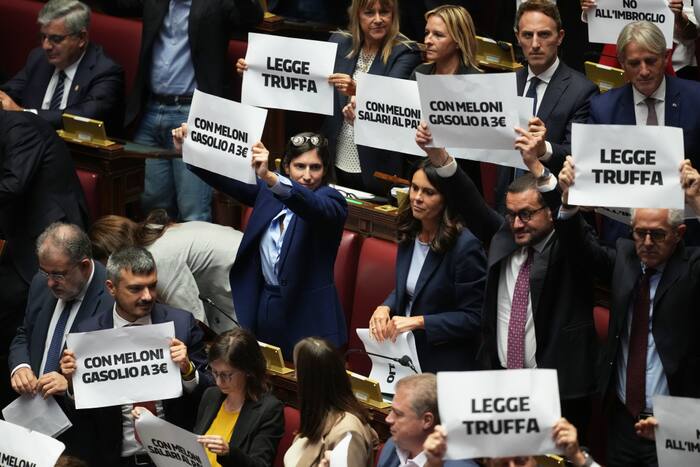
Every political commentator in Europe is currently having a collective meltdown over Rome. Giorgia Meloni has pushed her signature constitutional overhaul—the direct election of the prime minister alongside a rigid parliamentary majority bonus—past its final legislative hurdles. Brussels is clutching its pearls. Liberal pundits are screaming about the ghost of fascism marching back through the Mediterranean. The lazy consensus across mainstream media claims that Italy is sliding headfirst into authoritarianism, swapping checks and balances for unchecked executive brute force.
They are wrong. They are missing the mechanics of Italian stagnation entirely because they prefer the comfort of recycled clichés over structural reality.
For thirty years, Italy did not suffer from an excess of power in the executive branch. It suffered from a chronic, paralyzing vacuum of it. Cabinets collapsed like cheap lawn chairs. Prime ministers lasted an average of eleven months. Major reforms died on the vine while coalition partners held entire governments hostage for minor ministerial portfolios. To call this broken system a democracy is to mistake endless political paralysis for stability. Meloni’s reform does not destroy Italian democracy. It finally gives Italy a functioning one.
Let us look past the screeching headlines and dismantle the bad history underpinning the current panic.
The Myth of the Untouchable Dictator
The core argument from the critics is that binding the prime minister to a direct popular mandate and handing the winning coalition a guaranteed fifty-five percent parliamentary majority creates an elected monarchy. This is a profound misunderstanding of how political power actually operates in modern European states.
An elected monarchy implies a lack of institutional guardrails. Under the new constitutional architecture, the Italian president remains firmly in place with veto powers, the Constitutional Court retains the ultimate authority to strike down unlawful decrees, and ordinary parliamentary oversight does not vanish. What vanishes is the backroom wheeling and dealing that allowed micro-parties with two percent of the vote to blackmail prime ministers into submission.
I have watched political systems across the continent grind to a halt because a minor faction leader threatened to pull the plug over a local zoning dispute. That is not democratic accountability. That is institutional extortion. When governments change hands every ten months, nobody governs. Bureaucrats run the country by default while elected officials spend all their time counting votes and surviving confidence motions.
Meloni’s reform forces transparency. Voters will now know exactly who they are choosing for the top job, and that person will actually possess the mandate required to pass legislation, fix infrastructure, and negotiate with foreign powers without wondering if their own coalition will stab them in the back by Tuesday afternoon.
Why Proportional Purity is a Trap
The sentimental attachment to hyper-proportional representation is the disease eating away at modern European governance. The theory sounds lovely on a freshman political science syllabus: every fringe view gets a seat at the table, every minor constituency finds a voice, and consensus reigns supreme.
In practice, hyper-proportionality produces weak, trembling governments that cannot make a hard decision to save their lives. It creates a political class addicted to compromise where no one is ever responsible for failure because responsibility is pulverized across ten different coalition partners. When everything is negotiable, nothing gets done.
Italy spent decades trapped in this cycle. The political parties lost all connection to actual governing competence because they spent their entire energy on parliamentary arithmetic. The voters felt disenfranchised because no matter who they voted for, the same unelected power brokers stitched together the same dysfunctional majorities behind closed doors.
By tying executive survival directly to an explicit electoral outcome, the new framework shifts power back to the voters. If the prime minister fails, the voters know precisely who to punish at the next ballot box. That is accountability. The old system was designed to ensure that no one was ever truly responsible for anything.
The Real Danger No One Wants to Discuss
Every contrarian take requires an honest admission of its own blind spots. Let us be entirely clear about the risks here, because dismissing valid concerns makes for bad analysis.
The danger of a powerful executive is not that it enables fascism; it is that it concentrates incompetence just as easily as it concentrates competence. If a future prime minister elected under this system proves economically illiterate or politically reckless, there is no longer a clumsy coalition safety valve to stop them from ramming bad legislation through a guaranteed majority.
When you build a fast car, you need better brakes. By streamlining the legislative path and strengthening the executive, Italy is putting more horsepower under the hood. If the driver lacks skill, the crash will happen much faster than it did under the old sluggish regime. That is the legitimate trade-off. The mistake of the opposition is pretending that the old slow-motion train wreck was somehow safer than a vehicle moving with purpose.
The Structural Realignment of Southern Europe
What Brussels and the commentariat fundamentally fail to grasp is that Italy is pioneering a new template for governance in an age of permanent crisis. The old post-World War Two consensus, designed to prevent strongmen at all costs, is entirely unfit for a world defined by artificial intelligence shifts, migration pressures, economic volatility, and geopolitical fragmentation.
You cannot navigate twenty-first-century shocks with a government that takes six months just to agree on a budget. Speed, coherence, and direct accountability are the prerequisites of national survival in the current global climate.
Meloni understands this, even if her critics are too busy hyperventilating over historical phantoms to notice. She has outmaneuvered a fractured opposition not by subverting democratic norms, but by exploiting the glaring flaws of a system that everyone privately admitted was broken.
Italy is shedding its reputation as the sick man of European politics—not despite this electoral overhaul, but because of it. The whining from the old guard will fade the moment the first government actually finishes a five-year term and delivers a coherent policy agenda.
Stop mourning the death of parliamentary paralysis. It was never a virtue. It was a disease.