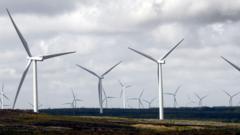
ScottishPower’s £1.5 billion investment plan for the Whitelee Windfarm marks a critical pivot in utility-scale renewable energy infrastructure: replacing 215 first-generation wind turbines with 124 larger models to double generating capacity from 539 MW to 1 GW on the exact same site.
This strategy illustrates the physics and project economics driving onshore wind repowering across Western Europe. As early-2000s turbine fleets reach their 20-to-25-year operational end-of-life, energy developers face a stark operational choice: extend asset lifespans at diminishing efficiency or clear existing sites to install modern megawatt-scale hardware.
The Physics of Repowering: Rotor Swept Area and Aerodynamic Efficiency
The decision to decrease turbine count while doubling output is dictated by fluid dynamics and structural engineering. Energy extraction from wind is governed by the power equation:
$$P = \frac{1}{2} \rho A v^3 C_p$$
Where $\rho$ is air density, $A$ is the rotor swept area, $v$ is wind velocity, and $C_p$ is the power coefficient of the turbine.
First-generation turbines installed at Whitelee in 2008 stood between 110 and 140 meters at blade tip height, generating roughly 2.3 MW to 2.5 MW per unit. Modern replacements reach tip heights exceeding 240 meters with capacities between 6 MW and 8 MW per turbine.
+--------------------------------------------------------------------+
|                      GENERATION COMPARISON                         |
+--------------------------+--------------------+--------------------+
| Metric                   | First-Gen Fleet    | Repowered Fleet    |
+--------------------------+--------------------+--------------------+
| Turbine Count            | 215                | 124                |
| Nameplate Capacity       | 539 MW             | ~1,000 MW (1 GW)   |
| Tip Height               | 110 m – 140 m      | 240 m+             |
| Capacity Factor (Est.)   | 25% – 30%          | 40% – 45%          |
| Est. Capital Expenditure | Initial build      | £1.5 billion       |
+--------------------------+--------------------+--------------------+
Two physical factors explain why 124 units outgenerate 215 units:
- Swept Area Growth: Swept area increases quadratically with blade length ($A = \pi r^2$). Doubling the rotor radius quadruples the swept area, allowing a single modern rotor to intercept significantly more kinetic energy than multiple smaller rotors combined.
- Boundary Layer Wind Velocity: Wind speeds increase with altitude due to reduced ground friction. Raising the hub height from 80 meters to over 140 meters positions the blades in faster, smoother airflow, driving an exponential increase in power generation due to the cubic velocity factor ($v^3$).
Lower turbine counts also mitigate aerodynamic wake losses. When wind passes through a turbine rotor, it creates a turbulent, lower-velocity wake downstream. Spacing fewer, larger turbines further apart minimizes wake interference across the array, raising overall plant efficiency and operational lifespan.
Capital Efficiency and Grid Constraint Realities
Developing greenfield onshore wind sites in the UK faces substantial non-technical barriers: planning consent delays, grid connection queues, and local environmental opposition. Repowering circumvents these bottlenecks by exploiting existing infrastructure assets.
Infrastructure Reuse and Capital Allocation
Repowering projects capitalize on established capital investments:
- Grid Infrastructure: The primary bottleneck for UK renewable expansion is National Grid connection capacity. Repowered sites retain existing high-voltage substation connections, eliminating multi-year waiting lists for new grid access.
- Civil Engineering and Access: Site access roads, civil foundations, and civil routing are already surveyed and established, lower risk profiles during phase-one groundworks.
- Wind Resource Certainty: Decades of historical wind velocity data collected on-site reduce financial forecasting risk compared to greenfield estimates.
However, modern 240-meter turbines cannot simply be bolted onto old foundations. The larger dynamic loads, increased overturning moments, and higher blade weights demand complete foundation removal and replacement. Upgraded underground cabling is also required to handle the increased current density from 8 MW machines.
The Curtailment Problem and Battery Storage Integration
Doubling Whitelee's capacity to 1 GW intensifies the need for energy storage. Scotland regularly experiences localized power grid congestion, leading to constraint payments where wind operators are paid to turn off turbines when transmission lines to southern demand centers reach capacity.
To mitigate transmission bottlenecks, modern repowering projects co-locate large-scale Battery Energy Storage Systems (BESS). Whitelee already operates a 50 MW BESS asset. Incorporating utility-scale storage enables energy arbitrage: storing excess generation during peak wind, low-demand periods and discharging into the National Energy System Operator (NESO) grid during peak demand windows, bypassing transmission curtailment losses.
The Phased Transition Model
Replacing an operational 539 MW asset requires strategic phased execution to preserve cash flow and avoid grid instability. ScottishPower's planned 2030–2035 rollout relies on a sectional repowering protocol.
Execution Phases
- Decommissioning and Recyclability: Older turbines are dismantled in planned geographic sections. Steel towers and copper wiring are fully recyclable, while composite fiber blades are routed to industrial recycling or cement kiln co-processing.
- Foundation Re-engineering: Existing concrete bases are excavated or crushed in situ to serve as aggregate for upgraded civil works capable of supporting 240-meter structural loads.
- Sequential Installation: New turbines are erected and energized section by section. This maintains baseline power export, generating continuous operational revenue to offset capital expenditure throughout the construction window.
Strategic Outlook for National Onshore Assets
Over 9 GW of the UK's current 14 GW onshore wind fleet will reach end-of-life status by 2040. The Whitelee repowering framework establishes a precedent for managing this transition.
If older assets are simply decommissioned without replacement, national net-zero targets face a structural capacity deficit. Repowering existing sites provides the highest generation yield per square kilometer of land while utilizing pre-approved transmission corridors.
Utilities must now structure capital allocation around asset life extensions versus full structural repowering. Operators that secure early planning variations for increased hub heights and co-located battery storage will capture superior long-term yields while minimizing land acquisition and grid-interconnection friction.