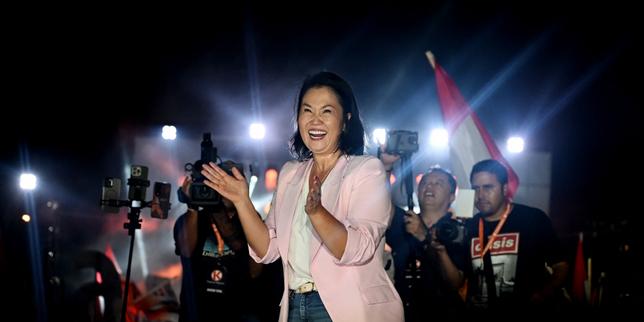
The 2026 Peruvian presidential election represents not a sudden ideological shift, but the mathematical optimization of political attrition. Keiko Fujimori’s narrow runoff victory over Roberto Sánchez—secured by a margin of less than one percent—establishes a definitive case study in institutional persistence. While superficial commentaries treat her ascension from first lady to president as a dramatic personal arc, a rigorous structural analysis reveals it as the execution of a multi-decade strategy designed to capitalize on the systemic collapse of Peru's legislative and executive framework.
To understand this victory, one must analyze the structural mechanics that converted high negative poll ratings into an irreversible electoral floor. Fujimori did not win by expanding her core appeal; she won by outlasting the institutional capacity of her opponents within a highly fragmented political market.
The Three Pillars of Dynastic Continuity
The survival and ultimate triumph of Fujimorismo as a political enterprise relies on three distinct operational assets developed since the 1990s.
Labeled Brand Equity and Name Recognition
In a country where traditional political parties have entirely dissolved, name recognition serves as a low-cost informational shortcut for voters. The Fujimori brand operates on a bifurcated legacy. For a segment of the electorate, the name represents the stabilization of hyperinflation and the neutralization of the Shining Path insurgency during the 1990 regime of Alberto Fujimori. By consistently anchoring her platform to this historical reference point, Keiko Fujimori maintained a disciplined, predictable voter base that hovered between 11% and 17% in the first round of the last four electoral cycles. In a field crowded with 35 presidential candidates, this structural floor guarantees entry into the runoff.
The First-Lady Asset and Informal Networks
Fujimori's tenure as first lady from 1994 to 2000 provided early, unmediated access to state patronage networks and regional power brokers. Unlike cabinet ministers whose influence is bounded by portfolio limits, the role of the first lady in Latin American presidential systems allows for the cultivation of deep-rooted loyalties through social fund distribution and direct civic engagement. This infrastructure was later institutionalized through the formation of the Popular Force (Fuerza Popular) party, transforming a highly personalized asset into a permanent legislative machine.
The Constitutional Legacy of 1993
The market-oriented economic architecture established by the 1993 Constitution—written under her father's administration—serves as the ideological and financial anchor for her coalition. This document guarantees explicit protections for private investment and enforces strict macroeconomic disciplines, securing the unyielding support of Lima’s corporate elite, the financial sector, and extractive industries. The defense of this constitution creates an automatic alignment between Popular Force and the country's economic establishment whenever a left-wing challenger threatens structural redistribution.
The Cost Function of Institutional Friction
A common analytical error is viewing Peru's extreme executive instability—characterized by eight presidents and 21 prime ministers over the last decade—as an obstacle to Fujimori's ambitions. In reality, her party was a primary engineer of this volatility, utilizing its legislative leverage to drive a deliberate strategy of institutional friction.
The strategy operated via a sequence of targeted legislative maneuvers:
- Executive Castration: Following her narrow loss in 2016, Fujimori deployed her 73-seat congressional majority to systematically obstruct the administration of Pedro Pablo Kuczynski. Popular Force weaponized the constitutional mechanism of vacancia (impeachment on grounds of "moral incapacity"), establishing a precedent that lowered the threshold for removing sitting executives.
- Regulatory Rollbacks: Once executive resistance was neutralized, the legislative majority systematically dismantled key structural reforms. Notable targets included the reversal of rigorous public education standards, the defunding of independent university regulators, and the relaxation of environmental oversight on informal mining.
- The Stability Monopoly: By creating a baseline of continuous governance failure—where the average cabinet minister's tenure dropped to weeks—Popular Force generated a profound public demand for "order." When crime and citizen insecurity spiked in 2025 and 2026, Fujimori positioned her movement as the sole entity capable of delivering state authority, successfully selling a solution to a crisis her own strategy helped exacerbate.
This cyclical friction carries a severe institutional price. The systematic weakening of the executive branch transferred disproportionate power to a fragmented Congress, regional illegal syndicates, and extraction cartels. The executive office Fujimori inherits in 2026 is structurally weaker than the one she sought to capture in 2011.
The Electoral Mathematics of Anti-Fujimorismo
The defining characteristic of modern Peruvian politics is the cleavage between Fujimorismo and Anti-Fujimorismo. Fujimori’s path to the presidency required a sophisticated optimization of this polarization, engineered through a rhetorical strategy known locally as terruqueo (the systematic labeling of left-wing or reformist opponents as terrorist sympathizers).
The operational execution of this strategy follows a precise sequence during the runoff phase:
[First Round: Capture ~15% Floor]
               │
               ▼
[Identify Left-Wing Runoff Opponent]
               │
               ▼
[Deploy Terruqueo / Anti-Communist Narrative]
               │
               ▼
[Trigger Urban / Corporate Risk Aversion]
               │
               ▼
[Consolidate 50.1% Negative Coalition]
This polarization explains why the runoff elections of 2011, 2016, 2021, and 2026 were all decided by fractions of a percentage point. In 2026, Roberto Sánchez captured the rural, structurally neglected southern highlands by questioning the equity of the extractive economic model. Fujimori countered by consolidating the urban center of Lima and corporate interests, framing the choice not as a policy debate, but as an existential defense of the republic against economic collapse. The final tally shows that her victory was not a mandate for her specific platform, but an expression of risk aversion by the urban middle class.
The Technocratic Blueprint and Structural Traps
The incoming administration has signaled an immediate return to orthodox economic management, appointing veteran technocrats like former Economy Minister Luis Carranza to reassure international markets. The stated policy objective centers on unblocking multi-billion-dollar copper and gold mining projects currently stalled by bureaucratic friction and localized social conflict.
The primary mechanism for growth relies on two initiatives:
- Regulatory Simplification: The administration intends to pass sweeping packages aimed at slashing compliance costs for small and medium enterprises. The goal is to incentivize Peru’s massive informal sector—which accounts for over 70% of the labor force—to formalize, thereby broadening the tax base.
- Militarized Public Security: Deploying the armed forces alongside national police to high-crime urban centers and illegal mining corridors. This strategy directly mirrors the 1990s security framework, trading civil liberty protections for immediate drops in visible extortion and street crime.
This blueprint contains a profound operational limitation. The strategy assumes that capital investment can be unlocked purely through regulatory decrees and police deployments. However, the true bottleneck is the total erosion of state legitimacy in the interior provinces. Having spent a decade weakening the administrative capacity of the executive branch, the new government lacks the bureaucratic infrastructure required to negotiate durable social pacts with indigenous communities and regional fronts. Forceful state intervention in these zones risks triggering severe social unrest, which would instantly neutralize the security premiums promised to foreign investors.
The administration faces an immediate structural trap. To maintain the legislative coalition required to govern without threat of impeachment, Fujimori must constantly negotiate with highly transactional, fragmented congressional blocs. These blocs routinely demand local patronage, protection for informal industries, and the dilution of anti-corruption measures as the price for their votes. Consequently, the presidency must choose between satisfying the technocratic demands of the global market or feeding the transactional demands of the domestic legislative machine that brought it to power.
Insights on the Return of the Fujimori Dynasty offers an essential field perspective from regional journalists, illustrating the deep polarization and governance hurdles confronting the incoming administration.