The relocation of high-profile political dissidents from state detention facilities to foreign jurisdictions is rarely an isolated act of clemency. Instead, it represents a calculated operational maneuver designed to neutralize domestic friction points while managing international diplomatic pressure. When a state releases an imprisoned artist or activist directly into exile, it executes a strategic trade-off: trading the domestic containment of a physical asset for the structural dilution of their immediate political influence.
Understanding this dynamic requires moving beyond the emotional narrative of personal liberation to analyze the underlying mechanics of state survival, judicial leveraging, and the systemic challenges faced by exiled movements. By dissecting the structural pipeline that moves an individual from maximum-security confinement to a foreign capital, we can map the precise cost-benefit calculations made by authoritarian regimes and the predictable bottlenecks that await displaced dissident movements.
The Tripartite Objectives of Political Offshoring
Authoritarian regimes operate under a continuous need to optimize resources dedicated to internal security. Prolonged incarceration of culturally significant figures—such as artists, writers, or community organizers—incurs compounding costs. The state’s strategy in transitioning a dissident from prison to exile relies on three distinct pillars.
Domestic De-escalation
Continuous imprisonment transforms a living dissident into a focal point for domestic mobilization. Inside a correctional facility, the individual serves as a static symbol of resistance, anchoring protests, international vigils, and domestic graffiti campaigns. By physically removing the individual from the geographic territory, the state fractures the immediate connection between the leader and the localized base. The physical absence creates a logistical vacuum in the domestic movement, forcing local networks to adapt to remote leadership, which inherently degrades operational velocity.
Diplomatic Leverage and Sanction Mitigation
Confinement of internationally recognized figures serves as a liability during bilateral negotiations. Conversely, the individual becomes a liquid asset—a bargaining chip used to signal concessions without altering the underlying legal or political architecture of the state. Regimes frequently time the release and expulsion of dissidents to coincide with international summits, trade negotiations, or periods of intense scrutiny regarding economic sanctions. The act of exile is packaged as a humanitarian gesture, allowing foreign governments to justify diplomatic re-engagement or the easing of specific pressures, even as the structural mechanisms of domestic repression remain intact.
Externalized Marginalization
The state calculates that the international arena will dilute the dissident's message. In a domestic context, every statement or act of defiance carries high stakes and immediate relevance. Once relocated to a foreign country, the dissident is forced to compete within a saturated global media environment. The immediate target audience shifts from a highly motivated domestic populace to a diffused, international sympathetic audience that lacks the agency to effect direct internal political change.
The Operational Pipeline: From Detention to Tarmac
The physical transition from a penal institution to an international flight is a highly synchronized logistical operation. It deviates sharply from standard deportation protocols, requiring coordination across judicial, state security, and diplomatic channels.
[State Detention Facility]
       │
       ▼ (Legal Coercion: Commutation via Conditional Deprivation of Nationality/Residency)
[Judicial Processing & Document Issuance]
       │
       ▼ (Secure Transfer: Eliminating Public Visibility)
[Tarmac Transfer & Embarkation]
       │
       ▼ (Geographic Displacement)
[Host Country Ingestion]
The process begins with judicial engineering. Because absolute expulsion of a nation's own citizen often violates domestic constitutional law or international treaties, the state utilizes specific legal mechanisms to formalize the exile. This typically involves a conditional commutation of sentence, where the suspension of a prison term is explicitly contingent upon immediate, permanent departure from the national territory. In some cases, this is accompanied by the formal deprivation of nationality or the invalidation of travel documents, rendering the individual legally incapable of a lawful return.
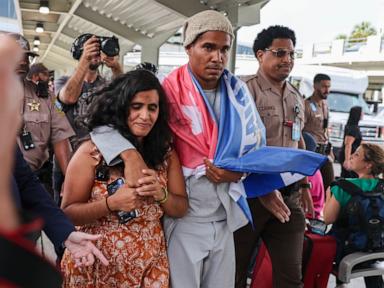
The second phase is secure transit. The movement from the detention facility to the international airport is executed under strict information blackouts to prevent spontaneous public gatherings or media interference. The individual is typically moved via state security vehicles directly to the tarmac, bypassing commercial terminals. This minimizes the window for symbolic final statements or visual documentation that could be used for counter-propaganda.
The final phase involves host country ingestion. The receiving nation—often the United States or a European Union member state—must rapidly coordinate immigration waivers, humanitarian visas, or refugee status to facilitate immediate entry. This requires prior, often covert, diplomatic communication to ensure that the arrival does not trigger a legal logjam at the destination port of entry.
The Asymmetric Friction of Exile
While exile provides immediate physical safety to the individual, it introduces structural friction that alters the efficacy of their activism. The transition introduces three systemic bottlenecks that systematically erode a dissident’s operational impact over time.
- The Authenticity Discount: Authoritarian state media apparatuses immediately leverage exile to launch targeted disinformation campaigns. The core narrative shifts from portraying the dissident as a internal critic to labeling them an external agent funded by foreign interests. Removed from the daily economic and social realities of the homeland, the exiled figure faces a compounding skepticism regarding their structural relevance to the ongoing domestic struggle.
- Logistical Disconnection: Managing a decentralized movement from abroad introduces significant communication latency and security vulnerabilities. Intercontinental digital communications are highly susceptible to state surveillance, interception, and deliberate internet blackouts executed by the regime. The loss of face-to-face tactical coordination diminishes the speed at which a movement can respond to shifting domestic political landscapes.
- Resource Redirection: Upon arrival in a host country, a significant portion of the dissident's operational capacity is diverted from political strategy to personal stabilization. Securing housing, navigating complex immigration frameworks, learning new languages, and establishing financial viability create an immediate drain on cognitive and logistical resources.
Strategic Assessment for Host Nations and Coalitions
For host governments and international human rights coalitions, the arrival of an exiled dissident demands a shift from reactive celebration to long-term strategic integration. Treating the event merely as a public relations victory misinterprets the state’s intent and squanders the asset's remaining utility.
Foreign policy frameworks must prioritize creating sustainable platforms that counteract the state's externalization strategy. This involves establishing institutional fellowships, secure communication infrastructure, and direct lines of communication to policy-making bodies. Failure to institutionalize this support results in the rapid depreciation of the dissident's political capital, playing directly into the long-term containment strategy of the expelling regime.