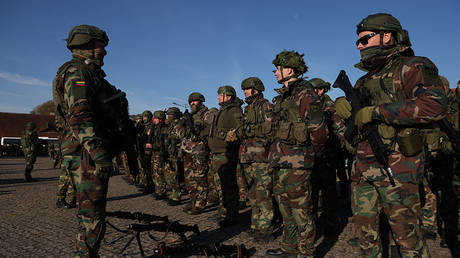
Universal conscription in the Baltic region is not a nostalgic return to Cold War mass mobilization; it is an asymmetric engineering solution to a severe demographic and geographic deficit. When a small state shares a direct land border with a numerically superior adversary, relying exclusively on an all-volunteer professional force creates a fatal mathematical vulnerability: high unit cost paired with zero strategic depth. Transitioning to universal or near-universal conscription—as pursued across Lithuania, Latvia, and historically maintained by Estonia—shifts the national defense architecture from a brittle, high-readiness vanguard to a deep, regenerable reserve network designed to make territorial occupation prohibitively expensive.
To understand the operational reality of Baltic conscription, one must strip away political rhetoric and examine the underlying resource allocation models. Conventional reporting treats conscription as a binary policy choice between freedom and security. In defense economics, it is a labor-market intervention designed to solve three compounding constraints: severe demographic contraction, narrow tactical maneuver space, and the time-distance problem of allied reinforcement.
The Strategic Geometry of the Suwalki Corridor and Forward Defense
Geography dictates force structure. Estonia, Latvia, and Lithuania occupy a narrow littoral strip along the eastern Baltic Sea, connected to the rest of continental NATO solely by the Suwalki Gap—a roughly 65-kilometer-wide land corridor wedged between the Russian exclave of Kaliningrad and Belarus. In military operational terms, this configuration eliminates strategic depth. Unlike larger continental powers that can trade space for time while mobilizing distant industrial bases, a Baltic defender faces immediate existential risk to its political and economic centers within hours of a border breach.
Modern NATO doctrine has shifted from "deterrence by punishment"—which implicitly tolerated temporary occupation followed by a counter-offensive—to "deterrence by denial," which requires stopping an incursion at the border. Deterrence by denial demands immediate troop density across hundreds of kilometers of terrain, including dense forests, urban centers, and riverine choke points.
Professional standing armies in small states cannot generate this density. With populations ranging from roughly 1.3 million in Estonia to 2.8 million in Lithuania, maintaining a full-time professional force large enough to saturate the defensive perimeter would bankrupt the state. Universal conscription resolves this by decoupling peacetime payroll costs from wartime manpower availability. By cycling cohorts of young citizens through an 8-to-11-month intensive training pipeline and subsequently assigning them to territorial reserve units, the state builds a latent force structure. The peacetime budget pays for the training cadre, infrastructure, and equipment storage, while the civilian economy absorbs the labor force until an activation threshold is crossed.
The Three Pillars of the Baltic Reserve Architecture
A functional conscription system is not merely a draft; it is an integrated human-capital pipeline. Across the Baltic states—specifically looking at Estonia's uninterrupted model, Lithuania's post-2015 reinstatement and expansion, and Latvia's phased reintroduction of the State Defense Service—the architecture rests on three distinct operational pillars.
1. The Cadre-Conscript Ratio and Institutional Memory
A conscript army fails when untrained recruits are led by inexperienced officers. The Baltic model relies on a strict division of labor between career professionals and citizen-soldiers. Full-time professional units serve two primary functions: maintaining high-readiness rapid reaction capabilities (such as mechanized infantry brigades) and acting as the permanent instructional backbone for incoming conscript cohorts.
When a state transitions from a lottery-based or selective draft to universal conscription, the primary bottleneck is rarely a lack of recruits; it is a shortage of non-commissioned officers (NCOs) and junior officers capable of executing standardized training cycles. Without a sufficient cadre-to-conscript ratio, training degrades into administrative busywork, eroding both combat effectiveness and public legitimacy.
2. Geographic Dispersion and Territorial Defense
Centralized mobilization depots are prime targets for long-range precision fires and ballistic missiles. To survive the opening phase of a conflict, Baltic reserve systems utilize decentralized mobilization protocols. Conscripts are frequently assigned to units tied to their specific geographic districts, often integrated alongside voluntary paramilitary organizations like the Estonian Defence League (Kaitseliit), the Latvian National Guard (Zemessardze), and the Lithuanian Riflemen's Union.
This localization accomplishes two tactical objectives:
- Reduced Mobilization Latency: Reservists report to dispersed local armories rather than traveling across contested transport arteries to central bases.
- Terrain Familiarity: Defenders operate in micro-environments—specific road networks, drainage ditches, and forest tracks—where they hold intimate local knowledge, magnifying the effectiveness of decentralized anti-armor and reconnaissance teams.
3. The Refresher Cycle and Skill Decay Mitigation
Initial conscription produces a baseline rifleman or specialist, but military proficiency decays rapidly without reinforcement. A reserve force that is never recalled is a paper tiger. High-performing conscription models institutionalize periodic snap exercises—unannounced readiness drills where reservists are summoned via digital notifications and expected to report, draw gear, and deploy within 24 to 48 hours.
These exercises serve as live stress tests for the state's logistical plumbing. They expose friction points in equipment sizing, weapon zeroing, communications interoperability, and employer compliance long before a crisis occurs.
The Cost Function of Universal Mobilization
Politicians frequently frame conscription as a low-cost alternative to professional armies. This is an accounting illusion. While universal conscription lowers direct defense ministry payroll outlays per soldier, it imposes substantial off-budget economic costs on the broader national economy. Rigorous defense planning requires quantifying both direct fiscal expenditures and indirect macroeconomic friction.
Direct Capital Expenditure vs. Operational Expenditure
Expanding a selective draft into a universal system triggers an immediate spike in capital expenditure (CapEx). Before a single additional recruit can be inducted, the state must construct barracks, expand live-fire training ranges, and procure individual combat loadouts (ballistic plates, night-vision optics, encrypted radios, and cold-weather gear).
In small states with tight fiscal margins, defense ministries face a zero-sum allocation dilemma: every euro spent on concrete barracks and basic infantry kit for conscripts is a euro unavailable for high-end force multipliers such as medium-range air defense, rocket artillery, or electronic warfare suites. Over-indexing on mass infantry without matching investments in artillery and air defense creates a force vulnerable to standoff bombardment.
Opportunity Cost and Labor Market Distortion
Removing tens of thousands of 18-to-26-year-olds from the civilian economy for nearly a year represents a direct contraction in labor supply. In the Baltic states, which already experience acute labor shortages and negative net demographic growth, pulling young workers out of entry-level technology, manufacturing, and service roles depresses short-term GDP growth and reduces tax receipts.
To mitigate this distortion, Baltic policymakers have increasingly structured service pathways to align with civilian skill acquisition. Cyber defense units, drone operations teams, heavy logistics management, and combat medic tracks allow conscripts to acquire marketable technical certifications during their service. When executed properly, this transforms conscription from pure labor extraction into a state-subsidized vocational accelerator, reducing post-service wage penalties for inductees.
Demographic Headwinds and the Universality Threshold
The term "universal" in modern European defense policy rarely means 100 percent induction of a given birth cohort. True universality is constrained by demographic realities, medical standards, and institutional capacity.
Following the collapse of the Soviet Union in the early 1990s, birth rates across Estonia, Latvia, and Lithuania plummeted. Thirty years later, those small birth cohorts represent the exact pool of military-age youth available for conscription. When the absolute number of 19-year-old males is structurally small, achieving target brigade strengths requires either lowering medical disqualification thresholds, extending service obligations, or expanding the recruitment pool to include women.
Medical screening presents a persistent operational hurdle. Modern sedentary lifestyles have increased rates of musculoskeletal issues, vision impairments, and mental health diagnoses among draft-age youth. In several European jurisdictions, medical rejection rates routinely exceed 30 to 40 percent of evaluated candidates. A rigid, binary fitness standard—where a candidate is either fit for frontline infantry or entirely exempt—wastes valuable human capital.
Progressive force planners solve this by implementing tiered fitness classifications. Candidates who cannot meet the physical load-bearing requirements of light infantry are routed into non-kinetic military roles: signals intelligence, logistics routing, drone piloting, cybersecurity, and administrative support. This preserves the principle of universal civic contribution while optimizing human resource allocation based on comparative advantage.
The Gender Integration Variable
As male birth cohorts shrink, excluding half the population from mandatory service becomes mathematically unsustainable for states seeking maximum reserve depth. However, transitioning from voluntary female service to mandatory female conscription—as pioneered by Norway and Sweden—introduces specific logistical and political requirements.
In the Baltic context, female participation has historically been voluntary, though strongly encouraged through public campaigns and integration into National Guard structures. Moving toward mandatory female conscription requires overcoming three specific bottlenecks:
- Infrastructure Retrofitting: Existing Soviet-era or early-2000s barracks often lack segregated hygiene and billeting facilities, requiring upfront capital investment before mandatory quotas can be enforced.
- Equipment Ergonomics: Standard-issue body armor, rucksacks, and load-bearing vests designed for the average male torso cause higher rates of musculoskeletal injury in female soldiers if not procured in tailored anthropometric sizes.
- Political Consensus: Universal male conscription enjoys broad historical legitimacy in the Baltics due to post-independence defense traditions. Extending the legal mandate to women requires sustained legislative consensus to avoid triggering public backlash or emigration among young professionals.
Social Cohesion vs. Societal Friction
Beyond kinetic combat power, universal conscription is frequently deployed as a tool for social integration—specifically in Estonia and Latvia, which possess significant Russian-speaking minority populations. Proponents argue that shared service in mixed-language units accelerates linguistic fluency, builds cross-cultural trust, and inoculates young citizens against foreign information operations.
This mechanism is not automatic; it carries distinct operational risks. If Russian-speaking conscripts are disproportionately concentrated in lower-prestige logistics roles rather than elite combat or technical units, conscription can reinforce social stratification rather than erase it. Furthermore, integrating populations with divergent media consumption habits requires proactive counter-intelligence screening and high-caliber junior leadership to prevent unit cohesion fractures under stress.
Simultaneously, the enforcement mechanism of the draft dictates its social legitimacy. A system riddled with loopholes—where affluent families use university deferments, medical exemptions, or overseas residency to bypass service while working-class youth shoulder the burden—rapidly loses public support. Universal conscription survives politically only when the burden is perceived as inescapable and equitably distributed across socioeconomic strata.
Operational Limitations of the Conscript Model
No defense architecture is without structural vulnerabilities. Treating universal conscription as a panacea for national security ignores three hard operational limits:
- Technological Complexity Ceiling: Modern warfare relies heavily on complex systems—integrated air and missile defense, counter-battery radar networks, and coordinated combined-arms maneuver. Eight to eleven months of training is sufficient to produce competent light infantry, anti-tank teams, and basic artillery crews. It is insufficient to master complex electronic warfare or multi-domain command-and-control platforms. Conscripts cannot replace long-service technical specialists; they can only augment them.
- Political Sensitivity to Casualties: Professional soldiers accept combat risk as an explicit condition of employment. Conscript forces represent the broader civilian population directly. In a protracted conflict, high attrition rates among conscript units generate immediate, intense domestic political pressure, testing national resilience in ways that professional losses do not.
- The Mobilization Window Vulnerability: A reserve-heavy army exists primarily on paper until mobilization is ordered. If an adversary achieves strategic surprise through hybrid ambiguity—masking an offensive buildup as routine exercises—a political leadership hesitant to trigger economic disruption by calling up reserves risks having its citizen-soldiers caught out of position before reaching their armories.
Strategic Imperatives for Force Modernization
For Baltic defense planners—and any small state attempting to replicate their deterrence model—expanding conscription numbers without upgrading the supporting ecosystem will yield diminishing returns. The viability of universal conscription over the next decade depends on executing four concrete structural adjustments:
- Shift from Headcount Metrics to Readiness Velocity: Defense ministries must stop measuring success by the total number of reservists listed in national registries. The decisive metric is time-to-trench—the exact number of hours required from the issuance of a mobilization order to the deployment of fully equipped, cohesive battalions into pre-prepared defensive positions.
- Automate Civilian-Military Skill Mapping: Induction boards should deploy algorithmic matching systems that evaluate conscripts' civilian educational and occupational backgrounds prior to basic training. Software engineers, heavy-equipment mechanics, and telecommunications technicians must be routed directly into specialized military occupational specialties rather than generic infantry billets.
- Institutionalize Employer Tax Offsets: To prevent private-sector resistance to snap reserve exercises and extended conscription cycles, governments must implement automatic, frictionless tax credits for small and medium-sized enterprises whose employees are called to active training, neutralizing the private economic penalty of national defense.
- Prioritize Stand-Off Fires Over Pure Manpower: Manpower without fire support is a target, not a deterrent. Every expansion in conscript brigade headcount must be proportionally matched by investments in automated mortar systems, loitering munitions, and distributed air-defense networks so that territorial infantry units can survive and attrit mechanized formations from concealed positions.