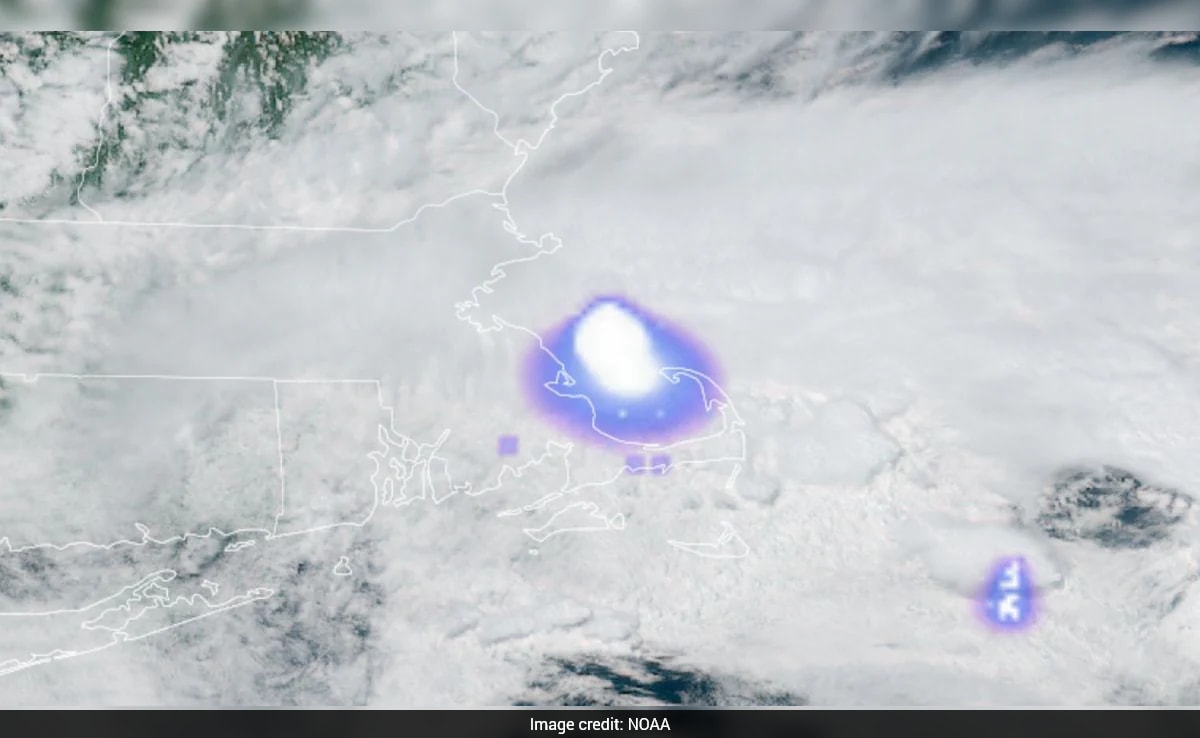
A bolide detonation yielding an energy release equivalent to 300 tonnes of TNT represents a highly compressed kinetic event that tests the limits of localized atmospheric dissipation. When NASA’s Meteoroid Environment Office confirmed these parameters for the recent fireball over the United States, public reporting defaulted to sensationalism. In contrast, an orbital debris and planetary defense analysis requires breaking this event down into its component vectors: mass-velocity ratios, atmospheric drag coefficients, and the efficiency of kinetic-to-thermal energy conversion.
Understanding these high-altitude detonations requires looking past the visual flash to analyze the structural failure of celestial bodies entering Earth's atmosphere. The event was not an explosion in the chemical sense, but rather a hypervelocity fragmentation event governed by fluid dynamics and mechanical stress.
The Kinetic Energy Equation and Atmospheric Deceleration
The destructive potential of an entering meteoroid is dictated by its initial kinetic energy, expressed fundamentally as:
$$E_k = \frac{1}{2}mv^2$$
While mass ($m$) scales linearly, velocity ($v$) scales quadratically. Typical entry velocities for meteors of asteroidal origin range from 11 to 72 kilometers per second. When an object traveling at 20 kilometers per second encounters the increasingly dense layers of the upper mesosphere, it experiences a monumental build-up of aerodynamic drag.
This resistance generates a stagnation pressure on the leading face of the meteoroid. The structural integrity of the object determines what happens next.
The Mechanical Failure Threshold
Most smaller bolides are not solid iron-nickel monoliths; they are chondritic "rubble piles" held together by weak mechanical bonds.
- Aerodynamic Drag Pressure: As the object descends, the pressure on its front face exceeds the internal tensile strength of the rock.
- Thermal Shock: The extreme compression of air ahead of the meteoroid generates temperatures scaling past 1,500 degrees Celsius, causing rapid, uneven thermal expansion.
- Runaway Fragmentation: Once the initial fracture occurs, the surface area exposed to the atmospheric airflow multiplies exponentially within milliseconds.
This exponential increase in surface area leads to an instantaneous dumping of the object's remaining kinetic energy into the surrounding atmosphere. This is the exact point of the "explosion" confirmed by satellite data. The 300-tonne TNT equivalence represents the total integrated energy released during this catastrophic disruption phase, rather than a steady burn.
Quantifying the Yield: Sensors and Infrasound Metrics
Measuring an airburst of this scale cannot rely on local eyewitness accounts. Planetary defense networks utilize a dual-method verification framework to calculate energy yields: satellite photometers and ground-based infrasound arrays.
Optical Light Curve Analysis
Government satellites equipped with specialized optical sensors detect the intense flash of the fragmentation event. By integrating the total light output over the duration of the flash—a process known as calculating the light curve—analysts determine the total luminous energy. This value is then converted to total kinetic energy using an empirical luminous efficiency factor, which typically hovers between 0.1% and 1% depending on entry velocity and material composition.
Infrasound Wave Propagation
The sudden displacement of air during the fragmentation generates low-frequency acoustic waves below the threshold of human hearing (less than 20 Hz). These infrasound waves travel vast distances through the atmosphere with minimal attenuation. By measuring the amplitude and period of these waves at multiple global monitoring stations, seismologists calculate the acoustic energy of the blast. The 300-tonne yield metric is verified when the optical and acoustic data converge on the same energy value.
Planetary Defense Risk Stratification
To put a 300-tonne TNT equivalent event into perspective, it must be mapped against the broader spectrum of Near-Earth Objects (NEOs). The planetary defense framework categorizes events based on frequency, energy output, and ground-impact potential.
- Micro-Meteoroids (Daily): Metric tons of dust and pebble-sized objects enter the atmosphere daily, burning up completely in the thermosphere with negligible energy footprints.
- Bolides / Small Airbursts (Monthly to Annually): Objects roughly 1 to 5 meters in diameter, like the recent US event, release energies in the hundreds of tonnes of TNT range. They inevitably detonate in the stratosphere (30–50 km altitude), leaving nothing but microscopic dust and rare, slowed meteorites.
- Regional Threat Impacts (Centennial): Objects larger than 20 meters, such as the 2013 Chelyabinsk meteor (which yielded roughly 400–500 kilotons of TNT equivalent), fracture much lower in the atmosphere. The resulting shockwave is capable of shattering glass, collapsing structural walls, and causing widespread indirect injuries.
The recent US fireball fits cleanly into the second category. It represents a routine atmospheric filtering event, demonstrating Earth's natural shielding capability against objects below a critical mass threshold.
Operational Limitations in Detection and Tracking
The fact that this object was detected primarily during its atmospheric entry highlights a persistent capability gap in global space situational awareness. Current asteroid tracking arrays, such as ATLAS and Pan-STARRS, are optimized for larger, potentially hazardous objects (greater than 140 meters in diameter).
Small bolides present severe detection bottlenecks:
The Albedo and Size Constraint
An object capable of generating a 300-tonne airburst is typically only a few meters wide. Reflecting very little sunlight against the backdrop of deep space, its apparent magnitude remains below the detection threshold of ground-based optical telescopes until hours before impact, if it is spotted at all.
Visual Blind Spots
If an object approaches Earth from the direction of the sun, ground-based optical telescopes are completely blinded by solar glare. Space-based infrared survey platforms, such as the upcoming Near-Earth Object Surveyor mission, are required to mitigate this specific vulnerability by scanning the orbital plane from a thermal vantage point.
Strategic Trajectory for Sensor Deployment
The analysis of the recent US bolide underscores the need for a shift from passive observation to automated, real-time atmospheric characterization. To optimize planetary defense infrastructure and eliminate blind spots for objects in the 1-to-10-meter regime, regional defense networks must execute a multi-layered sensor optimization strategy.
First, ground-based infrasound networks must be densified near high-population density corridors to reduce the localization error ellipse of stratospheric airbursts down to less than 5 kilometers. Second, weather radar data pipelines must be programmatically linked to automated astronomical alert systems. The ionized trail left behind by a fragmenting bolide reflects radar signals efficiently; integrating this data into civil defense frameworks will allow for immediate differentiation between an anomalous space weapon re-entry and a routine kinetic meteoroid dissipation.
Ultimately, allocating resources toward space-based short-wave infrared (SWIR) sensors positioned at the Earth-Sun L1 Lagrange point is the only definitive method to eliminate solar blind spots, ensuring that events of this energy profile are logged as predicted orbital tracks rather than surprise atmospheric entries.


