The gathering of G7 foreign ministers in Paris in November 2026 functions as a live stress test of alliance durability following the United States midterm elections. Rather than routine diplomatic coordination, this summit operates as a collective risk-pricing exercise by European and Indo-Pacific powers attempting to calculate the exact reliability of American security and economic commitments over the final two years of the Trump administration. When a hegemon shifts toward transactional bilateralism, junior partners do not immediately abandon the alliance; instead, they engage in structured hedging—a deliberate recalibration of defense posture, trade dependencies, and diplomatic signaling designed to insulate domestic interests from sudden American policy reversals.
Standard diplomatic coverage frames these meetings around surface-level friction and personal dynamics among foreign ministers. That framing obscures the underlying structural shift. To evaluate the actual output of the Paris summit, analysts must strip away communique rhetoric and examine the three core variables driving allied decision-making: the post-midterm domestic constraints on the White House, the divergence between transatlantic security imperatives and Washington's Indo-Pacific prioritization, and the institutional mechanisms allies are building to bypass potential U.S. vetoes. For an alternative view, read: this related article.
The Post-Midterm Domestic Calculus in Washington
Understanding allied behavior in Paris requires first mapping the exact political constraints operating on the U.S. executive branch following the November 2026 midterms. In international relations theory, specifically Robert Putnam’s two-level game framework, a leader’s negotiating leverage abroad is directly bounded by what can be ratified or sustained domestically.
Midterm elections historically alter the domestic win-set of a second-term president. Depending on the congressional balance of power, the administration faces two distinct operational realities: Similar reporting regarding this has been provided by NPR.
- Constrained Legislative Bandwidth: A divided Congress or narrowed majorities restrict the White House’s ability to pass major foreign aid packages, ratify treaties, or authorize long-term defense appropriations. Allies in Paris know that executive promises made without congressional backing carry high default risk.
- Lame-Duck Acceleration: Entering the final twenty-four months of a non-renewable term, an administration shifts focus from long-term institutional building to immediate, visible wins. For a transactional administration, this intensifies the use of executive actions—specifically tariffs, sanctions adjustments, and troop posture modifications—which require minimal legislative approval.
Allied foreign ministers are not assessing whether the U.S. will remain a superpower; they are calculating the volatility premium attached to American commitments. If the U.S. Secretary of State offers security assurances in Paris, European and Japanese counterparts must discount the value of those assurances by the probability that domestic political pressures or sudden executive pivots will nullify them before 2028.
The Asymmetric Cost Function of Transactional Diplomacy
The core tension inside the G7 stems from a fundamental mismatch in how Washington and its partners calculate the costs and benefits of multilateralism. The Trump administration’s foreign policy operates on a bilateral trade-balance model, viewing security umbrellas and market access as distinct commodities to be priced and exchanged for immediate concessions—such as higher defense spending targets, liquefied natural gas purchases, or tariff reductions.
Conversely, European G7 members (France, Germany, Italy, the United Kingdom) alongside Canada and Japan rely on a collective-insurance model, where institutionalized predictability reduces the transaction costs of global commerce and deterrence. When Washington applies bilateral pressure inside a multilateral forum, it triggers a specific chain of cause and effect:
- Erosion of Collective Bargaining: When one G7 member seeks a bilateral carve-out from U.S. tariffs or security demands, it weakens the bloc's ability to present a unified front on global trade rules or sanctions enforcement.
- Duplication of Capabilities: Uncertainty regarding the reliability of U.S. extended deterrence forces allies to reallocate capital from domestic economic investment into redundant defense infrastructure. Europe’s ongoing struggle to scale its indigenous defense industrial base illustrates the friction of this transition: capital expenditure increases immediately, while actual operational readiness lags by years.
- Strategic Distraction: Diplomatic bandwidth consumed by managing intra-alliance trade disputes directly reduces the capacity of G7 ministries to coordinate responses to external systemic challengers, notably China’s industrial overcapacity and Russia’s sustained war economy.
Host nation France has historically championed the concept of European strategic autonomy—a framework often dismissed by critics as rhetorical posturing. In the post-midterm environment, however, Paris views the G7 meeting as an opportunity to operationalize autonomy not as an anti-American project, but as a necessary insurance policy against American disengagement.
Three Operational Arenas Defining the Paris Agenda
Because the G7 lacks a formal secretariat or binding enforcement mechanisms, its utility lies entirely in policy synchronization among the world's largest advanced economies. In Paris, foreign ministers are forced to confront three acute geopolitical bottlenecks where allied and American trajectories threaten to diverge.
1. European Security Architecture and the Ukrainian Theatre
The primary operational test for the G7 remains the sustainability of support for Ukraine and the containment of Russian revisionism. By late 2026, the conflict has settled into a grinding war of attrition where industrial production capacity matters more than tactical breakthroughs.
The U.S. administration’s emphasis on rapid burden-shifting places the financial and materiel onus squarely on European capitals. In Paris, the critical metric is not the rhetoric of solidarity, but the mechanics of long-term financing. European ministers are pressing to finalize mechanisms that utilize frozen Russian sovereign assets—the majority of which are held in European clearinghouses like Euroclear—to underwrite Ukrainian defense and reconstruction. Washington has favored aggressive seizure or front-loaded monetization of these assets, whereas European central bankers and finance ministries have historically warned against systemic risks to the Euro's reserve currency status. The Paris discussions represent a bargaining session over who absorbs the legal and financial tail-risk of winding down the conflict.
2. Indo-Pacific Deterrence and Economic Coercion
Japan, as the sole Asian member of the G7, enters the Paris summit with a distinct threat matrix. Tokyo’s primary concern is preventing a geopolitical vacuum in the Indo-Pacific if Washington becomes overly consumed by domestic polarization or Middle Eastern crises, while simultaneously avoiding entanglement in a catastrophic U.S.-China trade war that would devastate Japanese supply chains.
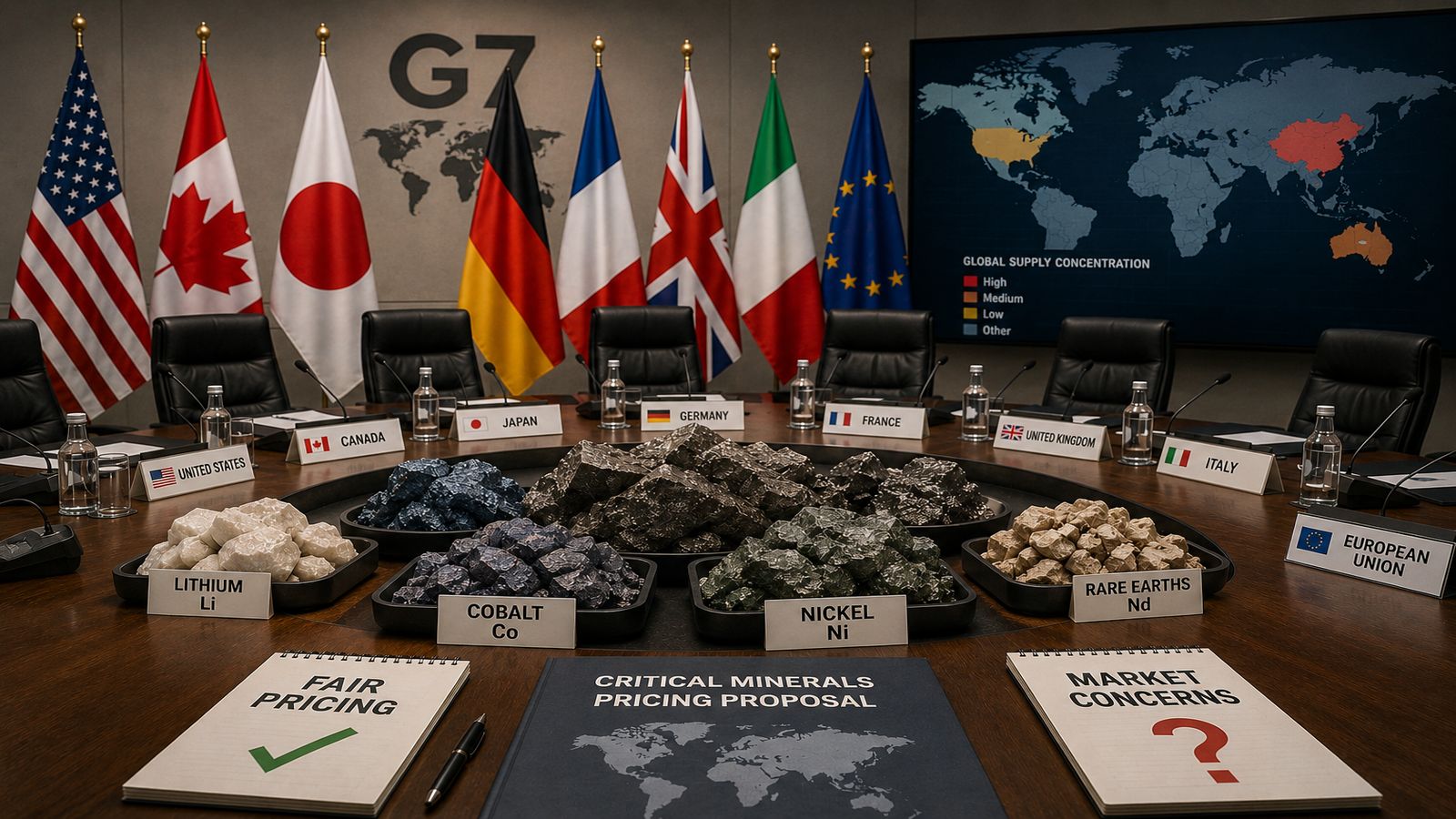
The G7 has attempted to build an anti-coercion framework to counter Beijing’s use of export controls on critical minerals (such as gallium, germanium, and graphite) and predatory pricing in green technologies. Yet, a structural fault line runs through this effort:
- The American Approach: Favors sweeping tariffs, strict outbound investment screening, and aggressive decoupling in dual-use technologies.
- The European and Japanese Approach: Favors targeted "de-risking," preserving access to the Chinese consumer market for legacy industries (such as German automotive manufacturing and Japanese precision machinery) while selectively protecting high-end semiconductors.
In Paris, foreign ministers must negotiate the threshold at which economic security overrides commercial interdependence. Without an agreed definition of what constitutes unacceptable economic coercion, joint G7 statements remain vulnerable to unilateral circumvention by individual member states seeking bilateral deals with Beijing.
3. The Global South and Institutional Legitimacy
A recurring blind spot in Western diplomatic analysis is the assumption that G7 consensus automatically translates into global norm-setting. In reality, the G7’s share of global GDP (measured by purchasing power parity) has steadily declined relative to the expanded BRICS+ bloc.
Foreign ministers meeting in Paris face an acute credibility deficit across the Global South, driven by perceived Western double standards regarding international humanitarian law in Gaza and Ukraine, alongside unfulfilled climate finance pledges. To prevent middle powers—such as Brazil, India, Indonesia, and Saudi Arabia—from drifting entirely into Sino-Russian diplomatic orbits, the G7 must offer tangible capital allocation rather than ideological lectures. This puts direct pressure on the Partnership for Global Infrastructure and Investment (PGII), the G7’s answer to China’s Belt and Road Initiative. If U.S. post-midterm fiscal constraints restrict American development finance contributions, European and Japanese institutions will be forced to carry the capital burden alone, significantly limiting the scale of alternative infrastructure financing available to developing nations.
The Structural Limitations of the G7 Format
Evaluating the Paris summit requires acknowledging the inherent constraints of the institution itself. Treating the G7 as a global steering committee leads to flawed strategic forecasting. Analysts must account for three structural limitations that cap what the foreign ministers can achieve in Paris:
- The Unanimity Constraint: Because G7 communiques operate by consensus, the final text inevitably regresses to the lowest common denominator. A single dissenting capital—whether Washington balking at climate language or a European state resisting aggressive phrasing on Beijing—can neutralize an entire policy track.
- The Execution Gap: Foreign ministers do not control treasury budgets, central bank interest rates, or defense procurement timelines. Agreements reached in Paris regarding sanctions enforcement or supply chain resilience frequently stall when handed over to domestic finance and commerce ministries, which answer to different constituencies and regulatory mandates.
- The Domestic Political Fragility of Incumbents: The leaders represented around the table in Paris are not operating from positions of unassailable domestic strength. Across Europe, coalition governments face persistent pressure from populist parties on both the right and left, constraining their ability to commit taxpayer funds to foreign crises or absorb the inflationary shocks of trade wars.
Strategic Positioning for the Next Twenty-Four Months
The Paris G7 ministerial meeting marks the transition from assessing the Trump administration’s rhetoric to pricing its structural impact into long-term national strategies. Because Washington’s foreign policy over the next two years will remain heavily transactional and sensitive to domestic political shifts, relying on traditional multilateral consensus is an obsolete strategy for allied capitals and multinational enterprises alike.
Allied governments and global institutional actors must execute a dual-track operational shift immediately following the Paris summit:
- Institutionalize Bilateral Side-Deals Within Multilateral Frameworks: Rather than waiting for unanimous G7 action, European and Indo-Pacific powers should utilize minilateral coalitions—such as the E3 (France, Germany, UK) plus Japan and Canada—to harmonize export controls, pool defense procurement, and coordinate sanctions enforcement independently of Washington’s legislative calendar.
- Isolate Critical Supply Chains from Tariff Volatility: Corporate and state planners must treat transatlantic trade friction as a permanent baseline condition rather than a temporary anomaly. Capital allocation should prioritize regionalized manufacturing hubs within North America, Europe, and allied Asian markets to bypass retaliatory tariff regimes, while locking in long-term sovereign off-take agreements for critical minerals to insulate industrial bases from both Chinese export restrictions and sudden U.S. policy pivots.