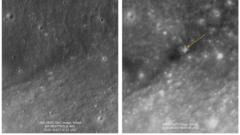
When a spent Falcon 9 upper stage intersected the lunar surface near Einstein Crater at approximately 8,000 kilometers per hour, the physical collision generated more than just a transient plume of regolith. It provided a rare empirical dataset for orbital mechanics and celestial body impact physics. The object, left drifting in high Earth-Moon space following a January 2025 mission carrying commercial lunar landers, lacked the residual propellant necessary to execute a controlled heliocentric or terrestrial de-orbit burn. Over roughly nineteen months, gravitational perturbations and solar radiation pressure slowly modified its trajectory until intersection became mathematically certain.
The primary utility of this event lies not in the fact of the collision itself, but in the diagnostic capture executed by South Korea's Danuri lunar orbiter. Operated by the Korea AeroSpace Administration, Danuri adjusted its trajectory to pass between 340 and 350 kilometers above the impact zone, executing an eight-image sequence using its high-resolution Lunar Terrain Imager. By acquiring baseline topography in the weeks prior and capturing the immediate post-impact telemetry, the mission bypassed the traditional post-hoc analysis that plagues historical artificial impact studies. This before-and-after architecture isolates the exact physical transformation of the regolith, quantifying the mass displacement and ejecta dispersal patterns of a known kinetic mass at a known velocity. Don't miss our previous article on this related article.
The Mechanics of Uncontrolled Cislunar Decay
To understand why this object collided with the Moon, one must examine the energy states of cislunar space. Launch vehicles operating in high-energy trans-lunar trajectories frequently discard their upper stages outside of Earth's primary atmospheric braking corridors. Without a dedicated disposal burn, these structures enter highly elliptical orbits governed by three-body gravitational mechanics involving the Earth, the Moon, and the Sun.
The decay sequence follows three distinct operational phases: If you want more about the history of this, Associated Press provides an excellent breakdown.
- Residual Propellant Depletion: Following payload separation, the upper stage retains zero or near-zero delta-v capacity. Station-keeping or orbital relocation becomes impossible.
- Perturbation Accumulation: Solar radiation pressure acting on the large surface area-to-mass ratio of an empty fuel tank gradually alters the eccentricity of the orbit over extended temporal horizons.
- Gravitational Capture: The orbit eventually crosses the sphere of gravitational influence of a secondary body, resulting in a hyperbolic intersection curve that terminates in a high-velocity surface impact.
The absence of atmospheric drag in high Earth-Moon orbits means objects do not experience natural orbital decay via friction. Instead, they remain in orbit indefinitely until gravitational cross-sections intersect a solid body. This creates a long-term orbital crowding problem that current space traffic management frameworks fail to price into launch economics.
Quantifying the Kinetic Transfer
The physics of the impact near Einstein Crater offer a strict baseline for hyper-velocity impacts on airless bodies. The Falcon 9 second stage has a dry mass estimated between 3,500 and 4,000 kilograms. Striking the lunar surface at roughly 8,700 kilometers per hour (or 2.4 kilometers per second), the kinetic energy release can be approximated using standard kinetic energy formulations.
While the velocity is lower than natural asteroidal impactors—which routinely exceed 15 to 20 kilometers per second—the mass density and structural rigidity of a spent rocket casing differ vastly from porous space rocks. The steel and aluminum-lithium alloys retain structural integrity longer during entry phases than loosely bound rubble piles, concentrating the kinetic transfer into a smaller surface area. Pre-impact predictive models estimated a crater formation approximately 27 meters wide and up to 5 meters deep. Danuri's high-resolution telemetry allows planetary scientists to test these numerical hydrocode models against empirical reality.
The optical signatures captured by Danuri's Polarimetric Camera further refine surface reflectance data. When high-velocity kinetic energy shatters lunar regolith, it exposes unweathered, sub-surface material protected from solar wind darkening and micrometeorite gardening. The resulting dark smudge and radial ejecta patterns provide a spectroscopic window into the mechanical properties of the lunar crust at that specific coordinate.
The Accountability Deficit in Cislunar Architecture
The collision highlights a structural gap in international space law and operational governance. Current regulatory frameworks mandate post-mission disposal plans for Low Earth Orbit (LEO) and Geosynchronous Equatorial Orbit (GEO) regimes, typically requiring spacecraft and upper stages to either de-orbit into the atmosphere within 25 years or move to a graveyard orbit. Cislunar space, however, exists in a regulatory gray area.
Launch providers frequently treat interplanetary or high-apogee departures as terminal operations where tracking responsibility degrades. The tracking of objects beyond GEO relies heavily on optical ground-based telescopes and sparse radar networks, leading to high ephemeris uncertainty. When a defunct upper stage drifts out of sensor range, predicting its exact collision timeline becomes an exercise in probabilistic modeling rather than deterministic tracking.
Addressing this deficit requires altering the cost function of mission design. Operators must budget a specific fraction of final-stage propellant specifically for active disposal maneuvers, such as heliocentric arching away from the Earth-Moon system or a targeted, controlled descent into a designated lunar mare. Relying on passive orbital evolution guarantees an ongoing accumulation of unpredictable impact events on the lunar surface.
Integrate automated tracking transponders and mandatory propulsion reserves into all commercial heavy-lift architectures destined for high Earth orbits, enforcing a zero-uncontrolled-decay standard for cislunar payloads.