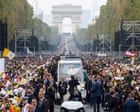
You wouldn't expect a fiercely secular European capital to shut down completely for a Catholic pontiff. Yet, when Pope Leo arrived for an open-air mass at the Place de la Concorde, nearly 700,000 people packed the heart of Paris.
For decades, pundits have predicted the steady decline of institutional religion in Western Europe. Empty pews and aging congregations became the standard narrative. Then the Pope rolled down the Champs-Élysées in an open-air popemobile, and the streets vanished beneath a sea of French and Vatican flags.
Let's look past the surface numbers and figure out why this historic gathering happened, what it means for modern secularism, and why people showed up in droves.
Breaking Down the Historic Paris Turnout
This wasn't just a casual Sunday gathering. It marked the first official papal visit to France in 18 years, drawing roughly 100,000 more attendees than official pre-registrations indicated.
Security forces locked down a 1.4-mile zone stretching from the Arc de Triomphe past the Place de la Concorde. Roughly 14,500 police officers, firefighters, and military personnel managed the immense logistics. Helicopters circled overhead while snipers kept watch from rooftops.
Despite the intense security footprint, the mood on the ground felt less like a rigid state function and more like a massive festival. Families hoisted toddlers onto their shoulders. Teenagers and young adults chanted "Leo, Leo" alongside lifelong parishioners.
The Core Message That Drew the Masses
Why did hundreds of thousands turn out in a country proudly rooted in laïcité—strict state secularism?
Pope Leo addressed the elephant in the room directly during his homily. He didn't lean into political talking points or cultural grievances. Instead, he targeted a universal human burnout: the exhaustion born of chasing material satisfaction.
"Are we content with material goods, immediate satisfactions, the countless little idols that promise us everything but leave our hearts empty?" he asked the vast crowd.
That message struck a nerve. In a hyper-digitized era driven by constant optimization, burnout, and anxiety, millions feel a profound existential vacuum. The pope offered an alternative vocabulary centered on spiritual thirst, community, and service. Observers noted that a significant portion of the audience wasn't even strictly Catholic. People of various backgrounds or no religious affiliation at all showed up simply because they were searching for a tangible sense of hope and shared humanity.
What This Means for the Future of European Catholicism
For years, sociologists of religion have mapped out the death of European Christianity. They point to falling baptism rates and closed rural parishes.
This massive Paris gathering doesn't erase those structural challenges. Parishes across France still face severe priest shortages and demographic graying. But the event proved that the cultural hunger for sacred spaces hasn't vanished. It went underground, waiting for an authentic spark.
Local believers interviewed after the service expressed a renewed sense of visibility. Many noted that practicing Catholics often feel like an invisible minority in public life. Seeing 700,000 people occupy the most famous avenue in France changed that dynamic overnight. It gave ordinary believers permission to be loud about their faith without apologizing for it.
When the dust settles and the barricades come down, the real test for religious institutions isn't how many show up for a historic spectacle. It's whether everyday communities can sustain that momentum once the popemobile heads back to Rome.