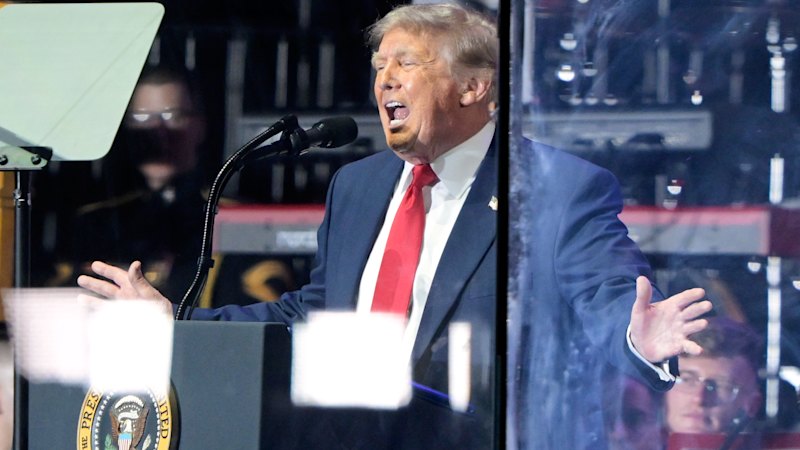
Every six months, the commentariat discovers panic. They look at a rally crowd, a transcript, a wild social media post, and they nod solemnly into their microphones. They whisper about a sobering realization. They tell you the bluster is a mask. They claim the man is losing the public.
It is comforting fiction. It helps legacy analysts sleep at night because it anchors politics to a framework they spent forty years learning. They want to believe that public opinion behaves like a bell curve, that moderation is the gravity of American politics, and that eventually, everyone gets tired of the shouting and demands a quiet center.
They are wrong. They are looking at a twentieth-century scoreboard while playing a completely different game.
The Structural Sorting of Modern America
To understand why the mainstream framing misses the mark, you have to look past the superficial headlines and examine how modern political geography operates. The classic model of elections assumed a vast, movable center—millions of independent voters sitting on the fence, waiting to be wooed by policy papers and polite rhetoric.
That middle is gone. It was not evicted by politicians; it was dismantled by decades of economic restructuring, geographic sorting, and digital media ecosystems that reward emotional friction over agreement. People do not live mixed together anymore. They live in ideological clusters. They consume entirely different information diets. They speak different political dialects.
When legacy pundits write breathless pieces about a candidate "losing the public," they are treating the public as a unified monolith. They assume that if approval dips in a suburban zip code in Ohio or a county in Pennsylvania, the electoral machine is breaking down. But politics is no longer about winning over the undecided voter in the middle. That voter is an endangered species, mostly because anyone still undecided in the current climate is either politically comatose or completely alienated from the process.
Trump does not care about the middle because the middle does not fund campaigns, spark viral clips, or stand in line for four hours in the freezing rain. Intensity is the only currency that clears the market.
The Psychology of the Complacent Commentariat
There is a distinct professional hazard that affects political journalists and elite analysts: projection. People who spend their days in quiet newsrooms, attending polite panel discussions, and emailing PR representatives naturally assume that the rest of the world values decorum, procedural norms, and institutional quiet just as much as they do.
When they see a public figure break every rule of traditional statecraft—insulting opponents, dominating news cycles with grievance, throwing institutional norms into a blender—they project their own horror onto the electorate. They think, Surely the public sees this lack of manners and abandons ship.
This is a category error of massive proportions. The voter sitting in a deindustrialized town or struggling with inflation does not give a single damn about institutional decorum. Decorum did not keep their local factory open. Decorum did not lower their grocery bills. Decorum is the language of an establishment that has spent decades managing national decline with polite memos.
When someone comes along and smashes the furniture, the working-class voter does not clutch their pearls. They pull up a chair and watch the show. They recognize the bluster not as a character flaw, but as a middle finger aimed directly at the people who broke the system in the first place.
Bluster is Not a Mask
The core error of conventional analysis is the belief that provocative statements, erratic social media posts, and hyperbolic rallies are a defensive mechanism. The narrative goes like this: behind closed doors, advisors are sweating, polls are tightening, and the noise is just whistling past the graveyard.
I have spent years watching how political communication teams build narratives under intense pressure. Real panic looks like caution. Real panic looks like strict message discipline, boring policy white papers, and defensive press releases designed to offend nobody.
Bluster is not panic. Bluster is the core product.
When you reduce politics to an attention economy, silence is death. If you are moderate, nuanced, and careful not to offend, you become background noise. You get a polite paragraph on page four of the paper. You get ignored.
Trump understands the physics of the modern attention market better than any institutional critic. Every outrageous sentence functions as a filter. It draws fire, forces opponents to overreact, sucks all the oxygen out of the news cycle, and rallies the base with absolute clarity. It is not an accident. It is a structured operational rhythm. When critics say, "He is going too far," they are falling into the exact trap that keeps him permanently at the center of the screen.
The Metrics That Actually Matter
Let us look at the data that actually matters, stripped of the emotional hand-wringing found in standard opinion columns.
Traditional favorability polls are broken. They measure whether someone likes a person in the abstract, as if they were voting for a corporate board member or a high school principal. That metric has zero predictive value in a high-polarization environment. You can have a net-negative favorability rating and still win structural power because your supporters are economically, socially, and psychologically locked into your success.
Look instead at metrics of engagement, donor retention, and narrative dominance.
When a standard politician speaks, the audience tunes out or treats it as white noise. When Trump speaks, even his harshest critics spend the next seventy-two hours dissecting every syllable. That is not a sign of a shrinking public footprint. That is a monopoly on the national conversation.
In the attention economy, being hated by half the country is infinitely more powerful than being mildly tolerated by everyone. Mild tolerance does not generate donations. Mild tolerance does not get people to drive trucks to state capitals or camp out at rally sites. Intensity wins elections because intensity drives turnout, and turnout is the only variable that moves the needle.
The Fragility Trade-Off
To be intellectually honest, this strategy carries a brutal downside, one that its architects rarely acknowledge openly.
When you build a political identity entirely on perpetual conflict and total polarization, you sacrifice the capacity for institutional stability. You cannot govern through consensus when you have systematically destroyed the vocabulary of compromise. Every policy issue becomes an existential crusade. Every routine piece of legislation turns into a holy war.
This is the trade-off. You achieve maximum mobility and an unshakeable base, but you leave behind a fractured civil infrastructure that struggles to perform basic administrative functions. The system becomes brittle. It can block things brilliantly, but it struggles to build anything durable.
Critics are right to point out the chaos, but they are dead wrong about the cause. The chaos is not a glitch; it is the engine. You cannot run a populist insurgency using the operating manual of a traditional bureaucracy.
Stop Asking the Wrong Question
The next time you read a breathless analysis claiming that a politician is losing touch with the public because their rhetoric is too sharp, ask yourself a better question.
Who are they losing touch with, and does that specific group matter to the math of power?
If the answer is a group of institutional elites who judge political success by cocktail party manners and polite editorials in legacy newspapers, then the loss is not just irrelevant—it is the entire point.
We are past the point where charm and conventional decorum move nations. We are living through a hard-nosed contest of tribal mobilization where the loudest, most disruptive force usually wins the room. Pretending that the old rules still apply is not sophisticated analysis. It is wishful thinking from people who refuse to admit that the room has changed forever.
Stop waiting for the bluster to stop. It is the music to which the modern political world dances.