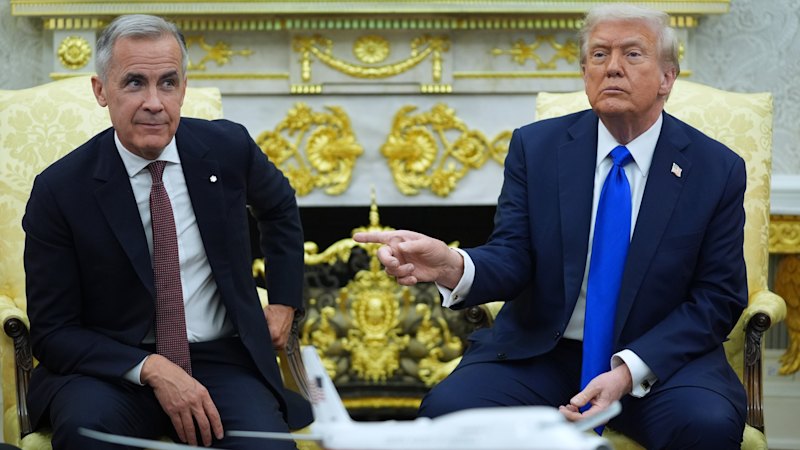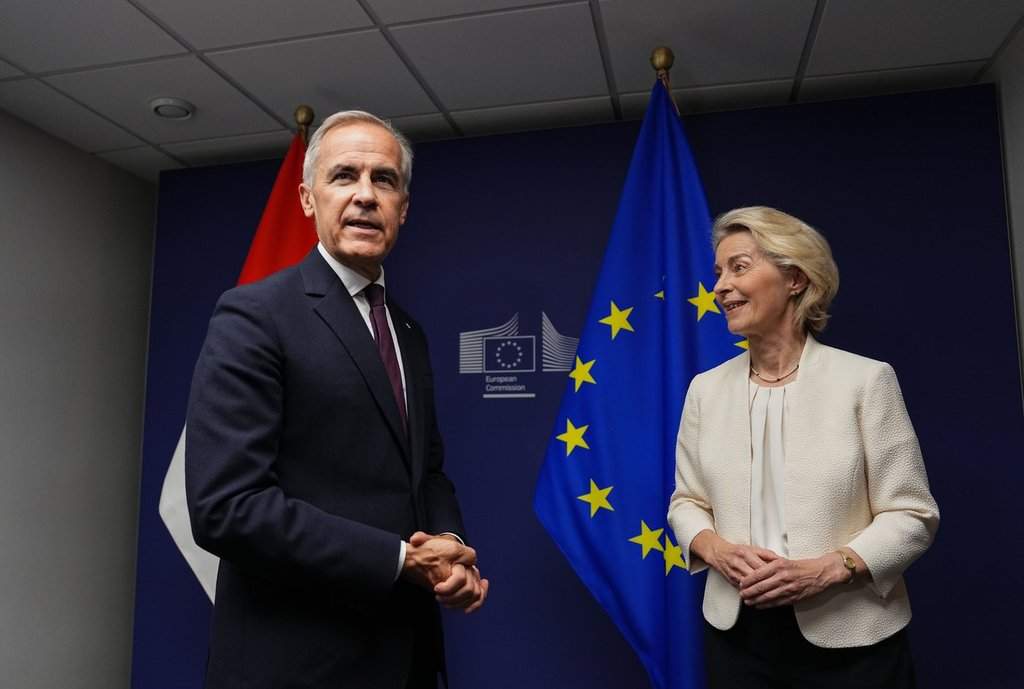
When Prime Minister Mark Carney stood before European counterparts and declared that Europe and Canada are stronger together, the diplomatic applause was predictable. The underlying desperation was not. Beneath the polished rhetoric of shared values and transatlantic solidarity sits a cold, hard calculation driven by Ottawa’s acute vulnerability to American trade protectionism and an urgent need to diversify an export economy dangerously tethered to a single neighbor.
Carney’s European push is not a routine diplomatic victory lap. It is an emergency hedge against the weaponization of North American supply chains, tariff threats from Washington, and a sluggish domestic productivity crisis that has left Canada exposed on the global stage. For decades, Canadian prime ministers have paid lip service to trade diversification while quietly letting the United States absorb roughly three-quarters of the country's outbound goods. That complacency has expired. With Washington increasingly willing to treat trade deficits as national security threats and renegotiate foundational agreements at will, Ottawa is scrambling to turn dormant frameworks like the Comprehensive Economic and Trade Agreement (CETA) into an actual economic lifeline.
The Illusion of the Transatlantic Safety Net
To understand why Carney’s pitch carries both high stakes and severe structural limits, you have to look at the ledger. Since CETA provisionally entered into force in 2017, bilateral merchandise trade between Canada and the European Union has grown, yet it remains a fraction of Canada’s daily cross-border volume with the United States. The geographical reality is unforgiving. Shipping liquefied natural gas, critical minerals, or manufactured components across the Atlantic requires port infrastructure, icebreakers, long-term off-take agreements, and capital commitments that cannot be conjured out of thin air during a bilateral summit.
Europe wants what Canada has underground. Lithium, nickel, cobalt, copper, and uranium sit in the Canadian Shield in quantities that could theoretically break Brussels’ reliance on Chinese processing monopolies. Yet the gap between geological potential and commercial extraction in Canada is measured in decades, not election cycles. Environmental assessments, overlapping federal and provincial jurisdictions, and protracted Indigenous consultations routinely stall major mining and energy projects for ten to fifteen years.
European industrial leaders know this. When German or French executives hear a Canadian prime minister promise reliable critical mineral supply chains, they quietly ask when the mines will actually open and how the ore will reach tidewater. Without massive regulatory streamlining at home, Ottawa’s grand European energy and resource diplomacy risks becoming an exercise in selling futures on infrastructure that does not yet exist.
What Brussels Actually Wants From Ottawa
The European Union does not operate on sentiment, regardless of how warm the press conferences look. Brussels approaches Ottawa with a transactional checklist shaped by the war in Ukraine, the energy shock following the collapse of Russian pipeline gas, and fierce industrial competition from both Washington and Beijing.
Critical Minerals Without the Chinese Bottleneck
European automakers and battery manufacturers are caught in a regulatory vice. Brussels has mandated aggressive timelines for phasing out internal combustion engines while simultaneously trying to reduce exposure to Chinese supply chains. Canada offers an ethically sourced, politically stable alternative. However, digging raw rock out of northern Ontario or Quebec solves only half the problem. Canada lacks the domestic refining and processing capacity to turn raw ore into battery-grade chemicals at scale. Until Ottawa and European sovereign wealth funds co-finance midstream processing facilities, raw Canadian minerals will still end up on ships bound for Asian refineries before ever reaching a European factory floor.
Defense Procurement and the Two Percent Trap
Carney’s overtures also land squarely in the middle of Europe’s frantic rearmament. As European NATO members overhaul their defense industrial bases, procurement budgets are swelling. Canada, long criticized by allies for lagging behind NATO’s two percent of GDP defense spending benchmark, sees an opening to buy goodwill and industrial offsets simultaneously. By aligning Canadian defense procurement—from submarines to Arctic surveillance systems—with European defense contractors, Ottawa hopes to secure technology transfers and domestic manufacturing jobs. The catch is fiscal space. Ottawa is already carrying heavy debt service costs, and every dollar committed to European defense hardware is a dollar pulled from domestic healthcare transfers or green energy subsidies.
Digital Governance and Regulatory Alignment
Beyond physical goods, Carney is positioning Canada as a regulatory bridge between Silicon Valley’s laissez-faire tech dominance and Brussels’ strict digital rulebook. Europe has exported its regulatory standards globally—from the GDPR privacy framework to the EU AI Act. By harmonizing Canadian artificial intelligence governance and data privacy rules with European standards, Ottawa hopes to make Canadian tech firms the preferred North American entry point for European enterprises. Yet this creates immediate friction with Washington, where major U.S. tech firms view European-style regulation as a non-tariff barrier aimed squarely at American balance sheets.
The Structural Friction Neither Side Mentions
If you listen closely to the official communiques, you would think the path to deeper integration is frictionless. It is not. Behind closed doors, trade negotiators in Ottawa and Brussels remain deadlocked over persistent non-tariff barriers that have prevented CETA from reaching full ratification across all EU member states.
Agricultural protectionism remains a third rail in European politics. French, Italian, and Irish farmers have fiercely resisted quotas for Canadian beef and pork, arguing that Canadian agricultural producers operate under different regulatory standards regarding hormones and feed additives. Conversely, European cheesemakers and wine producers have aggressively policed geographical indications inside the Canadian market, frustrating domestic retailers and consumers.
Then there is the carbon border problem. The European Union’s Carbon Border Adjustment Mechanism (CBAM) is designed to penalize imports from countries with weaker climate pricing regimes. While Canada maintains an industrial carbon pricing system, any political shift in Ottawa that weakens or dismantles federal carbon pricing immediately exposes Canadian steel, aluminum, and fertilizer exports to European border tariffs. Carney’s background in climate finance makes him uniquely fluent in this regulatory language, allowing him to assure Brussels that Canada will remain aligned with European decarbonization rules. Still, domestic political consensus on carbon pricing in Canada is fracturing, leaving European buyers hesitant to sign twenty-year supply contracts based on policies that a future parliament could repeal overnight.
Why Washington Is Watching Every Move
Every handshake in Brussels or Berlin sends a signal to Washington, and not necessarily the one Ottawa intends. For decades, Canada’s primary negotiating asset with the United States was its predictability as an integrated junior partner in the North American economic bloc. When Canada actively courts European regulatory alignment, defense contracts, and trade preferences, hawks in Washington take notice.
There is a sharp, unavoidable tension between deep North American integration and transatlantic diversification. Roughly eighty percent of Canada's population lives within a hundred miles of the U.S. border. Supply chains in the automotive, aerospace, and agricultural sectors cross the Detroit-Windsor corridor multiple times before a final product is assembled. If Canada adopts European technical standards, digital taxes, or procurement preferences that disadvantage American firms, retaliation from Washington will not be subtle. It will arrive in the form of stricter rules-of-origin enforcement under North American trade agreements, targeted tariffs on Canadian aluminum or softwood lumber, and exclusion from U.S. industrial subsidies.
Carney is attempting a high-wire act that has tripped up every Canadian leader since Pierre Trudeau’s "Third Option" policy in the 1970s. Back then, Ottawa tried to reduce economic dependence on the United States by building closer ties with Europe and Asia. The effort failed because gravity always wins in trade economics. Markets follow the path of least resistance, lowest transport cost, and deepest capital pools—and for Canada, all three sit directly south.
The Capital Flight Reality
Rhetoric does not build factories. Capital does. And right now, capital is voting with its feet. Canadian business investment per worker has trailed the United States for years, weighed down by interprovincial trade barriers, sluggish productivity growth, and complex tax structures. Ironically, it is often easier for a Canadian company to sell goods to Germany under CETA than it is to sell those same goods across a provincial border from Ontario to British Columbia due to conflicting trucking regulations, professional licensing rules, and local procurement preferences.
Expecting European institutional investors to pour billions into Canadian infrastructure when Canadian pension funds themselves routinely invest the vast majority of their assets outside the country is a hard sell. Major Canadian pension giants manage trillions of dollars, yet they have repeatedly bypassed domestic projects in favor of infrastructure assets in the United Kingdom, continental Europe, and the United States where regulatory timelines are clearer and returns are more predictable. Before Carney can convince European sovereign wealth funds to underwrite Canada’s economic transformation, his government has to prove that Canada is a place where big things can actually get built on time and on budget.
A Necessary Gamble With Narrow Margins
None of this means Carney’s European strategy is wrong. In an era where global trade is fracturing into competing geopolitical spheres, relying on a single superpower for three-quarters of your export revenue is an existential risk. Doing nothing is not an option. If the United States retreats further into economic nationalism, Canada needs functioning commercial off-ramps, alternative buyers for its commodities, and diplomatic allies who will stand beside it in international trade disputes.
Europe offers scale, rule of law, and a shared interest in preserving rules-based commerce. With a combined market of roughly 450 million consumers, the EU is one of the few economic blocs large enough to matter in a world dominated by American and Chinese economic weight. Strengthening intelligence sharing, coordinating sanctions enforcement, and aligning critical mineral strategies with Brussels are rational moves for a middle power navigating a hostile global environment.
Yet speeches in European capitals will not fix the bottlenecks at the Port of Vancouver, accelerate mine permitting in northern Ontario, or dismantle the internal trade barriers choking Canada’s domestic market. The hard work of making Canada and Europe stronger together does not happen at diplomatic summits. It happens in domestic legislative chambers, regulatory agencies, and capital markets—and until Ottawa clears the roadblocks inside its own borders, the transatlantic alliance will remain long on promise and dangerously short on tonnage.