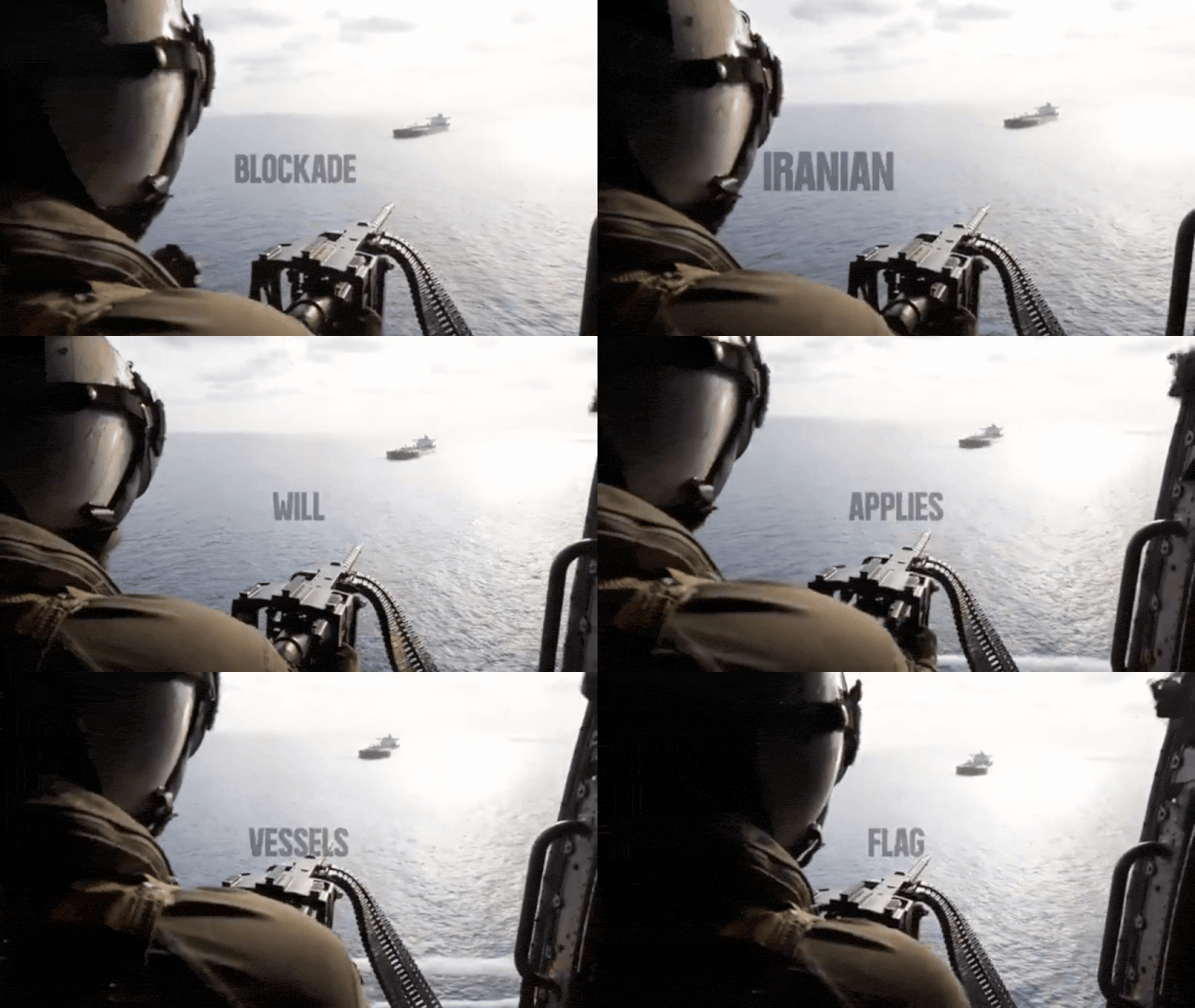
The shift from passive surveillance to active interdiction in littoral corridors near Iranian sovereign waters represents a fundamental change in the rules of engagement for airborne maritime security. When a US helicopter crew issues a kinetic warning to vessels attempting to bypass established inspection protocols, they are not merely performing a security check; they are executing a high-stakes calibration of the Deterrence Calculus. This calculus relies on the immediate credibility of force to prevent the escalation of a localized encounter into a regional maritime shutdown.
Recent operations involving the interception and reversal of 27 vessels highlights a strategic bottleneck: the physical and psychological friction required to maintain a maritime blockade without initiating open conflict. The effectiveness of these warnings hinges on three specific operational variables that define the success of maritime interdiction.
The Triad of Tactical Dominance
To understand why a verbal warning from a door gunner carries enough weight to turn back a fleet, one must analyze the structural advantages of the rotary-wing platform over small-craft swarms.
- Information Asymmetry: The helicopter operates at an altitude that allows for a comprehensive radar and visual map of the engagement zone. The vessels below lack this perspective, creating a "fog of war" that favors the airborne asset.
- Kinetic Response Latency: The time between a verbal warning and a disabling shot is measured in seconds. In contrast, surface-to-air responses from small vessels are uncoordinated and prone to mechanical failure under stress.
- Escalation Dominance: The US asset maintains the ability to increase force—moving from verbal warnings to flares, then to warning shots, and finally to disabling fire—long before the surface vessels can present a comparable threat.
When the gunner states, "If you attempt to run, I will engage," they are defining the Red Line of Intent. This isn't a threat; it is a statement of an automated response protocol. The vessels returned not because of the words themselves, but because the presence of the gunner provides visual proof that the cost-benefit analysis of continuing the voyage has flipped toward total loss.
The Cost Function of Non-Compliance
For a commercial or non-state actor operating in these waters, the decision-making process is governed by a simple risk-reward model. The goal is to reach a port—often in a contested zone like Yemen or near Iranian hubs—while minimizing operational friction.
The Compliance Threshold is reached when:
$$Total Risk > Potential Profit + Survival Probability$$
In the incident involving the 27 vessels, the US Navy and Coast Guard utilized the helicopter as a mobile enforcement node to increase the Total Risk variable instantly. By forcing a return to port, the intercepting force imposes a massive financial penalty on the operators:
- Fuel Sunk Costs: The energy expended to reach the interdiction point is unrecoverable.
- Time-to-Market Decay: Perishable or time-sensitive cargo loses value the longer it sits in a hold or is diverted.
- Insurance Premium Spikes: Operating in zones where "kinetic warnings" are documented causes a sharp rise in maritime insurance rates, eventually making the route economically unviable for legitimate or semi-legitimate trade.
Mechanical Constraints of Littoral Interdiction
The physics of a helicopter-vessel standoff dictate the outcome. A standard MH-60R or MH-60S Seahawk, often used in these missions, carries a suite of weaponry designed for precise disabling of engine blocks rather than the sinking of hulls. This "surgical kineticism" is vital. Sinking a ship creates an environmental and humanitarian crisis that complicates the strategic mission. Disabling a ship's propulsion achieves the same goal—stopping movement—without the diplomatic fallout of a mass-casualty event.
The primary tool in this environment is the M240 machine gun or the GAU-21 .50 caliber machine gun. These weapons are utilized to create "water plumes" ahead of a vessel's bow. The visual impact of heavy rounds hitting the water 10 meters in front of a pilot’s window serves as a psychological anchor, reinforcing the verbal warning. If the vessel continues, the next target is the outboard motor or the bridge, depending on the threat level.
Logistic Chokepoints and the Iran Factor
The proximity of these encounters to Iranian ports is not coincidental. These zones function as Sovereignty Buffers. Iran utilizes small, fast-attack craft and dhows to probe the limits of international maritime law. By using 27 vessels simultaneously, they attempt to saturate the bandwidth of the intercepting force.
This is a classic Swarmer Logic problem: if the US has two helicopters but there are 27 targets moving in different directions, the interdiction should, theoretically, fail.
The US counter-strategy relies on Sequential Deterrence. By making a public, high-profile example of the lead vessels, the intercepting force creates a "herd effect." Once the first three vessels are neutralized or turned back, the remaining 24 perceive the risk as systemic rather than individual. This psychological contagion is the only way to manage a 27-to-1 vessel ratio effectively without resorting to widespread destruction.
Geopolitical Friction and the Rules of Engagement (ROE)
The ROE in the Persian Gulf and the Gulf of Oman are among the most complex in modern warfare. Every radio transmission is recorded, not just by the US, but by regional actors looking for a "provocation" narrative.
The door gunner’s warning is the final link in a chain of De-escalation Protocols:
- Bridge-to-Bridge Radio: Attempting contact on Channel 16.
- Visual Signaling: Using signal lamps or flags to indicate a required change in course.
- Physical Positioning: Placing the helicopter or a surface ship directly in the path of the target vessel.
- The Kinetic Warning: The final verbal alert followed by the deployment of force.
The transition from step 3 to step 4 represents a failure of diplomacy and a shift into Active Policing. The fact that 27 vessels complied indicates that the threat was perceived as legitimate and the ROE was understood to be permissive toward the use of force.
Resource Depletion as a Strategic Tool
A secondary objective of these interdictions is the depletion of the adversary's logistics. By forcing vessels back to port, the US forces the opponent to cycle their crews, refuel their ships, and re-plan their routes. This creates an Administrative Burden that is often more effective than a single combat engagement.
If an organization (state or non-state) loses 100% of its mission objectives across 27 attempts, the internal pressure to find an alternative route or cease operations altogether becomes overwhelming. The goal is to move the conflict from the water to the spreadsheet, where the cost of defiance eventually exceeds the budget for the operation.
Structural Vulnerabilities in the Interdiction Model
Despite the success of this specific operation, the model has inherent limitations. The Availability Gap is the most significant. A helicopter can only stay on station for a limited duration before requiring a "hot refuel" or maintenance. If the adversary times their movements to coincide with these gaps, the deterrence factor drops to zero.
Furthermore, the Threshold of Violence is a fragile barrier. If a gunner is forced to engage and casualties occur, the narrative shifts from "maritime security" to "international incident." This risk often prevents commanders from being as aggressive as the tactical situation might require, creating a "hesitation window" that sophisticated adversaries can exploit.
The Shift to Autonomous Enforcement
The future of these littoral encounters lies in the integration of Unmanned Surface Vessels (USVs) and Unmanned Aerial Systems (UAS). Moving forward, the "door gunner" will likely be replaced by a remote operator or an AI-assisted targeting system capable of monitoring 27 vessels simultaneously with a level of persistence a human crew cannot match.
The deployment of loitering munitions and high-endurance drones will allow for a permanent "picket line" in high-risk zones. This will eliminate the Availability Gap and move the Deterrence Calculus from a human-to-human psychological battle to a machine-driven enforcement grid.
Commanders must now focus on the integration of acoustic hailing devices (AHD) and non-lethal millimeter-wave weapons (active denial systems) to provide a middle ground between a verbal warning and a machine gun burst. This "gray zone" weaponry will allow for the enforcement of maritime exclusion zones with reduced risk of lethal escalation, effectively neutralizing the swarm tactic without firing a single kinetic round. The 27-vessel reversal is a clear indicator that the current mix of human aggression and technical superiority is holding, but the operational tempo suggests a transition to automated, persistent surveillance is the only way to maintain this equilibrium long-term.