Political parties change their skin when it suits them. You watch candidates shape-shift, swap slogans, and quietly abandon core principles the moment a new voting bloc opens up. That is exactly what has happened with the Rassemblement National in France regarding the concept of laïcité.
For decades, the far-right movement wrapped itself in strict secularism. They used the flag of state neutrality to target Islamic practices, headscarves, and public religious displays. They claimed they were defending French republican values from outside influences. But when a major papal visit happens or political winds shift toward traditionalism, the script gets flipped. Suddenly, strict secular neutrality takes a backseat. Instead, party leadership starts chanting about the deep Christian roots of the French nation.
It is a striking ideological pivot. When a party builds its brand on keeping religion out of the public square, shouting about Catholic heritage looks hypocritical to critics. Yet, this move is calculated. It is about redefining who belongs in France by tying citizenship to a specific religious and cultural ancestry.
The Evolution of National Rally Rhetoric
You have to look at how the far-right talks about identity to understand this shift. Ten or fifteen years ago, Marine Le Pen and her inner circle pushed laïcité as an absolute shield. Every public debate about faith came back to the 1905 law on the separation of church and state. They argued that public spaces must remain entirely stripped of religious markers to preserve equality.
Critics watched closely. They pointed out that this defense of secularism was narrow. It disproportionately targeted Muslims while leaving traditional Catholic heritage monuments, rural church bells, and Christian holidays untouched. The argument was simple: secularism for thee, but historical privilege for me.
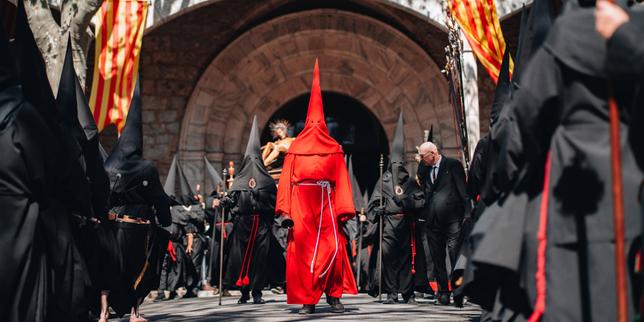
Now, the mask has slipped even further. Rather than pretending to care about neutral public spaces, party figures lean hard into France's Catholic history. They talk about cathedral spires, village churches, and centuries of Christian tradition as the defining pillars of Frenchness. Why the change? Because the political battlefield evolved. Winning over conservative Catholics and traditionalist voters requires speaking their language. Strict secularism feels cold to churchgoers. Heritage politics feels warm, exclusive, and potent.
Weaponizing History for Political Gain
History is a flexible tool in politics. When politicians invoke the Christian roots of France, they are not staging a theological debate. They are drawing a sharp boundary line.
If Frenchness is defined by Christianity, what happens to the millions of French citizens who are Muslim, Jewish, atheist, or from other backgrounds? They become outsiders by default. This rhetorical shift allows the party to exclude minorities without explicitly mentioning race. It sounds respectable. It sounds cultural. But the political exclusion remains identical.
During high-profile events like papal visits, this dynamic goes into overdrive. Leaders scramble to position themselves as the true protectors of Christian heritage. They frame themselves as the guardians of European civilization against outside forces. It plays well with a specific demographic that feels culturally displaced by globalization and immigration.
Yet, actual church leaders often push back against this appropriation. Priests and bishops frequently remind the public that Christian charity and universal brotherhood clash directly with nationalist exclusion. The irony is thick. Political figures who rarely step foot in a pew suddenly pretend to speak for the diocese when cameras are rolling.
The Crack in the Secular Armor
France takes its laïcité seriously. The 1905 law is foundational to the republic. It guarantees that the state does not recognize or subsidize any religion, creating a neutral public sphere where everyone supposedly stands on equal footing.
When a major political force like the National Rally bends this principle to fit a nationalist narrative, the whole constitutional balance wobbles. If secularism is only a weapon to restrict minority religions while preserving a majority heritage, it ceases to be a neutral principle. It becomes a tool of majoritarian dominance.
Voters notice the gymnastics. Secular republicans find themselves caught between a rock and a hard place. They want to defend state neutrality, but they watch the far-right co-opt religious symbols while the left struggles to find a coherent message on identity.
The strategy relies on a simple trick. You blur the line between culture and faith. You tell people you aren't talking about going to mass; you are talking about preserving French civilization. That distinction washes away the constitutional hurdles of mixing church and state.
What This Means for the Future of French Politics
This pivot tells you everything about where the European right is heading. Cultural nationalism is replacing old-school civic nationalism. You no longer just have to speak the language and respect the laws; you are expected to fit into a specific historical narrative.
Elections are won by emotional resonance, not constitutional purity. Talking about Christian roots evokes nostalgia, belonging, and a imagined past where everything felt simpler. It offers a clear enemy and a comforting identity.
Watch the polls. Watch the soundbites during the next religious holiday or papal tour. You will see the same script play out. The commitment to strict state neutrality will vanish the second a church steeple provides a good photo opportunity.
Pay attention to what politicians do, not what catchphrases they lean on. When the defenders of secularism suddenly start preaching from the cathedral steps, you know the game has changed.