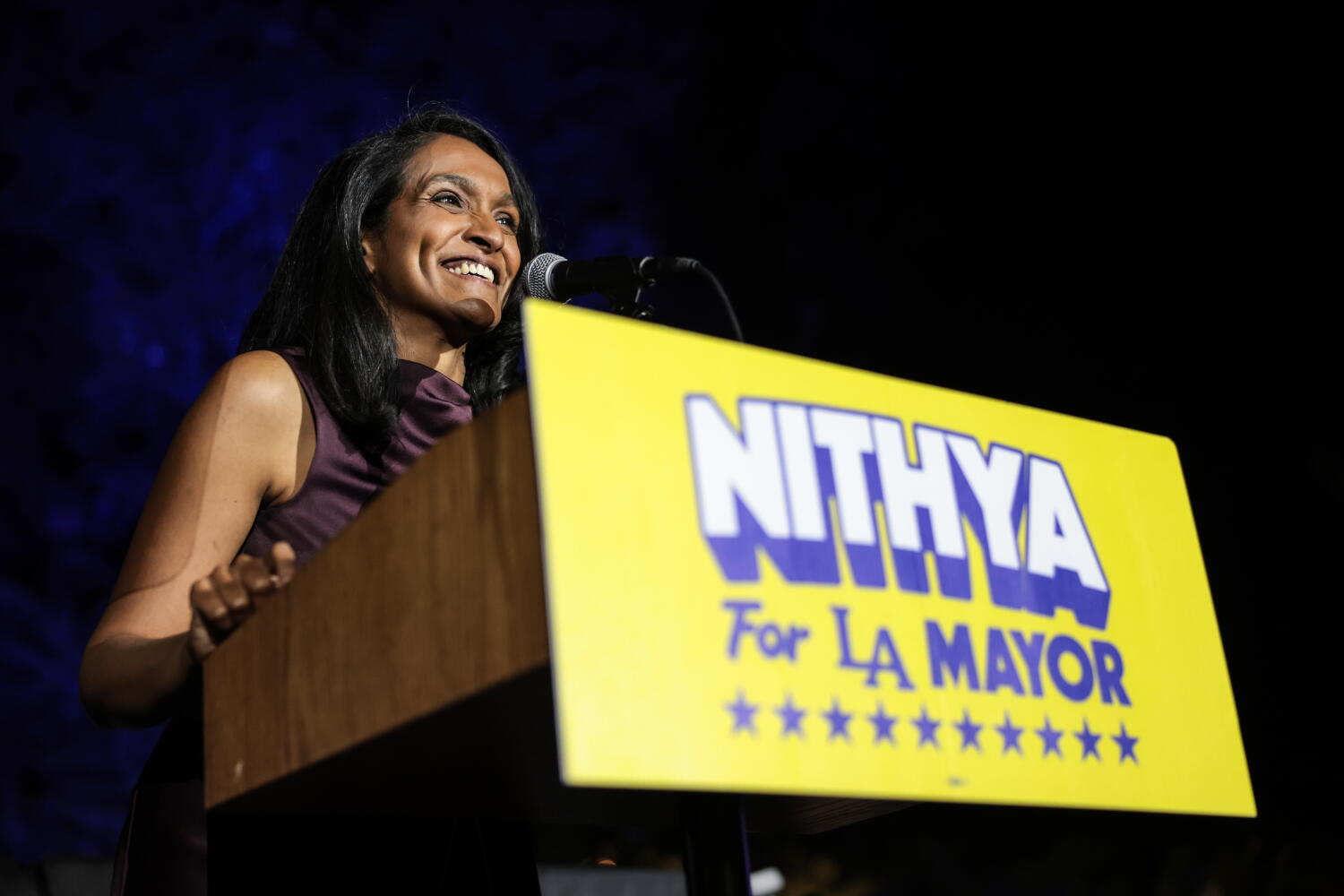
The editorial boards and pundits are already popping champagne. They want you to believe that Los Angeles voters just executed a daring, historic pivot by electing Nithya Raman as mayor. They call it bold. They call it a mandate for systemic disruption.
They are wrong.
Calling a vote for Nithya Raman "bold" is the laziest consensus in California political commentary. It confuses ideological branding with structural capability. For decades, Los Angeles has operated on a predictable cycle: elect a charismatic reformer who promises to dismantle the broken machinery, watch that reformer get swallowed alive by the City Charter, and then act shocked when nothing changes. Voters didn't take a bold leap into the unknown. They bought the exact same ticket they always buy—just printed on recycled, progressive paper.
If you want to understand why the "stay bold" cheerleading misses the point entirely, you have to stop looking at campaign slogans and start looking at the plumbing of municipal governance.
The Structural Trap of the Weak Mayor System
The single biggest misconception in Los Angeles politics is that the mayor actually runs the city.
Pundits write about the L.A. mayor as if the office carries the executive authority of New York’s City Hall or Chicago’s Fifth Floor. It doesn’t. Under the Los Angeles City Charter, the mayor operates within a notoriously fragmented system where real, granular power sits with the fifteen members of the City Council.
I have spent years watching bright-eyed policy architects walk into Spring Street thinking their mandate gives them a magic wand, only to realize they don't even control the zoning on a single street corner without a councilmember's blessing. In L.A., every council district is a medieval fiefdom. Land use, street sweeping, shelter placement, and local permitting are guarded like state secrets by individual council offices.
When commentators urge Raman to "stay bold," they are asking a swimmer to outpace a tsunami while tied to a concrete block. You cannot out-ideologize a structural deficit in executive power. To pass a budget, appoint department heads, or execute a citywide housing strategy, a mayor must trade favors with the exact political machine they campaigned against.
The moment Raman compromises to get eight votes on the Council, her base will scream betrayal. The moment she refuses to compromise to "stay bold," her agenda dies in committee. That isn't a test of courage. It is a math problem with no solution.
The Housing Paradox Nobody Wants to Admit
The core of the Raman pitch—and the centerpiece of the pundit class's praise—is her approach to homelessness and housing. Her background as an urban planner and her work with the SELAH Neighborhood Homeless Coalition gave her unimpeachable credibility on the street level. She campaigned on leading with services, rejecting punitive sweeps, and aggressively expanding tenant protections.
Here is the uncomfortable truth that the "bold" narrative completely ignores: Los Angeles does not have a compassion deficit. It has a production and cost-per-unit crisis.
Let’s look at the mechanics of municipal housing development. California’s regulatory framework—anchored by the California Environmental Quality Act (CEQA), prevailing wage mandates, and Byzantine local zoning codes—has turned building affordable housing into a financial hallucination. Under Proposition HHH, voters approved $1.2 billion to build supportive housing, only to watch per-unit costs balloon past $600,000, $700,000, and in some cases over $800,000.
You cannot subsidize your way out of a supply shortage when every unit costs as much as a luxury condo in a mid-sized American city.
Why Tenant Protections Often Backfire
Raman’s fiercest supporters celebrate her push for stronger rent stabilization and eviction defenses. In the short term, these policies keep vulnerable families from falling onto the pavement. That is an undeniable good.
However, basic urban economics—validated by decades of research from institutions like the UCLA Lewis Center for Regional Policy Studies and economists like Edward Glaeser—shows what happens when you tighten price controls without radically deregulating supply. Capital flees. Mom-and-pop landlords sell to corporate consolidators who can afford compliance lawyers. New multifamily construction stalls because institutional lenders refuse to underwrite projects capped by shifting municipal rules.
Imagine a scenario where a city passes the strongest tenant protections in the country while simultaneously maintaining single-family zoning across more than 70 percent of its residential land. You don't get a progressive utopia. You get a frozen market where insiders stay locked into cheap leases forever, and everyone else pays an exorbitant premium for whatever scraps remain.
If Raman "stays bold" by doubling down on market restrictions while leaving the permitting and zoning bottlenecks intact, she won't solve the housing crisis. She will just manage its decline more politely.
The Myth of the Outsider Mandate
Every election cycle, the media falls in love with the "outsider" narrative. Raman defeated an entrenched incumbent in Council District 4 in 2020, building a grassroots juggernaut powered by young renters and Democratic Socialists of America organizers. Moving from that insurgent council seat to the mayor’s office is framed as the ultimate triumph of people power over the establishment.
Look closer at the numbers. Municipal elections in Los Angeles suffer from chronically dismal turnout, often hovering well below 30 percent of registered voters outside of presidential cycles. Winning a low-turnout local race doesn't mean you have transformed the electorate. It means you built a superior turnout machine among a narrow slice of highly motivated voters.
That distinction matters enormously when governing a city of nearly four million people. The electorate that decides a primary is vastly more ideological than the general population that pays the taxes, rides the Metro, and walks past encampments on their way to work.
The Public Safety Blind Spot
Nowhere is this disconnect sharper than on public safety and policing. The progressive blueprint calls for shifting funding away from the Los Angeles Police Department and toward unarmed crisis response teams and social infrastructure.
On paper, sending a social worker instead of an armed officer to a mental health crisis makes total sense. In practice, scaling that model across 500 square miles of sprawling metropolis is an operational nightmare.
- Recruitment bottlenecks: Los Angeles already struggles to hire and retain qualified mental health clinicians, who can make more money in private practice without working graveyard shifts on Skid Row.
- Response times: Unarmed teams cannot legally or safely enter volatile situations involving weapons or severe erratic behavior, meaning LAPD still has to clear the scene first—doubling the footprint rather than replacing it.
- Voter patience: While activists debate the theoretical end-state of abolition or reimagining safety, average residents in the San Fernando Valley, South L.A., and the Harbor area care about one metric: how fast someone shows up when they dial 911.
If Raman ignores the pragmatic demand for visible, rapid enforcement in favor of ideological purity, she will trigger the exact same backlash that recalled progressive district attorneys up and down the West Coast.
What Real Boldness Actually Looks Like
If we strip away the campaign rhetoric, "boldness" in Los Angeles doesn't mean giving fiery speeches about systemic inequity. Anyone with a microphone can do that. Real boldness requires taking a blowtorch to the sacred cows of both the establishment and the progressive base.
First, it means declaring war on the municipal bureaucracy itself. The Department of Building and Safety, the Bureau of Engineering, and the Department of Water and Power operate like independent republics that treat private builders and public housing developers alike as hostile invaders. A truly bold mayor would gut the discretionary review process, mandate 30-day ministerial approvals for any multifamily project that meets basic safety codes, and fire department heads who miss permitting deadlines.
Second, it means confronting the labor unions that bankroll local campaigns. You cannot simultaneously demand rapid, cheap public housing and defend every work rule, project labor agreement, and contracting delay that drives up municipal costs by 30 percent. Somebody has to pay for the inefficiency, and right now, it is the unhoused resident waiting four years for a studio apartment to break ground.
Third, it means acknowledging that street encampments cannot be tolerated as an indefinite waiting room for permanent supportive housing. When shelter beds are available, the city must enforce basic rules regarding public space, sidewalks, and parks. Refusing to clear hazardous encampments until a $700,000 apartment is built isn't compassion. It is abandonment disguised as progressive virtue.
The Sobering Reality of Governing L.A.
I will give Raman credit where it is due: she understands policy at a granular level that most career politicians never bother to learn. She actually reads the white papers. She knows the difference between permanent supportive housing and interim shelter, and she understands how federal Continuum of Care funding streams work. That expertise is rare in a city hall accustomed to machine politics and backroom deals.
Furthermore, bringing an urban planner’s lens to a city designed entirely around the automobile is a welcome shift. Los Angeles desperately needs someone who views transit, density, and climate resilience as interconnected systems rather than isolated line items.
Yet expertise does not immunize a leader against political gravity. The very qualities that make Raman a darling of the activist class—her ideological consistency, her skepticism of private developers, her reluctance to use municipal enforcement—are the exact liabilities that threaten to paralyze her administration.
The pundits telling her to "stay bold" are setting her up for failure. They want a hero who refuses to bend, a symbol they can cheer for in op-eds while the city’s underlying metrics continue to rot.
Los Angeles does not need another ideological crusader. It needs a ruthless pragmatist willing to break the city's administrative gridlock, even if it means alienating the very people who put her in office. Until someone in the mayor's chair cares more about measurable outcomes than progressive applause lines, every "historic" election in L.A. will end the exact same way.