There are houses that hold history like dry tinder, waiting for a spark. Althorp is one of them. For over five hundred years, its red-brick chimneys have cut through the Northamptonshire mist, watching generations of Spencers rise, stumble, govern, and fade into the portraits lining the long gallery. But among all the Earls and countesses whose oil-painted eyes follow visitors across the parquet floors, one presence lingers with an unmatched, piercing gravity.
It is not an ancestor from the Tudor court. It is a sister.
When Charles Spencer speaks of Diana, he does not speak of the global icon whose face launched a thousand magazine covers, nor does he speak of the tragic heroine of a twentieth-century myth. He speaks of a little girl who shared the echoing hallways of a sprawling estate, a sibling whose laughter once bounced off the same stone walls that now receive thousands of footsteps from strangers seeking communion with a ghost.
Time is supposed to blunt the edges of grief. That is the comforting fiction we tell ourselves, an unspoken social contract promising that if we wait long enough, the sharp corners of loss will wear smooth, sanded down by the relentless friction of ordinary days. Decades have dissolved since that suffocating summer of 1997. The world has turned over several times. New crises have rewritten the front pages, new faces have claimed the public imagination, and children born long after that fateful night in Paris are now raising families of their own.
Yet, grief does not always obey the calendar. For Charles, the absence is not a fading echo. It is a daily fixture.
To understand why an Earl’s confession that he misses his sister every single day carries such profound resonance, one must look past the aristocracy, past the titles, and past the limestone walls of the estate. One must look at the peculiar, agonizing geometry of public bereavement.
Most people who lose a sibling bury them in private. They grieve in familiar kitchens, over shared albums, in quiet corners where the world leaves them undisturbed to stitch their shattered routines back together. Their sorrow belongs to them. It is an intimate, sacred burden shared only by those who knew the deceased before the world gave them a crown or a headline.
For Charles Spencer, privacy was obliterated the moment the car crumpled in the Pont de l'Alma tunnel.
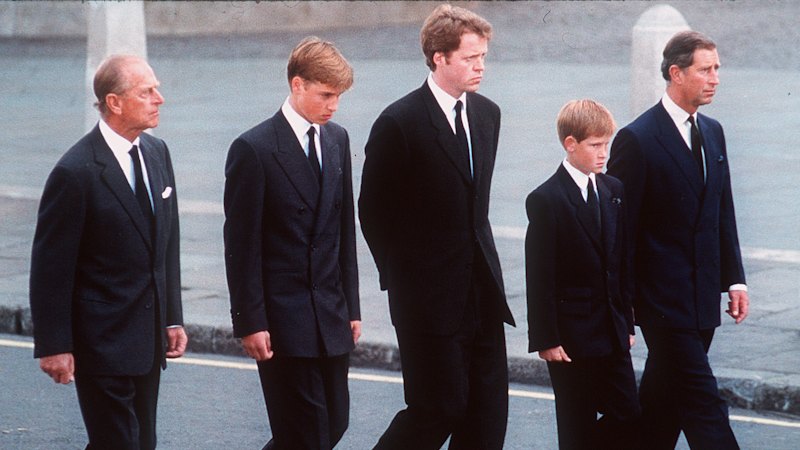
Suddenly, his sister—his flesh and blood, the girl who knew the same childhood wounds and family eccentricities—was seized by the planet. Millions wept in the streets of London, tossing flowers until the pavement disappeared beneath a carpet of petals. Candles flickered outside Kensington Palace. Hymns echoed through Westminster Abbey. In that surreal, bewildering blur, a private brother was forced to share his mourning with a billion strangers who demanded a piece of his sister’s memory.
That division never truly heals. How could it? When you walk through a museum dedicated to your childhood home and see millions of people looking at replicas of your sister's life, the boundary between personal memory and public property shatters permanently. Every anniversary brings a fresh wave of media vans, probing questions, and well-meaning mourners standing at the gates, waiting for a sign, a word, an emotional offering.
Yet, away from the cameras, beneath the towering oak trees of the parkland where she rests on a secluded island in the oval lake, the reality of her absence is starkly mundane.
Loss is rarely cinematic in the quiet hours. It does not arrive accompanied by swelling orchestral strings. It is found in the sudden, jarring realization that a phone number will never ring again. It is the spontaneous impulse to share a joke, an old family memory, or a petty grievance, only to hit the impenetrable wall of finality.
Charles knows this wall intimately.
When he talks about missing her every day, he is not performing for an audience. He is articulating a universal human truth that transcends nobility. Anyone who has lost a foundational pillar of their early life understands the haunting persistence of phantom limbs. You learn to walk through the world, you learn to laugh, you build a life around the crater, but the missing piece remains missing. The shape of the void does not shrink. You simply grow around it.
Consider what happens when a family is torn apart so violently under the unforgiving glare of the spotlight. The trauma calcifies. It embeds itself in the architecture of daily existence. For years, Charles has remained the guardian of Althorp, maintaining the estate not merely as a historic landmark, but as a shrine and a sanctuary. Every corridor holds a memory of a time before the cameras arrived, before the fairy tale soured, before the tragedy cemented Diana into marble and myth.
It is easy for the public to forget that behind the statues and the exhibitions stands a human being who simply wants his sister back. People project their own grief onto public figures, using them as emotional vessels. We look to Charles to carry our collective nostalgia for the nineties, for a princess who made the royal family feel human, for a vanished era of innocence. We ask him to maintain the altar.
And he does. With quiet dignity, he preserves the grounds, manages the estate, and occasionally steps forward to remind the world of the fierce, vulnerable, deeply human woman who existed before the legend took over.
When he admits that the ache has not faded, that the passage of years has done nothing to dull the sharpness of the loss, he is committing an act of quiet rebellion against the cultural expectation that grief should have an expiration date. Society loves a neat narrative arc. We prefer our tragedies packaged with a beginning, a middle, and a redemptive resolution. We want the mourning to wrap up neatly so we can move on to the next chapter.
Life refuses to cooperate with that script.
Some wounds are structural. They alter the gravity of your entire existence. For the Spencer family, Diana’s shadow is not a seasonal topic to be dusted off every August for television ratings; it is the atmospheric pressure of their daily lives.
To walk the grounds of Althorp is to feel the weight of this invisible architecture. You see it in the hushed reverence of visitors standing by the lake. You hear it in the careful cadence of an older brother's voice when he speaks of her childhood spirit, her mischievous laughter, her innate sensitivity to the suffering of others.
The world got a symbol. Charles got a sister. And long after the memorials are quiet, long after the tourists have gone home and the iron gates are locked against the evening chill, the brother is left standing in the stillness, navigating a world that kept spinning while his stopped.
There are no tidy conclusions to grief like this. There is only the endurance of love, stubborn and unyielding, persisting long after the flowers have withered and the cameras have turned away.
The lake is calm today. The water laps gently against the shores of the island, undisturbed by the noise of the world outside. The trees drop their leaves into the dark current, marking the passage of another year, another season, another turn of the earth. And somewhere beneath the quiet Northamptonshire sky, a brother remembers, as he does every morning, the girl who used to run these halls, holding onto a bond that time cannot erode and death cannot silence.