The afternoon air in southern Lebanon carries the heavy, unyielding scent of dust and distant citrus groves. It is a familiar heat, the kind that settles deep into the marrow and makes every hour feel heavy with waiting. For months, perhaps years, time has meant nothing to the four civilians whose world shrunk to the dimensions of a cell, a concrete wall, and the persistent hum of uncertainty.
Then came the movement.
Borders are strange abstractions. Drawn by ink on aged maps, guarded by men with rifles, they are treated as immutable lines of destiny. Yet, on this particular day, a specific crossing point hummed with a different kind of tension. Not the tension of conflict, but the fragile, agonizingly slow machinery of release.
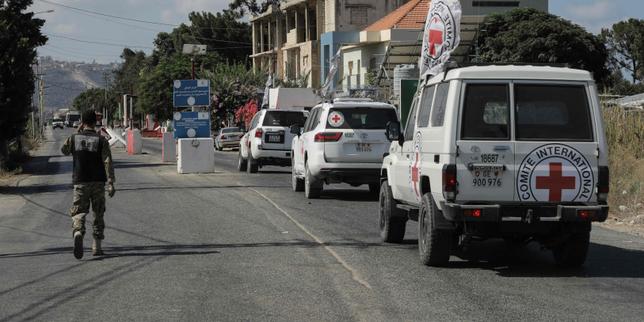
Let us be precise about the mechanics. According to verified reports and the official channels of the International Committee of the Red Cross, four individuals—civilians caught in the violent crosscurrents of a relentless regional standoff—were transferred from Israeli custody back to Lebanese soil. They were handed over at the border, received by delegates of the ICRC who have long served as the invisible bridge between warring sides, and transported toward their home territory.
These are the cold, clinical facts. They belong in a news ticker. They belong in a bulleted press release issued by an international organization rushing to document logistics before the sun dips below the Mediterranean ridge.
Civilian lives are not logistics.
Imagine standing on a strip of neutral earth. The grass is dry. The white vehicles of the Red Cross bear a red emblem that has meant sanctuary in the worst places on Earth for over a century. You have spent an eternity answering questions in rooms with no windows. You have learned to measure life by the shifting slant of light beneath a door. And suddenly, someone tells you to step forward.
Just four people. In the grand ledger of modern geopolitics, where casualty counts scale into the tens of thousands and entire cities are reduced to skeletal outlines of rebar and ash, four is a statistical whisper. It is a rounding error.
To ignore that whisper is to miss the entire architecture of human suffering.
The weight of a war is never borne solely by the combatants. Soldiers sign an implicit contract; they carry rifles, wear uniforms, and accept the grim mathematics of engagement. Civilians do not. They are the bakers, the farmers, the university students, the mechanics, the elderly grandmothers tending to jasmine vines on balconies that suddenly catch shrapnel. When a civilian is detained, a family system collapses. A chair sits empty at dinner every single night. A mother checks her phone at three in the morning, jumping at every ring, wondering if tonight is the night the silence breaks.
Consider what happens when that silence finally does break.
The handover at the border was quiet. There were no grand speeches, no political theater staged for evening broadcasts. The ICRC operates on a strict doctrine of neutrality, a calculated silence that allows them to cross lines where others would be shot. Their delegates checked documents, verified identities, and offered quiet words of reassurance in Arabic and Hebrew.
Humanitarian logistics are rarely heroic in the cinematic sense. They are bureaucratic, tedious, and filled with endless waiting. Delays happen because a signature is missing, because a checkpoint commander wants to re-verify a serial number, because bureaucracy loves a tragedy.
Yet, beneath that paperwork beats the raw pulse of survival.
When the four individuals crossed into Lebanese territory, they did not step into an uncomplicated paradise. They stepped back into a nation fractured by economic ruin, political paralysis, and the constant, vibrating anxiety of what tomorrow might bring. Their homes may still stand, or they may be piles of gray rubble. Their families may be waiting with tears and feast-laden tables, or they may have been displaced to temporary shelters miles away.
This is the hidden cost of displacement and detention. It does not end with a handshake at a border post.
Release is not a destination. It is the beginning of a grueling excavation. How do you re-enter a world that moved on without you? How do you quiet the phantom footsteps in the hallway after you have spent months learning to fear every sound?
We often talk about peace treaties as if they are signed on paper by men in tailored suits. We forget that peace is actually negotiated in the quiet reunions of ordinary people who were never supposed to survive the crossfire. Every time an international agency facilitates a transfer, every time a prisoner returns home, a tiny fracture in the global fabric is sewn back together—imperfectly, clumsily, but necessarily.
The white vehicles of the Red Cross rolled away from the border, their mission complete for the afternoon. Somewhere down the winding coastal highway, a car door opened. Feet touched the ground. A voice called out a name, and a family stopped holding its breath.