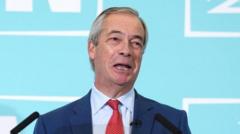
The British political press is currently obsessed with a script that belongs in a bin. You’ve seen the headlines: Nigel Farage launches a campaign, claims the local elections are a "referendum" on Keir Starmer, and the Westminster bubble collectively gasps. It is a neat, tidy narrative. It is also fundamentally wrong.
Calling a local election a referendum on a sitting Prime Minister is the oldest trick in the consultant’s playbook. It’s a low-stakes way to manufacture high-stakes drama. But here is the truth that neither Reform UK nor the Labour Party wants you to swallow: Nigel Farage isn’t Starmer’s executioner. He is his shield.
The Myth of the Referendum
When Farage stands at a podium and declares that the upcoming vote is a judgment on Starmer’s performance, he is performatively inflating the importance of a set of contests that are usually decided by bin collections and pothole repairs.
Historically, local elections are terrible predictors of general election outcomes. They are "protest votes" by design. People use them to kick the dog because they know the dog won't actually die. In 2021, the Conservatives dominated local polls only to see their national polling collapse shortly after. In the 1990s, the Liberal Democrats regularly cleaned up in local seats while remaining a distant third in Parliament.
By framing this as a "referendum on Starmer," Farage is doing the Labour leader a massive favor. He is lowering the bar. If Labour loses a handful of councils but maintains its core, Starmer can claim he "survived the referendum." If Reform gains a few seats, Farage gets a news cycle. Both men get what they want: relevance without responsibility.
Why Farage Needs Starmer to Stay Exactly Where He Is
The lazy consensus suggests that Reform UK is the primary threat to the Labour establishment. That is a fundamental misunderstanding of the British electoral map.
Farage’s true utility in this cycle is as a disruptor of the right-wing base. Every vote Reform UK peels away from the Conservatives in a local election is a gift to Labour candidates. In the "Red Wall" seats—those post-industrial heartlands that flipped to Boris Johnson in 2019—Farage acts as a wedge. He doesn't necessarily win the seat for Reform; he just ensures the Conservative candidate loses.
I’ve watched political operatives spend millions trying to calculate the "Farage Effect." They always miss the point. Farage is not building a government; he is building a brand. His goal is to be the loudest voice in the room, not the man holding the keys to Number 10. To do that, he needs a "left-wing" bogeyman like Starmer to rail against. A successful, unchallenged Starmer is the best marketing tool Farage has ever had.
The Competency Trap
The media frames Starmer’s struggle as a "personality crisis." They ask, "Is he charismatic enough?" or "Does he have a vision?"
These are the wrong questions. Starmer’s real problem—and the one Farage is expertly exploitation—is the Competency Trap.
The Competency Trap occurs when a leader promises "adults in the room" governance but inherits a system that is fundamentally broken beyond the reach of mere administrative competence. When the NHS wait times don't drop and the boats don't stop, the "sensible manager" looks like an incompetent one.
Farage doesn't offer solutions to these systemic failures. He offers a vent for the frustration. He isn't competing on policy; he is competing on vibes. While Starmer is busy trying to explain the fiscal rules and the complexities of planning reform, Farage is talking about "taking our country back."
- Starmer's Strategy: Incrementalism and risk-aversion.
- Farage's Strategy: Maximum friction and cultural polarization.
One is trying to fix a machine; the other is throwing a wrench into it and laughing at the sparks.
The Local Government Shell Game
Let’s talk about what these local elections are actually about: money. Or the lack of it.
For a decade, local councils have been the sacrificial lambs of the UK Treasury. They have been stripped of funding while being legally mandated to provide increasingly expensive social care. Whether a council is Red, Blue, or Reform-Purple, the math remains the same. They are bankrupt or heading there.
When Farage talks about these elections as a referendum on Starmer, he is ignoring the reality that local councillors have almost zero power to affect the national issues he complains about. A Reform councillor in Hartlepool cannot change national immigration policy. A Labour councillor in Birmingham cannot fix the national productivity crisis.
By nationalizing local politics, we are effectively destroying local accountability. We are voting for "The Message" rather than the manager of our parks and libraries. It is a vanity project for national figures played out on the stage of local decline.
The "People Also Ask" Delusions
If you look at what the public is searching for, the confusion is clear.
"Will Nigel Farage win the local elections?" No. Reform UK lacks the ground game, the data infrastructure, and the localized candidate vetting to win in any significant volume. They are a "vortex party"—they pull energy and attention toward the center, but they rarely leave a lasting structure behind.
"Is Keir Starmer losing his grip?" The premise is flawed. Starmer’s "grip" was always an illusion maintained by the collapse of the Conservative Party. He didn't win the public's heart; he was the last man standing in a burning building. Farage isn't making Starmer lose his grip; he's just pointing out that Starmer's hands were never actually on the wheel.
The High Price of the Protest Vote
There is a downside to this contrarian view that I must admit: the protest vote is addictive.
Once a voter realizes they can use a local election to "send a message" to London, they stop caring about the quality of their local representatives. This leads to a feedback loop of incompetence. We elect "message candidates" who have no interest in governance, the councils fail further, and the national populists use that failure as evidence that "the system" is broken.
It is a self-fulfilling prophecy.
Farage knows this. He is a master of the feedback loop. He doesn't want to fix the council; he wants the council's failure to prove his point.
The Reality of the "Referendum"
If you want to understand what is actually happening during this campaign launch, ignore the rhetoric about Starmer. Look at the Conservative benches.
Farage’s target isn't Starmer. His target is the soul of the Conservative Party. These local elections are a hostile takeover bid. By framing the vote as a referendum on Starmer, Farage is forcing Conservative candidates to defend a national record that is indefensible. He is forcing them to move further to the right to compete with him, which in turn alienates the moderate voters Starmer needs to win a general election.
It is a brilliant, cynical pincer movement. Starmer gets the "middle," Farage gets the "fringe," and the Conservative Party is hollowed out from the inside.
Stop Looking at the Podium
Every time a journalist asks Starmer how he feels about Farage’s "referendum" comments, the journalist has already lost. They are playing Farage’s game.
Starmer’s real challenge isn't a silver-tongued populist on a campaign bus. It’s the fact that he is offering a 1990s solution to a 2020s crisis. He is trying to be Tony Blair in an era that has no money, no optimism, and no consensus.
Farage is simply the man pointing at the emperor’s new clothes. He hasn't got any clothes of his own to offer, but in a cold climate, the man who admits it's freezing will always get more attention than the man trying to explain why the thermostat is technically functioning according to the latest quarterly review.
Don't buy the "referendum" hype. It’s a distraction from the fact that our local democracy is being used as a backdrop for a national soap opera.
Stop watching the campaign launches and start looking at the balance sheets of your local borough. That's where the real disaster is happening, and neither Farage nor Starmer has a plan to stop it.
Go check your council’s projected deficit for the next fiscal year. That’s the only referendum that actually matters.