Morning on the border smells like wet pine and cold iron.
If you stand on the edge of the clearing in Pabrade, looking east across the narrow ribbon of farmland that separates Lithuania from Belarus, the silence feels heavy. It is not a peaceful silence. It is the kind of quiet that holds its breath. A crow lifts off from a fence post, its wings beating against the heavy gray sky, and for a second, the sound is the loudest thing in Europe.
Down the road, twenty miles from the frontier, a twenty-four-year-old conscript named Lukas adjusts the strap of his helmet. His fingers are stiff in the October chill. He has never fired a shot in anger. He knows his history books well enough to remember what happens when small nations become footnotes in larger tragedies. His grandparents still speak of the gray trucks that rolled in decades ago, of doors beaten down in the middle of the night, of borders redrawn with blood and ink by men sitting thousands of miles away in warm rooms.
Lukas is not thinking about geopolitics right now. He is thinking about whether his thermal socks are dry.
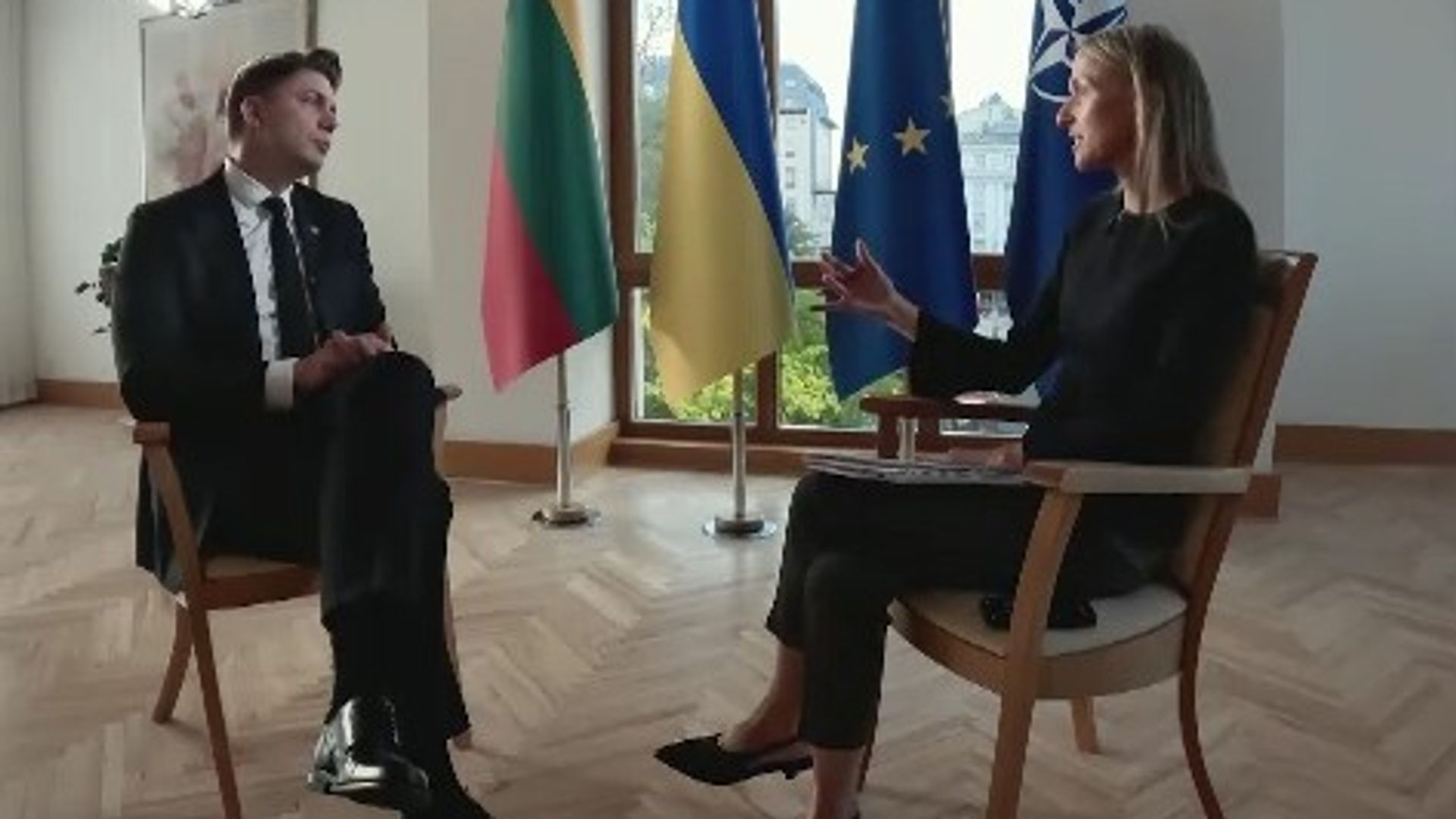
Yet, his boots stand on a threshold that the entire architecture of Western security is currently pledged to defend. When Lithuanian Prime Minister Ingrida Simonyte speaks with absolute confidence about a massive NATO response to any potential Russian aggression, she is not just talking to reporters in Vilnius. She is talking to Lukas. She is talking to the mothers pushing strollers down Gediminas Avenue. She is talking to a Kremlin calculation room where every word, every hesitation, and every tremor of doubt is weighed on a jeweler’s scale.
Deterrence is an invisible currency. It only has value if everyone believes the vault is full.
To understand why Lithuania’s leadership projects such unwavering certainty about Article 5—the foundational collective defense pact of the North Atlantic Treaty Organization—you have to look past the crisp suits and diplomatic communiques. You have to look at the geography of vulnerability. Lithuania is a narrow strip of land, flanked by the heavily militarized Russian exclave of Kaliningrad to the west and Belarus to the east. It is a dagger point on the map. If you study a topographical map of the region, there are no great mountain ranges to hide behind, no sprawling expanses of tundra to slow an advance. There are only rivers, forests, and small towns with names that most people outside the Baltics cannot pronounce.
For centuries, this flat landscape has been a highway for empires on the march.
When the Soviet Union collapsed, nations like Lithuania made a generational gamble. They looked West. They traded the dictated safety of the Warsaw Pact for the democratic friction of the European Union and the nuclear umbrella of NATO. That gamble was not made out of naive optimism. It was made out of a cold, historical clarity: standing alone in the European plain is a fatal error.
Now, as the war in Ukraine grinds through its brutal seasons, that gamble faces its ultimate stress test.
Critics in foreign think tanks sometimes whisper about the periphery. They ask if a capital city five hundred miles from Berlin is truly worth a global confrontation. They calculate risks in percentages and acceptable losses. But those calculations miss the fundamental psychology of deterrence. The moment a leader begins to qualify their commitment—the moment a phrase like "all necessary means" is weighed against domestic political convenience—the wall begins to crumble.
This is why Simonyte’s rhetoric is deliberately absolute. There is no room for ambiguity in the grammar of survival.
If an aggressor believes that an attack on the Baltic states might trigger a fractured, hesitant response—that some member states might argue for weeks over whether a cross-border strike constitutes a full-scale invasion—then the threshold for war drops dangerously low. Ambiguity is an invitation. Clarity is a shield.
Consider what happens inside a command bunker when a leader draws a hard line.
Every radar screen is monitored. Every troop movement across the border is logged by satellites hanging silently in the thermosphere. Analysts pore over intercepted radio traffic, looking for the subtle cadence shift that separates an exercise from an assault. In that environment, the political leadership's public stance acts as the ultimate anchor. It tells the military planners that their orders will not change when the first shell lands. It tells the alliance that the political will matches the treaty text.
Lukas doesn't read the white papers published by Brussels think tanks. He doesn't analyze the fine print of NATO’s strategic concept. But he knows what his sergeant told him this morning: We are not alone here.
That phrase is easy to print on a poster. It is much harder to believe when the wind howls through the pines and the horizon to the east turns the color of a bruised plum.
Yet, the alliance has spent years knitting its physical presence into the fabric of these frontline states. Multinational battlegroups, composed of German, Dutch, Norwegian, and American soldiers, train side-by-side with Lithuanian forces in those very same forests. They share cold rations, broken-down engines, and language barriers that dissolve over shared thermoses of instant coffee. When a German Leopard tank maneuvers through a Lithuanian pine wood, it is not just a display of hardware. It is a physical manifestation of a promise. It is an insurance policy written in steel and tread marks.
If deterrence fails, the cost will not be measured in abstract economic sanctions or diplomatic rebuffs. It will be measured in rubble. Everyone in Vilnius knows this. The historical memory here is not an academic exercise; it is etched into the stone walls of the Old Town and passed down through family recipes and quiet kitchen-table warnings.
That is why the confidence coming from the Prime Minister’s office is different from ordinary political bravado. It is the armor of a nation that has decided it will never again be traded away in a secret protocol.
The sun breaks briefly through the overcast sky, casting long, sharp shadows across the clearing. Lukas looks down at his rifle, clears a speck of dirt from the receiver, and looks back toward the tree line.
A mile away, across an invisible line marked by yellow posts and cleared earth, the forest is quiet. But the world is watching. And the line holds.