The metal is cold before dawn.
If you press your forehead against a fence long enough, the chill of galvanized steel begins to mimic the weather inside your bones. It is a specific kind of cold, born of salt air rolling off the Mediterranean and the heavy, flat silence of a frontier that refuses to look you in the eye.
Hundreds of human beings stood against that cold on the outer rim of Spain.
We talk about borders as if they are lines drawn in ink on an old school atlas. We picture neat, clean divisions where one color bleeds politely into the next, separated by a dotted line and a cartographer's quiet stroke of precision. But a border is not a line. A border is a wall. A border is a camera lens clicking in the dark. A border is a gate that opens for goods, for capital, for passports stamped with the right ink, and slams shut for flesh, for bone, for desperation.
Consider what happens next.
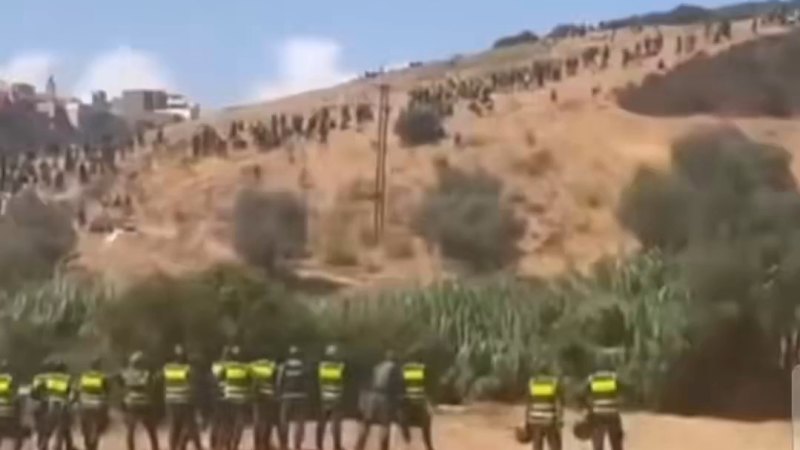
Dawn breaks over the enclave of Melilla. Or Ceuta. The geography shifts, but the concrete remains identical. To stand on the Moroccan side is to stand in a theater of infinite waiting. Behind you lies the dust of a journey measured not in miles, but in months—across deserts where the sand eats your shoes, through towns where strangers demand bribes for a cup of murky water, over ridges where the night wind strips the warmth right off your skin. Ahead of you sits Europe. Just over there. A strip of razor wire, a double fence twelve feet high, and a line of men in riot gear whose faces are hidden behind dark visors.
To them, you are a statistic. You are an influx. You are a pressure metric on a dashboard in Madrid or Brussels.
I remember the smell of wet wool and woodsmoke from a different camp years ago, but the smell is always universal. It smells like endurance. It smells like the desperate, stubborn refusal to accept that where you were born must dictate where your story ends.
When hundreds of people rush a border fence, television screens reduce the chaos to thirty-second soundbites. Helicopters hover overhead, churning the air into a frantic roar. Sirens wail. The anchors on the evening news lean into their microphones with practiced solemnity, speaking of security protocols, enforcement agencies, and migration crises.
They never tell you about Amina's shoes.
Amina is a hypothetical cipher, yes, but she is built from a thousand real women who stood in that exact mud. Amina wrapped her feet in plastic grocery bags before she ran, securing them with twine because her soles had given out somewhere in the Atlas Mountains. When the baton strikes the chain-link, the sound is metallic and final. It vibrates up through the palms of your hands. It tells you that stone and steel care nothing for why you are crying.
Spain blocks the crossing. That is the bare fact printed in the morning dispatches.
But what does blocking a crossing actually mean in human currency? It means a grandfather who sold his family's olive grove to finance his grandson's passage now sits on a curb in Nador, staring at his empty calloused hands. It means a young man who studied engineering in a city with no electricity finds himself pinned against a concrete pylon, his jacket torn, watching the lights of a Spanish ferry glide across the dark water just two miles away.
The distance between safety and suffering is often just a matter of geography and paperwork.
We have built a world where the accident of your birthplace is the ultimate sentence. If you are born inside the fence, your passport is a magic carpet. It buys you cheap flights, open doors, and the luxury of complaining about airport queues. If you are born outside the fence, your existence is treated as a logistical threat.
The authorities call it border management. The politicians call it sovereignty.
Language is a brilliant tool for sanitizing violence. We invent administrative terms so we don't have to look at the blood on the wire. We talk about "deterrence strategies" and "unauthorized entries" as if we are discussing traffic flow on a congested highway. But there are no cars here. There are only human chests heaving for air. There are only children clutching the hems of their mothers' torn skirts, wide-eyed and silent, learning early that the world is divided into those who are protected and those who are kept out.
Look closer at the line.
On the Spanish side, instructions are barked through megaphones. The loudspeakers crackle with authority. The message is absolute: Turn back. There is no way through.
On the other side, the silence is heavier than the noise. It is the silence of options evaporating. It is the quiet realization that the wall is not just a physical barrier, but a moral choice made by millions of people who will never have to smell the mud of the borderlands or feel the bite of the night frost on an open hillside.
History will not judge this era by our economic growth charts or our digital innovations. History will look at the fences. It will measure the height of the walls we built to keep our abundance safe from the misery we helped create through centuries of extraction, climate destabilization, and political meddling. We draw lines around our comfort and call it civilization.
The crowd outside the fence begins to thin as the sun climbs higher, burning off the morning mist. The tear gas clears. The sirens fade into the distance.
A few people manage to slip through, climbing high enough to touch European soil for one breathless, terrifying second before gravity and boots pull them back down. Most remain on the outside, huddled beneath plastic sheeting, waiting for darkness to give them back their courage.
The fence stands tall, freshly mended, gleaming in the noon sun.
Somewhere across the water, a coffee cup is set down on a ceramic saucer in a warm kitchen. A radio murmurs about border security. The butter melts on the toast. And out in the dust, a pair of plastic-wrapped feet takes another step toward a door that will not open.