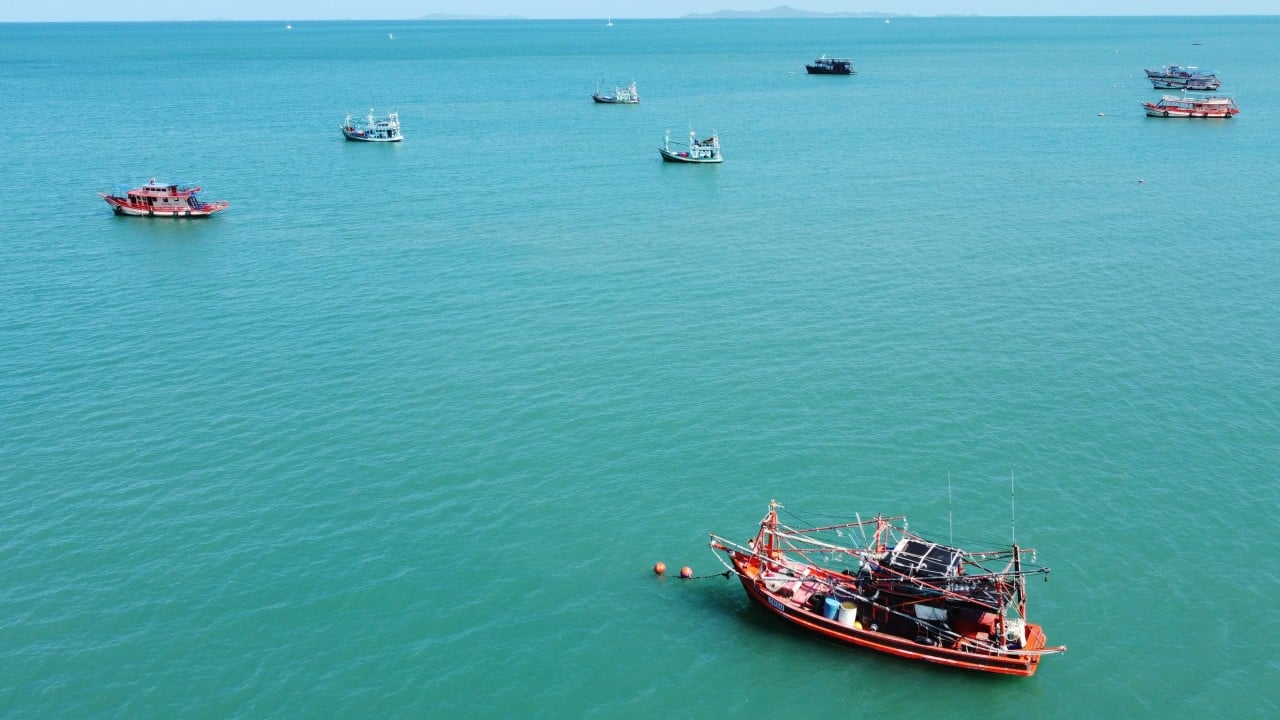
Salt air carries a sharp, metallic tang out in the Gulf of Thailand before dawn, when the water looks like hammered pewter and the horizon refuses to say where one country stops and another begins.
No fences stand on the waves. No border posts rise from the swell. Yet beneath roughly twenty-six thousand square kilometers of warm tropical water sits an estimated treasure worth up to three hundred billion dollars in trapped natural gas and oil—an invisible fortune that has quietly pulled Thailand and Cambodia toward friction for half a century while diplomats try to keep the peace.
From the outside, a maritime boundary dispute can sound like a dry cartographer's quarrel over coordinates, straight baselines, and exclusive economic zones. Read a standard wire report and you get neat sentences about overlapping claims, energy security, and talks to calm escalating tensions.
That misses the weight of the water.
When I first stood on a coastal pier overlooking the Gulf years ago, watching diesel-smelling trawlers chug past offshore supply vessels, I felt how deceptive calm water can be. On the surface, everything looked ordinary—sun glinting off small waves, gulls wheeling over nets, heat rising off concrete pilings. Below, geologists knew ancient sedimentary basins held billions of cubic feet of gas that could keep factories humming in Bangkok, light up homes in Phnom Penh, or spark a costly standoff if politics overtook patience.
I should be honest right away: international maritime law is dense, technical, and sometimes maddeningly ambiguous. Even seasoned negotiators struggle with why two neighbors who share history, trade, and a coastline can stare at the same stretch of sea and see two different maps. Let's trace why this dispute flares up, what is actually sitting under those waves, and why both capitals are trying to cool the temperature before a spark catches.
Two Maps Drawn in Different Ink
To understand why three hundred billion dollars sits frozen in place, picture a shared kitchen table where two roommates each drew their own boundary line with a permanent marker before sitting down together. (That is a metaphor for how unilateral maritime claims collide on a chart—no physical lines exist on the sea itself.)
In the early 1970s, Cambodia and Thailand each proclaimed maritime claims extending across the Gulf of Thailand. Because their coastlines curve and neighbor islands sit close to the shore—including Thailand's Koh Kut, which plays an outsized role in how lines are projected—the two claims overlapped across a wedge of roughly 26,000 square kilometers.
Why do countries draw overlapping lines in the first place? Because modern ocean law rewards geography and timing, and every nautical mile can carry billions in seabed resources and fishing rights. Under the 1982 United Nations Convention on the Law of the Law of the Sea—often shortened to UNCLOS—coastal states can claim territorial seas and exclusive economic zones extending up to two hundred nautical miles where geography allows, though enclosed or semi-enclosed seas like the Gulf of Thailand leave neighbors squeezing into tight quarters.
In 2001, Bangkok and Phnom Penh signed a Memorandum of Understanding—known as MOU 44—meant to create a framework for negotiating both the maritime boundary and joint development of resources in the overlapping zone. For years, talks stalled and restarted like an engine turning over in cold rain. Domestic politics in both countries often turned a technical border question into a test of national pride. Mentioning compromise on a map can suddenly sound like giving away soil, even when no one is standing on dry land.
Consider what happens next when energy demand climbs on both sides of the border.
The Human Stakes Beneath the Rig Lights
Imagine a hypothetical character to see how an abstract seabed number touches daily life: Somchai, a shift supervisor at a gas-fired power plant in eastern Thailand, and Sreyneang, a small-business owner in Cambodia whose workshop depends on steady, affordable electricity. (Both are fictional composites created to illustrate real economic pressures rather than specific individuals.)
Somchai watches gas supply numbers the way a farmer watches rain clouds. Thailand has long relied heavily on natural gas to generate electricity, and domestic gas fields in the Gulf have matured over decades, forcing the country to import more liquefied natural gas at volatile global prices. Every dollar spent on expensive LNG imports is a dollar not going into grid upgrades, public transit, or household relief.
Now look across the water toward Sreyneang in Cambodia. Cambodia's economy has grown rapidly over recent decades, driving up demand for reliable power to run mills, cold storage, and small workshops. Cheaper, closer domestic energy—if safely and fairly tapped—could lower power costs and broaden energy independence.
Yet neither power grid can plug into a pipe that does not exist.
Exploration and production in disputed waters carry massive commercial risk. Energy companies hesitate to sink billions of dollars into drilling platforms, subsea pipelines, and processing gear if a sudden diplomatic freeze or patrol clash could halt operations overnight. Nobody wants a multi-billion-dollar rig stranded in geopolitical limbo.
Fishermen feel the ripple effects too. Boats working near contested waters face heightened anxiety whenever naval patrols step up or political rhetoric heats up. A routine day hauling catch can turn tense fast when maritime authorities tighten scrutiny around sensitive zones.
Why Both Sides Reach for the Brake
Escalation is loud. Calm is quiet work.
When tensions rise between Thailand and Cambodia over the overlapping seabed area, headlines naturally gravitate toward sharp rhetoric, nationalist commentary, or fears of a standoff at sea. Yet both governments have strong reasons to pull back from the brink rather than let a resource dispute spiral.
Trade binds them tightly. Thailand and Cambodia are neighbors within the Association of Southeast Asian Nations, linked by cross-border supply chains, migrant workers, tourism, and overland commerce. A prolonged rift over seabed gas would hurt far more than energy talks; it would sour cooperation on border trade, security, and regional stability.
There is also a practical lesson from history across Southeast Asia. Neighbors with overlapping offshore claims have sometimes found ways to separate sovereignty questions from commercial development—creating joint development areas where revenue and costs are shared while final boundary lines remain a subject of long-term negotiation. Whether Bangkok and Phnom Penh can revive and update that spirit of compromise depends on political will in both capitals and public trust at home.
Still.
No diplomatic memo erases decades of mutual suspicion overnight. A three-hundred-billion-dollar estimate is a ceiling of possibility, not cash sitting in a vault today—actual recoverable reserves, extraction costs, environmental safeguards, and market prices all shape what can realistically be pulled from the seabed.
What Keeps the Water Still
When people ask whether this dispute can be solved quickly, the honest answer is no. Maritime boundaries are among the slowest puzzles in international diplomacy because they touch territory, money, and history all at once.
Yet calming an escalating dispute is not nothing. Keeping hot tempers out of cold water buys time for technical teams, legal experts, and leaders to talk rather than posture. It protects coastal communities from sudden flare-ups and signals to markets that two neighbors prefer negotiation over confrontation.
Out on the Gulf, the sun climbs higher and turns the pewter swell bright blue. A cargo ship crosses the horizon, leaving a long white wake that slowly smooths back into the sea, reminding anyone watching that the ocean remembers nothing—and everything depends on what humans choose to write on the map.