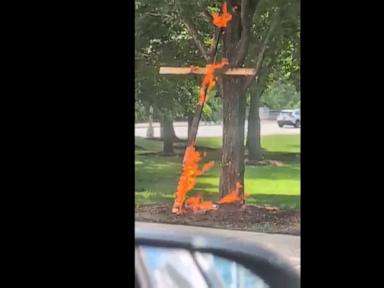
The prosecution of bias-motivated property destruction operates at the intersection of criminal mischief, arson, and constitutional law. When an individual admits to igniting a cross in a public park within municipal limits, the legal trajectory shifts from a standard property offense to a state or federal hate crime prosecution. This shift is governed by strict evidentiary frameworks and statutory thresholds that transform the act from localized vandalism into a specialized category of civil rights violations.
The underlying mechanics of this legal transformation rely on proving a dual-intent structure. The state must establish not only that the physical act of arson occurred, but that the selection of the symbol and the location was explicitly predicated on the victim's actual or perceived protected characteristic.
The Prosecutorial Framework for Bias-Motivated Arson
To understand the elevation of a property crime to a hate crime enhancement, the offense must be deconstructed into its component variables. Criminal statutes generally require two distinct elements: actus reus (the guilty act) and mens rea (the guilty mind). In standard property crimes, the mens rea requires proof of intent to destroy property. In a hate crime prosecution, a third variable is introduced: bias motivation.
The structural framework of this prosecution can be broken down into three operational pillars.
The Objective Act of Destructive Conduct
The baseline offense requires clear physical evidence of property destruction or unauthorized ignition. In public parks, this typically involves municipal property or items brought explicitly to the site for destruction. The physical manifestation of the fire provides the foundational charge, establishing the baseline parameters for criminal liability.
The Symbolic Selection Matrix
The choice of a burning cross carries defined historical and legal weight. Within American jurisprudence, specifically following benchmarks established in cases like Virginia v. Black, a burning cross is recognized as a specific instrument of intimidation. The selection of this symbol removes the act from random arson and categorizes it as targeted expressive conduct designed to communicate a threat.
The Target Demographics and Public Space Selection
The geography of the offense serves as an accelerant for prosecution. A public park is a non-exclusive zone protected by federal and state public accommodation laws. Executing an act of symbolic intimidation in a shared public space broadens the class of victims from an individual to an entire community demographic, satisfying the statutory definition of public intimidation.
The Evidentiary Threshold of Intent Self-Admission
The primary challenge in hate crime litigation is proving the subjective motivation of the defendant. Absent explicit documentation, prosecutors must rely on circumstantial evidence. A direct self-admission alters this evidentiary calculus, removing ambiguity regarding the defendant's immediate objectives.
[Intent Identification] -> [Symbolic Execution] -> [Admitted Bias] = Statutory Enhancement
The admission of guilt regarding the ignition acts as a foundational anchor. However, an admission of the physical act does not automatically satisfy the statutory requirements for a hate crime enhancement. The prosecution must tie the admission directly to the animus.
The first mechanism involves verifying the temporal alignment of the statement. Admissions made during or immediately following the apprehension carry higher evidentiary weight under standard hearsay exceptions, such as excited utterances or statements against interest. The secondary mechanism involves corroborating the admission with digital or physical artifacts, such as digital search histories, possession of materials, or ideological literature.
When a defendant admits to the act, the defense strategy typically shifts from denying the conduct to challenging the legal classification of the intent. The defense may argue that the conduct, while destructive and offensive, lacks the specific targeted intent required by hate crime statutes, attempting instead to reduce the charges to reckless conduct or criminal damage to property. This creates a structural bottleneck in the trial strategy, forcing the prosecution to rely heavily on the precise wording of the admission.
Public Space Jurisprudence and Community Impact Metrics
The choice of a municipal park as the site for bias-motivated arson introduces distinct legal complexities regarding public accommodation and community harm. Under Title II of the Civil Rights Act of 1964 and corresponding state statutes, individuals are guaranteed equal access to public accommodations, including public parks, free from discrimination or intimidation.
The legal injury in this context extends beyond the physical degradation of the park infrastructure. The harm is quantified through the systematic exclusion of protected classes from public spheres. When an act of symbolic violence occurs in a shared space, it functions as a psychological barrier, effectively denying access to the space for specific segments of the population.
The prosecution measures community impact through several vectors:
- The proximity matrix: The geographical relationship between the incident site and residential areas populated by protected demographics.
- The operational disruption: The measurable decrease in park utilization or the cancellation of community events following the incident.
- The municipal expenditure: The direct financial cost allocated to security posture adjustments, structural repairs, and community outreach frameworks.
This systemic harm elevates the offense from a private dispute to a public safety crisis, providing the justification required for the state to pursue maximum statutory penalties under hate crime enhancement provisions.
Systemic Bottlenecks in Hate Crime Classifications
Statutory enhancements are powerful tools, yet their application faces systemic bottlenecks within the judicial framework. The primary limitation stems from the variance between state and federal hate crime definitions. Local jurisdictions may operate under statutes that require proof that bias was the sole motivating factor, whereas other frameworks require bias to be a substantial motivating factor among others.
This structural variance creates a high burden of proof for local prosecutors. A defendant may argue that the act was motivated by generalized anti-social behavior, substance use, or mental health crises rather than specific group animus. If the jury finds reasonable doubt concerning the singularity of the bias motivation, the enhancement fails, leaving only the base property charges intact.
The second limitation is the risk of constitutional overreach. Expressive conduct, even when deeply offensive, is protected under the First Amendment unless it crosses the threshold into a "true threat" or incitement to imminent lawless action. The prosecution must demonstrate that the burning cross in a public park was not merely offensive expression, but a direct, targeted threat intended to place individuals in reasonable fear of physical harm.
Strategic Allocation of Judicial Resources
To maximize the probability of a successful conviction in high-profile bias offenses, prosecution strategies must pivot toward a dual-track adjudication model. Municipalities should not rely exclusively on local hate crime enhancements, which are vulnerable to localized jury biases and statutory limitations. Instead, local law enforcement must establish immediate evidence-sharing protocols with federal agencies, specifically the Department of Justice Civil Rights Division.
This dual-track strategy ensures that if state-level enhancements face procedural bottlenecks or fail to meet the sole-motivation threshold, federal charges under the Matthew Shepard and James Byrd Jr. Hate Crimes Prevention Act can be deployed as a secondary enforcement mechanism. Federal statutes often provide broader definitions of intent and carry more substantial mandatory minimum sentences, creating an effective countermeasure against localized judicial vulnerabilities.