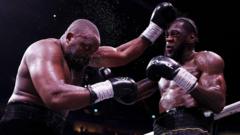
The air inside the arena didn’t smell like a sporting event. It smelled like a forge. It carried that thick, metallic tang of sweat hitting hot canvas, mixed with the expensive cologne of front-row spectators who had no idea what it felt like to be punched in the liver by a man weighing two hundred and forty pounds. To the casual observer, the fight between Derek Chisora and Deontay Wilder was a heavyweight crossroads. To those who understand the violent geometry of the ring, it was something far more desperate. It was a study in the persistence of the human will against the cold, mechanical reality of physics.
Derek Chisora walked toward the ring like a man heading to a shift at a coal mine. There were no theatrics. There was no dancing. At this stage of his career, "War" Chisora is less of a boxer and more of a walking monument to endurance. He carries the scars of a thousand gym wars and the heavy gait of a veteran who knows that every round survived is a victory against time itself. Opposite him stood Wilder, the Bronze Bomber, a man whose entire boxing identity is built on a single, terrifying truth: he only has to be right for one second. You have to be right for every second of every minute of every round.
The disparity is cruel.
The Weight of Every Step
When the first bell rang, the tension was a physical presence. You could feel it in your teeth. Chisora did exactly what everyone knew he would do. He marched forward. He tucked his chin behind his lead shoulder, making himself small, trying to close the distance where Wilder’s long, lever-like arms become liabilities rather than weapons. It is a terrifying way to make a living. It is the equivalent of trying to disarm a bomb while the timer is ticking, knowing that the slightest slip of the hand results in total erasure.
Chisora found success early. He lunged in with overhand rights that looked more like haymakers thrown in a car park than polished pugilism. But they landed. They landed with a thud that echoed in the quiet moments between the crowd's roars. For a few rounds, it felt like the old guard might actually pull it off. The narrative of the "gatekeeper" is often used as an insult in boxing, but it shouldn't be. A gatekeeper is the one who decides who is worthy of entering the hall of legends. Chisora was testing Wilder’s worthiness, forcing the American to breathe the thin air of a deep-water fight.
Wilder looked uncomfortable. He looked human. He was backed against the ropes, his spindly legs absorbing the shock of body shots that would have folded a normal man. But Wilder possesses a haunting quality that most fighters lack. He can look like he’s losing a fight right up until the moment he ends it. He doesn't need a rhythm. He doesn't need a lead in the judges' scores. He just needs a gap.
The Physics of the Finish
Consider the mechanics of a Wilder right hand. It isn't a punch in the traditional sense; it is a ballistic event. It starts in his toes, travels through a frame that seems too lean for such violence, and culminates in a gloved fist that moves at a velocity that defies the heavy-set nature of the division.
As the middle rounds approached, the pace began to take its toll on Chisora. The human body is not designed to sustain that level of intensity while under constant threat of a knockout. His movements became a fraction of a second slower. His head movement, once crisp, began to lag. It was the "invisible stake" of the fight—the slow erosion of a man’s defensive shell under the psychological pressure of Wilder’s looming right hand.
Then, it happened.
It wasn't a flurry. It wasn't a sustained beating. It was a single, clean connection. Wilder found the angle he had been calculating for twenty minutes. The punch landed flush on the temple, and for a heartbeat, the entire arena went silent. Chisora didn’t fall like a man who had been tripped. He fell like a building whose foundations had been detonated.
The referee's count felt like a formality.
There is a specific kind of heartbreak in seeing a veteran like Chisora hit the floor. It isn't just about the loss. It’s about the realization that the grit, the heart, and the decades of sacrifice can be undone by one mistake. It’s the unfairness of the sport laid bare. Chisora had outworked Wilder for significant portions of the contest. He had shown more craft. He had shown more heart. None of it mattered. In the heavyweight division, power is the ultimate eraser. It rubs out the story you were trying to write and replaces it with a blunt, final period.
The Morning After the War
In the aftermath, the headlines focused on Wilder’s return to form and what it means for the title picture. They talked about rankings and mandatories and "game-changing" paydays. But those are cold facts. They don't capture the image of Chisora sitting on a stool in a quiet dressing room, his face mapped with bruises, wondering how many more times he can go to the well.
Boxing is the only sport where you can do everything right and still lose everything in a heartbeat. It mirrors the most frustrating parts of life—those moments where hard work is eclipsed by someone else's natural, unearned gift. Wilder has that gift. He is a freak of nature in a sport of technicians.
Chisora, meanwhile, remains the soul of the British heavyweight scene. He is the man who refuses to go away, the one who forces the stars to prove they are made of something more than hype. He lost the fight, but he reaffirmed why we watch. We don't watch for the technical perfection of a jab. We watch for the man who knows the bomb is going to go off and walks toward it anyway.
The lights in the arena eventually dimmed, and the crowds filtered out into the cold night air, talking about who Wilder should fight next. They had already moved on. But the image of that right hand remains burned into the collective memory of everyone who was there—a reminder that in the ring, as in life, you are only ever one second away from everything changing.
Derek Chisora walked out of the building the same way he walked in. Head down. Shoulders broad. Still carrying the weight of a world that demands everything from its warriors and gives back very little in return. He is still the gatekeeper. And the gate is heavier than it has ever been.
The roar of the crowd is gone, replaced by the ringing in the ears and the long, slow walk to the next battle.
Physics won. But the human element? That stayed in the ring, soaked into the canvas, waiting for the next man brave enough to try and defy it.