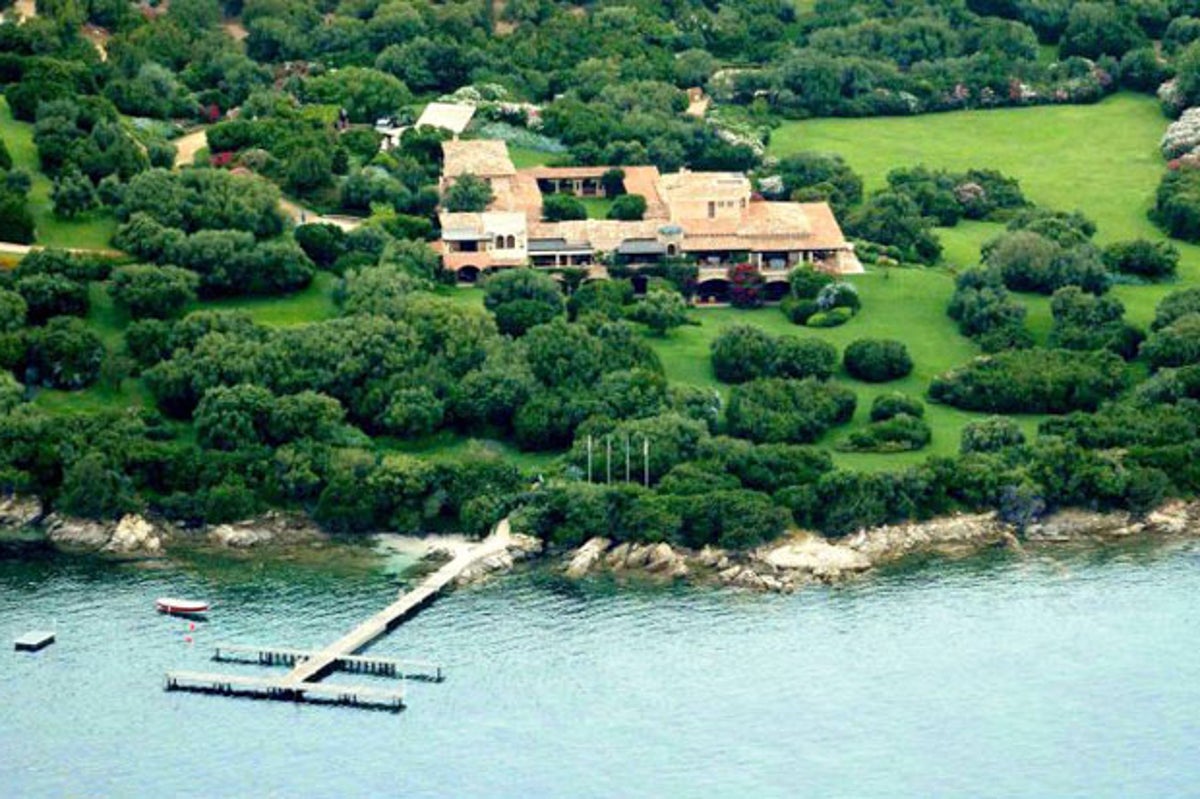
The sea breeze off Sardinia’s Costa Smeralda carries a specific scent. It smells of wild myrtle, salt crust, and the heavy, intoxicating perfume of money so vast it shapes the politics of a continent. For decades, that breeze whistled through the manicured grounds of Villa Certosa, a 120-hectare compound that functioned less like a residence and more like a sovereign theatrical state.
Silvio Berlusconi built this place to stun. He filled it with 126 rooms, an amphitheater inspired by ancient Greece, seven swimming pools, and an underground cave where James Bond-style speedboats could slide into the subterranean gloom, away from the telephoto lenses of the paparazzi. He even constructed an artificial volcano that, at the push of a button, would shake the earth and spew fireworks into the Mediterranean night.
Power. Excess. Spectacle.
But the volcano is quiet now. Silvio Berlusconi passed away, leaving his five children to parse through the colossal, complicated architecture of his ghost. This week, Fininvest, the family holding company, accepted a binding offer to sell the crown jewel of the billionaire’s real estate empire. The price tag is a staggering €350 million, down from an initial ambitious valuation of €500 million.
The buyer is not an Italian industrialist, nor a tech billionaire from Silicon Valley. The keys are being handed to Constellation Hotels Holding Ltd, an investment vehicle tied directly to the Al Thani dynasty—the royal family of Qatar.
The Ghosts in the Grotto
To understand why this transaction is more than a simple high-end real estate flip, you have to look past the spreadsheets. Consider what happens when the physical stage of a nation's defining political era changes hands.
During the peak of Berlusconi's four terms as prime minister, Villa Certosa was the epicenter of global leverage. Tony Blair and his wife Cherie spent summers here, strolling past the thousands of rare cacti. Vladimir Putin visited frequently; in the summer of 2002, his teenage daughters used the estate as their private playground. It was a venue where treaties were unofficial, alliances were forged in linen shirts, and the lines between public governance and private debauchery were permanently blurred.
It was also the birthplace of the infamous "bunga bunga" mythos. The estate became synonymous with late-night decadence, a symbol of a media mogul who viewed the world as a television studio and his properties as the ultimate set. When a Spanish newspaper published photos of naked European politicians lounging by these very pools, it sparked a firestorm that ultimately fractured Berlusconi’s marriage and signaled the twilight of his political dominance.
Imagine being one of his heirs walking through those empty corridors today. The party music has stopped. The heavy velvet curtains are drawn against the harsh Italian sun. For the children, selling the villa isn't just a corporate restructuring; it is a profound, perhaps painful detachment from the towering, exhausting legacy of their father. They are rationalizing a portfolio, yes, but they are also burying the past.
The Quiet Shift of Global Ownership
The transaction highlights a broader, quieter transformation across southern Europe. Local dynasties are receding. Sovereign wealth from the Gulf is moving in to fill the vacuum.
The Al Thani family is not a stranger to Sardinia's Gallura region. Qatar has been systematically investing in the area for years, securing prime stretches of the Costa Smeralda through the Qatar Foundation and funding major local infrastructure like the Mater Olbia Hospital. They do not buy properties to throw wild parties; they buy them to anchor institutional presence.
Where Berlusconi used Villa Certosa as a loud, brash projection of personal ego, the new Qatari owners view it through the lens of long-term asset management. The theatricality is being replaced by corporate precision. Will the mock volcano ever erupt again? It seems unlikely. The estate will either become an ultra-luxury, high-security enclave for the global elite or an ultra-exclusive resort where the ultra-wealthy can sleep in the rooms where modern history was quietly negotiated.
The transition feels inevitable, yet it carries a distinct melancholic weight for the locals who watched the Cavaliere's helicopters land for forty years. Berlusconi was polarizing, flawed, and chaotic, but he was undeniably Italian. The sale of his fortress marks the end of an era of homegrown, eccentric barons.
The speedboats have cleared out of the hidden grotto. The Greek amphitheater stands empty under the stars. On the coast of Sardinia, a new flag is being hoisted over the old playground, written in the quiet, absolute language of sovereign finance.