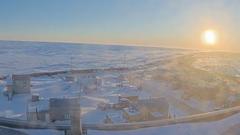
The sun doesn't set so much as it surrenders.
In Utqiagvik, Alaska, the northernmost settlement in the United States, the horizon is a thief. On a Tuesday in mid-November, the residents gather at the edge of the world to watch a gold coin slip into a slot it won’t emerge from for sixty-five days. There is no fanfare, no fireworks, and no Hollywood swell of music. There is only the wind, the biting scent of brine and frozen diesel, and the heavy, physical realization that the lights are going out until late January.
Imagine a man named Elias. He is a composite of the souls who call this tundra home—part hunter, part technician, part philosopher. He stands on the shore of the Arctic Ocean, his breath hitching in a frost-dusted beard. He isn't watching the sunset because it's beautiful. He’s watching it because it’s a deadline.
For the next two months, the sun will remain below the horizon. This isn't just a quirk of geography or a trivia point on a weather broadcast. It is a fundamental shift in the chemistry of the human brain.
The Weight of the Blue
When the sun dips below the horizon in the Arctic, the world doesn't immediately turn pitch black. Instead, it enters a prolonged, ethereal state known as civil twilight. For a few hours each "day," the sky bruised with shades of violet, indigo, and a fleeting, ghostly pink. It is a period of transition where the air feels thick, almost liquid.
Scientists call this the Polar Night. To those living through it, it feels more like a long, shared breath held in the lungs.
The mechanics are simple, yet they feel like a betrayal of the senses. Because the Earth is tilted on its axis at approximately $23.5°$, the regions within the Arctic Circle are shielded from the sun’s rays during the winter solstice. As the planet journeys around the sun, the top of the globe leans away into the shadow of space. For Utqiagvik, situated at $71.3°$ North, the math is brutal.
Elias knows the math. He also knows the cost.
Without the sun, the body’s internal clock—the circadian rhythm—begins to drift like a boat cut from its moorings. The pineal gland, confused by the perpetual gloom, overproduces melatonin. You feel heavy. Your limbs move through the day as if wading through waist-deep slush. In the lower forty-eight states, people talk about the "Monday blues." In the high Arctic, the blue is a season. It is a color that settles into the walls of your house and the marrow of your bones.
The Architecture of Survival
Survival here isn't about fighting the dark; it's about building a life that doesn't require the sun to function.
In the absence of natural light, the town becomes a constellation of artificial glows. High-intensity discharge lamps hum in living rooms, mimicking the spectrum of a sun that refuses to rise. Vitamin D supplements are consumed like daily bread. But the most important infrastructure isn't electrical—it’s social.
When the sun vanishes, the community draws inward. The "invisible stakes" are the threads of sanity that keep a small population from fracturing under the pressure of isolation.
Consider the local high school. In any other town, a basketball game is a pastime. In Utqiagvik during the Polar Night, it is a lifeline. The gym becomes a sanctuary of heat and light, a place where the rhythmic squeak of sneakers on hardwood serves as a heartbeat for a town buried in frost. You don't go to the game to see who wins. You go to see that your neighbors are still there. You go to prove that the dark hasn't swallowed the spirit of the place.
There is a specific kind of silence that accompanies $-30°F$ when the sun is gone. It is a silence so profound you can hear the ice cracking miles out at sea, a sound like a gunshot echoing through a cathedral. In that silence, the mind can play tricks.
Hypothetically, let’s say you’re walking home from the grocery store. The wind picks up, swirling the dry, crystalline snow into "whiteout" plumes. Without a horizon line to guide you, your sense of balance wavers. Up and down become suggestions rather than facts. This is why the residents of Utqiagvik are obsessive about routine. You wake at seven. You drink your coffee. You go to work. You do not let the darkness dictate the tempo of your heart.
The Science of the Shadow
While the human heart struggles, the atmosphere performs a strange, invisible dance. The Polar Night is when the Northern Lights—the Aurora Borealis—become the primary protagonists of the sky.
These lights are the result of solar winds hitting the Earth’s magnetic field, sending charged particles spiraling toward the poles. They collide with oxygen and nitrogen in the atmosphere, releasing energy in the form of light.
$$E = h \nu$$
The energy of each photon is proportional to its frequency. To a physicist, it’s a standard interaction. To Elias, standing on the frozen gravel of his driveway, it is a celestial riot. Neon greens, shimmering reds, and ribbons of ghostly white dance across the void. It is the only time the sky feels alive during the long wait.
But the aurora is a cold comfort. It provides no warmth. The mercury continues its steady, relentless crawl downward. The permafrost beneath the town is a permanent reminder that the Earth here is not interested in hosting life; it merely tolerates it.
The Long Wait for the Return
The transition into the dark is a slow descent, but the exit is a frantic climb.
By the time January rolls around, the town is frayed. The "SAD" (Seasonal Affective Disorder) isn't just a clinical diagnosis; it's a shared exhaustion. People move slower. Conversations are shorter. The anticipation for the first sunrise—scheduled for January 23rd—becomes an obsession.
When that day finally arrives, the entire town shifts its gaze southward. If the weather holds and the clouds break, a sliver of the sun will peek over the horizon for a grand total of about twenty minutes.
It is a meager offering. A thin, weak line of gold that barely manages to cast a shadow.
Yet, for those who have spent sixty-five days in the blue, it is everything. It is the proof that the planet is still spinning, that the tilt has shifted, and that the long, cold march toward the midnight sun of August has begun. In August, the opposite happens: the sun won't set for months. The town will vibrate with a manic, sleepless energy, people mowing their lawns at 3:00 AM because the light demands it.
But for now, as the last bit of orange disappears from the Alaskan sky this week, Elias turns his back on the ocean. He walks toward the yellow glow of his front porch light. He stamps the snow off his boots. He goes inside to a world of lamplight and canned soup and the steady, quiet hum of a heater.
The sun is gone. The long night has begun. And in the heart of the darkness, the people of Utqiagvik simply keep the lights on for one another.
The dark doesn't win if you refuse to stop moving.