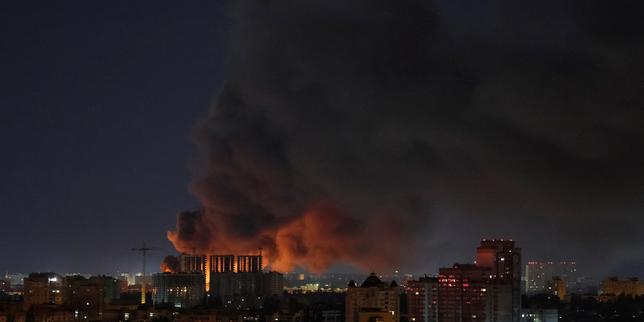
The timing of ballistic missile strikes on Kyiv during high-level diplomatic summits follows a predictable geopolitical cadence rather than immediate tactical necessity. When Russian forces launched ballistic missiles and drones at Kyiv and Kharkiv on July 8, 2026, coinciding with the final day of the NATO summit in Ankara, the primary objective was political signaling and resource depletion. Understanding these strikes requires moving past the raw imagery of burning warehouses and evaluating the hard economic math governing integrated air defense systems (IADS).
The operational reality of modern air defense rests on a profound cost asymmetry. Western-supplied interceptors, such as those used by the Patriot (PAC-2/PAC-3) and SAMP/T systems protecting Kyiv, carry a steep price tag. A single PAC-3 MSE interceptor costs approximately $4 million. Conversely, the vectors deployed against them operate on completely different cost curves: If you liked this article, you should check out: this related article.
- Geran-2 (Shahed-136) loitering munitions cost roughly $20,000 to $40,000 each.
- Kalibr or Kh-101 cruise missiles cost between $1.2 million and $13 million depending on variant production scales.
- Iskander-M and Kinzhal ballistic or pseudo-ballistic missiles range from $3 million to $10 million.
This creates an unfavorable cost-exchange ratio for the defender when facing complex, multi-tiered strike packages.
The Attrition Mechanism of Mixed Strike Vectors
Russian strike planners structure attacks to overwhelm Western-supplied systems through a sequential, three-tiered methodology designed to force bad economic and tactical trade-offs. For another angle on this development, refer to the latest update from TIME.
[Tier 1: Loitering Munitions (Geran-2)]
     --> Purpose: Map Radar Positions & Attrit Low-Cost Interceptors

[Tier 2: Subsonic Cruise Missiles (Kh-101)]
     --> Purpose: Saturate Fire Control Channels via Complex Flight Paths

[Tier 3: Hypersonic/Ballistic Vectors (Iskander-M/Kinzhal)]
     --> Purpose: Target High-Value Infrastructure / Penetrate Depleted Batteries
The first wave utilizes cheap loitering munitions. Their slow, low-altitude flight paths are designed to trigger air defense radars. This forces the defender to choose between exposing the locations of their mobile radar units or letting the drones hit electrical or industrial targets unhindered. If the defender engages, they consume inventory—often utilizing short-range systems like NASAMS or IRIS-T, whose missiles still cost far more than the incoming drone.
The second wave introduces cruise missiles. These weapons utilize terrain-following profiles and programmed waypoints to alter headings mid-flight, maximizing the geometric workload on tracking radars. The goal is saturation: filling the air defense system’s engagement matrix with more simultaneous targets than its fire control computers can track and clear.
The final tier consists of high-velocity ballistic or aero-ballistic missiles like the Iskander-M or Kh-47M2 Kinzhal. These targets travel at extreme speeds and steep terminal angles. Because of their speed, the detection-to-intercept window is compressed to minutes or seconds. By the time these high-end vectors arrive, the IADS engagement channels are already saturated by the lower-tier waves, and missile magazines may be depleted.
Sensor Failure and Temporal Dead Zones
A critical indicator of system saturation occurred during the July 8 strikes in Kyiv: initial detonations were reported by ground observers before air defense sirens were triggered. This structural failure reveals a specific operational bottleneck in tactical warning networks.
Air defense detection relies on a chain of sensors, starting with space-based infrared satellite assets detecting thermal signatures at launch, followed by long-range early warning radars, and finally terminal engagement radars. When an explosion occurs before an alarm sounds, it indicates a breakdown in this chain, typically caused by one of two factors.
The first factor is a short flight-time trajectory. Missiles fired from the Bryansk or Kursk regions, or from ships in the Black Sea, have abbreviated flight times to Kyiv. If a ballistic missile is fired on a depressed trajectory, the time from radar acquisition to impact can be under four minutes.
The second factor is algorithmic or human latency in data relay. If the tracking data from Western electronic intelligence (ELINT) or regional radar networks is delayed by even 90 seconds while being integrated into Ukraine's localized command and control framework (such as the Delta system), the warning becomes useless to the civilian population and terminal defense crews. This lag creates a temporal dead zone where the weapon arrives before the defensive network can fully transition from a search state to an active track state.
The Limits of Kinetic Interception
Ukrainian President Volodymyr Zelensky’s renewed appeals at the Ankara summit for additional air defense platforms highlight a stark structural limitation. Simply adding more batteries does not solve the underlying ammunition supply bottleneck.
Global industrial capacity for complex interceptors is inelastic. The United States and its European allies produce PAC-3 MSE interceptors at a rate of roughly 500 units per year, with plans to scale upward. However, a single sustained Russian multi-axis strike can deplete dozens of these missiles in a single night if defenders fire two interceptors per incoming target to guarantee a kill probability ($P_k$).
Furthermore, deploying more systems increases the electronic signature footprint. Active radar units emit high-powered radio frequency signals that Russian electronic intelligence aircraft and ground stations map continuously. Once mapped, these batteries become prime targets for Kh-31P anti-radiation missiles or Lancet loitering munitions if deployed too close to the front lines, as seen in the repeated losses of individual launchers in the Kharkiv and Donetsk sectors.
Strategic Deficit Realities
To counter this asymmetry, Ukraine has shifted towards targeting the source of the cost curve rather than just absorbing the strikes. Lacking parity in high-end ballistic systems, Ukrainian forces rely on long-range, domestically produced strike drones targeting Russian energy infrastructure and oil refineries.
This counter-strategy aims to inflict asymmetric economic damage on Russia's primary revenue export, attempting to balance the fiscal ledger of the war. However, while striking a refinery can disrupt local fuel logistics and impose a direct financial cost on Moscow, it does not immediately degrade the mobile missile launchers or strategic bombers operating deep within the Russian interior.
The defense of major urban areas like Kyiv and Kharkiv will remain a bottleneck characterized by high consumption rates of irreplaceable Western munitions against cheap, mass-produced adversary vectors. Without an exponential increase in Western industrial manufacturing lines or the widespread deployment of non-kinetic directed-energy weapons, the defensive math dictates that major cities will continue to experience periodic system saturation and localized infrastructure damage, regardless of total battery deployment numbers.


