A four-year-old boy named Matteo stands before a pile of smooth, gray river stones, a handful of dried eucalyptus leaves, and a large sheet of corrugated cardboard. There are no plastic blocks here. No flashing electronic toys beep at him to press a yellow button. No teacher stands at a whiteboard scrawling the letter B and demanding replication.
Matteo frowns, balances a heavy stone on top of a fragile leaf, and watches it collapse. He tries again. This time, he places the widest stone at the base. Discover more on a connected subject: this related article.
To a casual observer, he is just playing. To the educators watching from the doorway, he is studying physics, testing hypotheses, and learning how to negotiate failure.
Thousands of miles away, millions of children sit at uniform desks, gripped by a quiet anxiety. They trace dotted lines on mass-produced worksheets. They are drilled for standardized assessments before they even know how to tie their shoes. We have turned early childhood education into a corporate assembly line, obsessed with measurable metrics and uniform outcomes. Further analysis by Apartment Therapy highlights similar perspectives on this issue.
But a quiet rebellion is gaining ground, and it recently drew the attention of the world’s most watched mother.
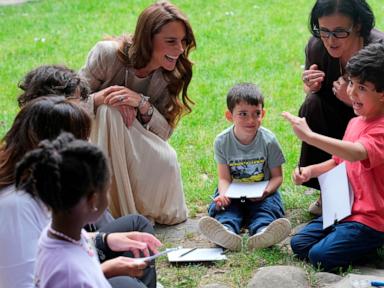
When Kate Middleton, the Princess of Wales, quietly stepped into a progressive preschool during an official visit to Italy, she wasn't just fulfilling a royal duty. She was hunting for an antidote to a global crisis. The Princess has spent years championing early childhood development, focusing heavily on how the first five years of life shape the adult brain. In the sun-drenched classrooms of Italy, she found a philosophy that throws out the standardized rulebook entirely.
It is an approach that treats children not as empty vessels to be filled with facts, but as citizens with rights, voices, and an innate capacity to understand the world.
The Tyranny of the Worksheet
Walk into almost any standard kindergarten today, and you will see the same depressing sight. Brightly colored but sterile rooms filled with plastic toys that perform only one function. If you press the plastic cow, it moos. The toy does the thinking for the child.
Then come the worksheets.
We have become obsessed with the illusion of progress. Parents want to see a folder full of completed papers at the end of the week because it provides tangible proof that tuition money is being well spent. "Look," the paper says, "your child can color inside the lines of an apple."
But what happens to the child’s brain during that process? Very little.
Neuroscience tells us that the human brain develops at an astonishing rate during the first few years of life. Billions of synaptic connections form based entirely on sensory experiences. When we force a child to sit still and trace letters for hours, we aren't accelerating their learning. We are stifling their executive functioning—the ability to plan, focus, remember instructions, and juggle multiple tasks.
Consider a different way. In the Italian approach that captured the Princess's attention, the environment itself is the teacher. Rooms are flooded with natural light. Materials are recycled, organic, and open-ended. A cardboard tube can become a telescope, a tunnel, a tower, or a musical instrument. The child must invent the function.
When you give a child a toy that only does one thing, you teach them to follow instructions. When you give them raw materials, you teach them to think.
The Royalty and the Radical
The roots of this philosophy stretch back to the aftermath of World War II in the Emilia-Romagna region of northern Italy. A visionary educator named Loris Malaguzzi, working alongside local parents, realized that the rise of fascism had been aided by an education system that demanded blind obedience and conformity. They wanted to build a new kind of school—one that would produce critical thinkers who could never be easily manipulated by authority.
They called it the Reggio Emilia approach. It centers on the belief that children possess "a hundred languages" to express themselves: through drawing, sculpting, dancing, shadow play, and music.
When the Princess of Wales toured these classrooms, she didn't see teachers lecturing from the front of the room. Instead, she saw educators acting as researchers. They listen to the children’s conversations, document their ideas through photographs and written notes, and then co-construct a curriculum based on what the children are actually curious about.
If a group of children becomes fascinated by a spider web in the garden, the teacher doesn't shoo them away to study the alphabet. The teacher seizes the moment. The next day, the classroom might be filled with thread, wire, and magnifying glasses. The children will spend weeks exploring symmetry, biology, and architecture, all sparked by a single, real-world observation.
This isn't a chaotic free-for-all. It is a deeply rigorous, highly intentional form of education. It requires teachers to possess immense skill, patience, and trust.
Trust is the missing ingredient in modern schooling. We do not trust children to be capable of directing their own learning, so we micromanage every minute of their day.
The Hidden Cost of Conforming
We are living through a terrifying spike in childhood anxiety and depression. By the time kids hit middle school, many are already burned out, obsessed with grades, and terrified of making mistakes.
We must ask ourselves: where did that fear begin?
It began when we decided that a child’s value could be measured by a test score. It began when we took away recess to make more time for test preparation. It began when we decided that every four-year-old must reach the exact same milestone at the exact same month, ignoring the beautiful, erratic, human reality of individual development.
Some children talk early. Some walk early. Some excel at spatial reasoning long before they can grasp phonics. A standardized system treats these natural variations as deficits. It labels children as "behind" before they have even had a chance to begin.
The Italian visit by the Princess highlighted a profound truth that our modern policy-makers seem to have forgotten: you cannot standardize a human being.
When the Princess sat on a miniature wooden chair, watching children collaborate on a massive clay sculpture of their neighborhood, she was witnessing the cultivation of emotional intelligence. The children weren't fighting over the clay. They were negotiating. They were discussing whose house should go where. They were learning how to be a community.
Reclaiming the Magic
Changing an entire educational infrastructure feels impossible. The testing industry is a multi-billion-dollar behemoth. School districts are bound by bureaucratic mandates. Parents are trapped in a competitive rat race, terrified that if their child isn't reading fluently by age four, they will somehow lose the future.
But change doesn't require a total systemic overhaul overnight. It starts with a shift in perspective.
It starts when a parent looks at a messy bedroom floor covered in cardboard boxes and sees a masterclass in engineering rather than a mess to be cleared away. It starts when a teacher has the courage to close the workbook and take the class outside to watch the rain fall.
The real stakes here are not about whether our children get into prestigious universities twenty years from now. The stakes are about who they are right now, in this fleeting moment of childhood.
Back in the classroom, Matteo finally balances the third stone on his structure. It stays. He steps back, his face illuminating with a fierce, quiet pride. He didn't look at a teacher for validation. He didn't receive a gold star or a sticker. The reward was the mastery itself.
He knocks it down and begins to build a completely different shape.