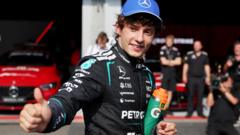
Kimi Antonelli has claimed a sensational pole position for the Belgian Grand Prix, mastering a treacherous, rain-soaked Spa-Francorchamps circuit to edge out Max Verstappen. While Verstappen set the fastest outright time in the final session, a pre-existing ten-place grid penalty for exceeding power unit components demoted the Dutchman, elevating the teenage prodigy to the front of the grid. Antonelli capitalized on the changing track conditions by delivering a flawless final sector, securing his maiden pole position in extraordinary fashion.
This is not merely a story of a grid penalty shaking up a Sunday lineup. It is a seismic shift in the sport's competitive order.
The Technical Mastery Behind a Rain-Soaked Shock
Driving an F1 car at Spa in the wet requires an almost pathological level of bravery. Doing it as a rookie, while carrying the weight of a team's championship aspirations, is entirely different.
The track dried unevenly during the final minutes of the session. Drivers faced a classic Spa dilemma: search for grip on the damp racing line or risk running wide onto the slick, painted curbs. Verstappen looked to have the session entirely under control, utilizing a high-downforce setup that made the Red Bull look glued to the tarmac through the sweeping turns of Sector 2.
But Antonelli and his engineering wall gambled on a lower downforce configuration.
- The Straight-Line Advantage: By shedding wing angle, Antonelli was vulnerable through the high-speed corners of Pouhon and Fagnes. He kept the car on the black stuff, surviving two massive snaps of oversteer.
- The Kemmel Straight Payload: That lower drag allowed him to carry immense speed up the hill from Eau Rouge through the Kemmel Straight, pulling back tenths of a second against Verstappen's benchmark.
- Tire Management: He kept his intermediate tires alive through the final chicane, where most drivers encountered severe front-end graining as the track began to dry out.
It was a masterclass in risk management. While the veteran drivers complained about visibility and standing water, the teenager simply adjusted his brake balance, hunted for late-apex grip, and let the car slide.
Verstappen and the Red Bull Power Unit Conundrum
To understand the true gravity of tomorrow's race, one must look closely at Red Bull's strategic choices. Taking a engine penalty at Spa is a calculated risk. The circuit offers genuine overtaking opportunities, particularly into Les Combes and the Bus Stop chicane.
Yet, Verstappen’s demotion to eleventh completely alters the strategic calculus of the front runners.
"We knew the penalty was coming, but seeing the gap to the field in the wet shows the car has the pace. Passing will be tough if the dry lines form early tomorrow." — Max Verstappen during post-qualifying media scrums.
Red Bull chose to maximize Verstappen's downforce to ensure he could pass cars quickly in the dirty air of the midfield. If Sunday brings dry weather, that high-downforce wing will turn him into a sitting duck on the straights against teams running trimmer aerodynamic packages. Antonelli’s team recognized this vulnerability early in the weekend, optimizing their car specifically to defend the lead on the long straights rather than chasing the ultimate lap time in Q3.
The Changing of the Guard Is Accelerating
For the past few seasons, Formula 1 has operated under a predictable hierarchy. Verstappen dominated, while a rotating cast of veterans from Ferrari, McLaren, and Mercedes took turns picking up the scraps.
That era is over. The arrival of raw, uncompromising talent has broken the predictability of the sport. Antonelli's pole position is proof that the simulator-trained generation requires zero acclimatization period to handle the sport's most hostile environments.
The paddock reaction shifted rapidly from polite applause to genuine concern. Established stars suddenly face a driver who does not respect the unwritten rules of veteran spacing or defensive positioning. He drives with the total absence of fear that only a teenager possesses, unburdened by the memory of massive shunts or political team battles.
The Sunday Survival Blueprint
Starting from pole at Spa is notoriously difficult. The run from the start line down to the tight hairpin of La Source is incredibly short, meaning the pole-sitter rarely holds a commanding advantage by the time the pack accelerates down the hill toward Eau Rouge.
The second-place starter will get a massive slipstream up the Kemmel Straight. To win tomorrow, Antonelli cannot simply drive away from the field. He will have to master the art of defensive positioning under extreme pressure, breaking the tow of the cars behind him before they reach the braking zone at turn five.
Verstappen will be slicing through the field from eleventh, likely running an aggressive alternate tire strategy to offset the traffic. The race will not be decided by raw lap time, but by who manages the thermal degradation of the left-rear tire through the long, loaded corners of the second sector. Antonelli has the track position, but he lacks the race-distance database of the drivers breathing down his neck. The psychological war starts long before the lights go out.