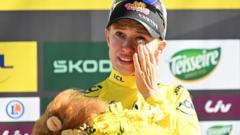
Mont Ventoux does not negotiate. The Giant of Provence demands payment in oxygen, cadence, and absolute psychological surrender, punishing anyone who approaches its lunar summit with hesitation. When Kasia Niewiadoma-Phinney accelerated away from her rivals on those merciless white-gravel slopes, she did not merely win a stage of the Tour de France Femmes. She rewrote the hierarchy of modern stage racing, turning a brutal mountain pass into a personal monument and seizing the yellow jersey in a masterclass of tactical attrition.
The climb is legendary for a reason. Wind shears across the exposed peak with enough force to lift a rider off the tarmac, and gradients rarely offer mercy once the tree line disappears behind the wheels. Analysts often point to watts per kilogram as the ultimate predictor of success on such terrain. Yet mathematics alone failed to capture the chaotic beauty of how Niewiadoma-Phinney dismantled the peloton. This victory was born from years of near-misses, tactical frustrations, and an unyielding refusal to race defensively.
The Anatomy of a Mountain Masterclass
To understand how the stage unfolded, we must look beyond the final broadcast highlights and examine the attritional warfare waged hours before the finish line. Teams with GC aspirations spent the flatter approaches trying to suffocate the pace, hoping to preserve their protected riders for the final ramps. Niewiadoma-Phinney, riding for Canyon-SRAM, understood that waiting for the final three kilometers would play directly into the hands of heavier climbers with superior pure acceleration.
Instead, the selection happened organically through sheer exhaustion. The team set a punishing tempo at the base of the climb, shedding domestiques one by one until only the heavyweights remained. When the decisive move occurred, it was sharp, explosive, and executed with absolute commitment.
- Pacing Strategy: Avoiding early traps set by rival squads.
- Nutritional Execution: Maintaining core temperature and glycogen levels under extreme heat.
- Terrain Management: Utilizing the shifting winds on the upper slopes to shelter while forcing rivals into the open air.
Breaking the Psychological Barrier
For seasons, Niewiadoma-Phinney carried the heavy burden of being one of the most consistent yet notoriously under-victorious riders in the upper echelon of the sport. Second places accumulated like dust on a mantlepiece. Fans loved her attacking flair, but commentators whispered about her tactical timing. Doubts crept into the collective consciousness of the cycling world. Could she seal the deal against the absolute titans of the sport when the stakes reached their absolute zenith?
Mont Ventoux provided the definitive answer.
The psychology of racing at altitude is peculiar. Every breath burns. The brain screams for cessation while the legs lock into an anaerobic prison. Riders who dwell on the pain inevitably falter. Niewiadoma-Phinney has spent her career learning how to sit inside that discomfort and weaponize it. When she attacked, she did not look back. That absence of hesitation paralyzed the chase group behind her, creating a crucial gap that expanded with every pedal stroke into the thin air.
The Shift in Peloton Dynamics
Stage victories on iconic climbs ripple through the entire ecosystem of professional cycling. The psychological blow dealt to opposing team managers cannot be overstated. Squads that entered the Tour with clear defensive blueprints found themselves scrambling to invent new strategies on rest days.
Consider the impact on team leadership structures. When a rider takes yellow on Ventoux, the remainder of the race transforms into a defensive chess match. Every other contender must attack, spending precious energy trying to claw back seconds, while the race leader dictates terms from the wheels of loyal teammates.
Equipment and Preparation Variables
Modern cycling leaves nothing to chance, least of all on mountain stages where every gram dictates success.
- Bicycles were stripped of excess weight, utilizing specialized climbing setups.
- Tire pressures were meticulously calculated to balance grip on the rougher upper sections with rolling efficiency on the lower tarmac.
- Hydration strategy involved specialized bidons containing precise electrolyte formulations to combat the brutal Provençal heat.
Yet equipment is merely the vessel. The engine remains human, fallible, and subject to the unpredictable whims of physical recovery over a grueling multi-week calendar.
What Comes Next for the Yellow Jersey
Holding the yellow jersey is harder than winning it. The burden of control shifts entirely to the shoulders of the race leader and her support staff. Every transition stage becomes a high-stress exercise in positioning, guarding against crosswinds, and avoiding late-race crashes that can end a campaign in a split second.
Niewiadoma-Phinney faces a peloton desperate for redemption. Rivals will test her on subsequent climbs, probing for weaknesses in her recovery or exploiting any vulnerabilities in her team's depth. But the psychological landscape has shifted. The narrative that she cannot close out a major title has been permanently buried beneath the white stones of Ventoux.
The road to Paris is long, unforgiving, and paved with uncertainty. For now, the queen of the mountains stands alone in yellow, having conquered both her fiercest competitors and her own history.