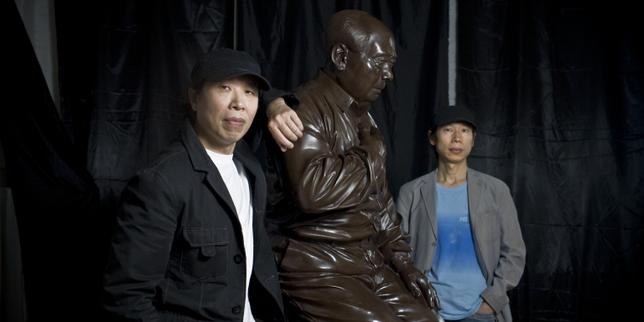
The judicial sentencing of seventy-year-old artist Gao Zhen to three years in prison provides a clear case study in the intersection of retroactive jurisprudence and state narrative control. Arrested in August 2024 during a family visit to China and formally sentenced in August 2026 by the Sanhe City People’s Court in Hebei province, Gao’s prosecution centers on satirical sculptures of Mao Zedong produced between 2005 and 2009.
Analyzing this case requires stripping away political rhetoric to examine the structural components driving the verdict: the temporal mismatch of legal statutes, the economic and operational vulnerability of transnational dissidents, and the signaling function of maximum-penalty sentencing in authoritarian legal systems. If you enjoyed this piece, you should look at: this related article.
The Temporal Mechanics of Retroactive Enforcement
The primary legal anomaly in the Gao case rests on the gap between the execution of the creative work and the codification of the offense. Gao and his brother, operating as the Gao Brothers, completed works such as "Mao's Guilt"—a sculpture depicting the former leader kneeling in repentance—and "Miss Mao" between 2005 and 2009.
The statutory instrument used to prosecute Gao is the Law on the Protection of Heroes and Martyrs. This legislation was enacted in March 2018 and subsequently strengthened in criminal amendments through 2021. For another look on this story, refer to the latest update from Al Jazeera.
In standard legal systems operating under the principle of nullum crimen, nulla poena sine praevia lege poenali, acts committed prior to the passage of a criminal statute cannot be prosecuted under it. The application of the 2018/2021 statute to art created over a decade prior demonstrates a structural shift in enforcement logic.
Instead of treating law as a fixed boundary for future behavior, the enforcement mechanism functions as a continuous review process where historical cultural production is re-evaluated against contemporary political imperatives. This framework converts past compliance into retrospective illegality whenever state thresholds for acceptable historical interpretation shift.
The Risk Calculus of Transnational Mobility
Gao’s status as a United States permanent resident who maintained familial and professional ties within China highlights a fundamental vulnerability in cross-border dissidence. The decision to cross an international border back into the jurisdiction of a home state introduces severe tail risks that often outweigh long-term assimilation abroad.
The operational variables of this risk matrix include:
- Jurisdictional Reach: Permanent residency offers protection within the host state but provides zero diplomatic immunity or consular leverage equivalent to full citizenship during physical presence in the country of origin.
- Information Asymmetry: Transnational artists frequently underestimate how digital archiving and updated state monitoring priorities catalog historical portfolios for retroactive targeting.
- Collateral Detention: The imposition of exit bans on Gao’s wife and U.S.-citizen son, neither of whom faced formal criminal charges, illustrates an institutional strategy of collective leverage designed to suppress external advocacy.
By retaining a physical presence or family anchors inside the target state, individuals maintain an exposed attack surface. The cost function of visiting family heavily favors total operational separation once an artist's catalog crosses state-defined lines of political sensitivity.
The Deterrence Function of Maximum Penalties
The Sanhe City Court handed down the maximum three-year sentence permitted under the charge of slandering heroes and martyrs, running consecutive to the two years Gao already spent in pre-trial detention. In penal strategy, the assignment of maximum penalties serves an instrumental communication purpose rather than a purely corrective one.
When applied to high-profile cultural figures, the maximum sentence acts as a high-visibility signal intended to induce a chilling effect across a broader ecosystem. The target audience of the ruling is not merely the individual defendant, but the wider community of domestic and expatriate creators.
By utilizing closed-door trial procedures and restricting diplomatic access, the judicial apparatus minimizes legal transparency while maximizing the psychological impact of the outcome. The state establishes an unambiguous boundary: historical critique of foundational figures carries severe personal and operational costs, effectively eliminating the grey areas that previously permitted avant-garde political satire during earlier periods of relative cultural leniency.
The defense strategy on appeal will likely hinge on challenging the temporal validity of the statutory application. However, given the structural integration of party-state priorities within the judiciary, relief depends less on procedural technicalities and more on shifts in the broader calculus of state-managed cultural orthodoxy. Future risk assessments for transnational artists must account for a permanent contraction of safe harbor parameters, where historical portfolios remain perpetual liabilities under flexible, retroactive legal frameworks.
.jpg?auto=webp&format=pjpg&width=3840&quality=60)