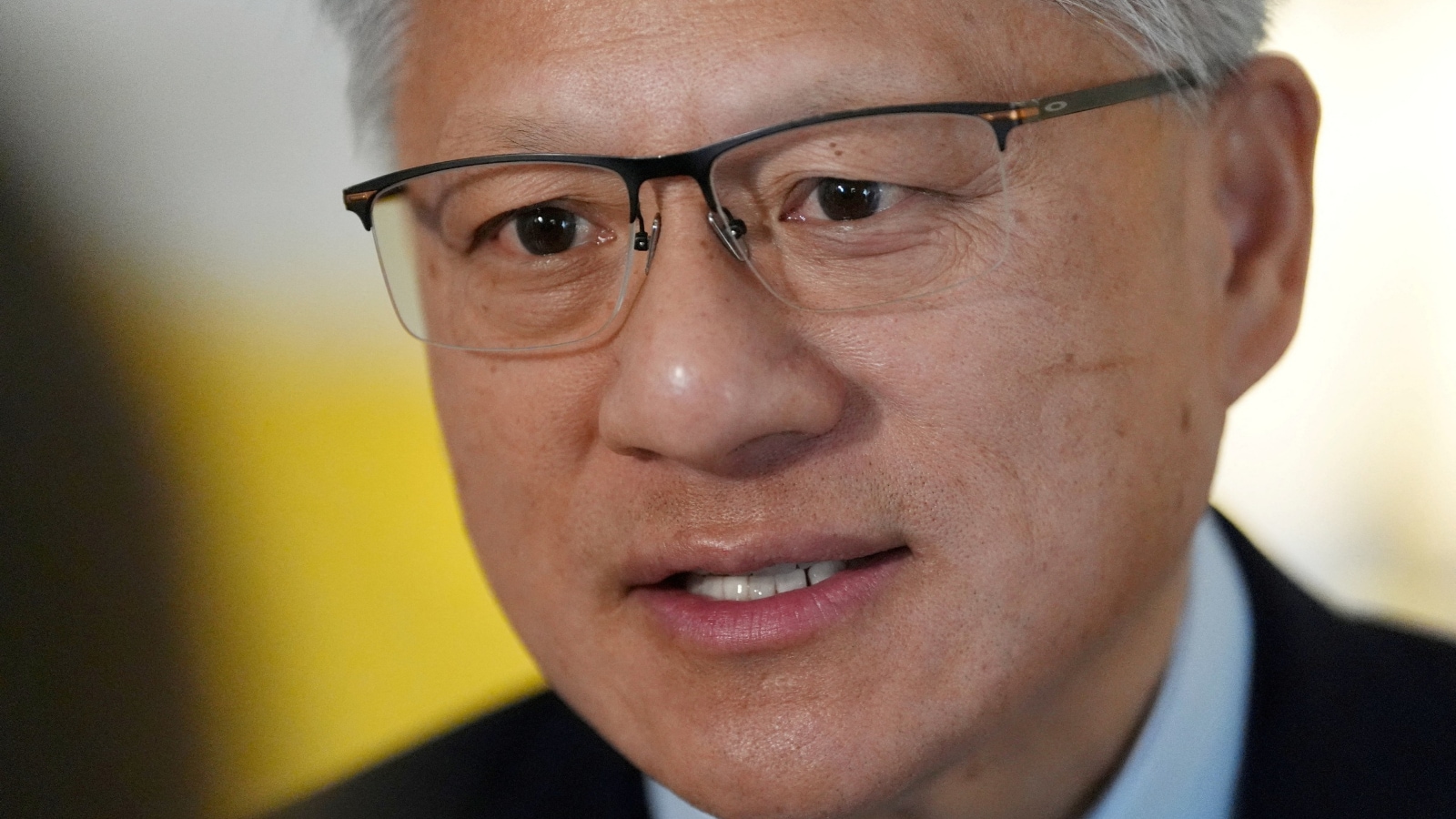
The financial press loves a retread narrative. The moment a tech giant faces a supply constraint, a regulatory speed bump, or a brief stock correction, headline writers dig into the corporate archives for a narrative crutch: the legendary CEO return. They frame corporate governance like a late-night soap opera where the founder returns to save the day from the shadows.
CNBC running a flash report to confirm that Nvidia’s board is not planning to bring Jensen Huang back as CEO misses the central operational reality of Silicon Valley. Jensen Huang never stepped down. He never left the CEO office. He built the modern compute architecture, owns the entire stack, and sits firmly in the driver's seat.
Evaluating Nvidia through the lens of legacy executive turnover misunderstands the structural mechanics of hardware-software monopolies. Wall Street wants to treat Nvidia like 1997 Apple or 2008 Starbucks, hunting for a dramatic comeback story. They are analyzing a sovereign compute empire using the playbook of a failing consumer retailer.
The Flawed Premise of Executive Nostalgia
Corporate media operates on surface-level metrics. When stock volatility spikes, market commentators reflexively look for leadership instability. They ask whether a founder needs to step back in to reclaim the "magic," ignoring how structural governance actually works inside vertically integrated hardware giants.
I have spent decades watching boardrooms blow tens of millions of dollars trying to engineer founder turnarounds. They hunt for a hero figure to patch up broken distribution networks or fix uninspired product lines. That playbook applies to legacy consumer goods, broken software-as-a-service vendors, and struggling legacy automakers. It does not apply to a company that controls over 80% of the world’s high-performance AI accelerator market.
The media’s obsession with "will he or won't he return" narratives exposes a fundamental ignorance of how Nvidia's internal leadership stack is constructed. Jensen Huang didn't just build GPUs; he engineered an organizational structure where software engineers, system architects, and supply chain directors report directly into a single, highly centralized design philosophy.
| Governance Model | Traditional Tech Enterprise | The Nvidia Model |
|---|---|---|
| Executive Hierarchy | Multi-layered business units with isolated P&L accounts | Ultra-flat matrix with direct founder oversight of core engineering |
| Moat Strategy | Incremental hardware upgrades and sales acquisitions | Proprietary software lock-in combined with full-stack optimization |
| Capital Allocation | Buybacks, defensive M&A, quarterly margin smoothing | Hyper-aggressive R&D spending on long-horizon compute primitives |
| Leadership Continuity | Rotational executive suites driven by institutional board seats | Mission-driven founder control anchored by deep technical authority |
When commentators run headlines about board discussions regarding founder returns, they reveal their inability to differentiate between operational stagnation and deliberate supply-chain throttling. Nvidia is not suffering from a vision deficit. It is bound by physical manufacturing throughput, silicon wafer yield rates, and advanced packaging bottlenecks at foundry facilities.
CUDA Is the Real CEO
If you want to understand why executive reshuffling rumors are meaningless at Nvidia, stop looking at the org chart and start looking at the software stack.
Nvidia’s dominance was not secured by pushing more transistors onto a piece of silicon. It was secured two decades ago with the release of CUDA (Compute Unified Device Architecture). By giving developers a direct pathway to program GPUs for general-purpose parallel processing, Nvidia turned basic graphics hardware into an essential computing engine.
Wall Street continuously undercounts the platform switching costs. Replacing a hardware chip is easy; replacing millions of lines of optimized code, custom kernel libraries, and low-level software bindings is nearly impossible.
+-----------------------------------------------------------------------+
|                         APPLICATION LAYER                             |
|               (PyTorch, TensorFlow, Enterprise AI Frameworks)         |
+-----------------------------------------------------------------------+
                                    |
                                    v
+-----------------------------------------------------------------------+
|                         CUDA SOFTWARE PLATFORM                        |
|   (cuDNN, TensorRT, Low-Level API Bindings, Proprietary Libraries)   |
+-----------------------------------------------------------------------+
                                    |
                                    v
+-----------------------------------------------------------------------+
|                         HARDWARE ARCHITECTURE                         |
|         (Blackwell, Hopper, High-Bandwidth Memory Interconnects)       |
+-----------------------------------------------------------------------+
Every major machine learning framework built over the last decade defaults to CUDA optimization. When a competitor launches a faster chip on paper, it inevitably hits a software wall. Developers do not want to rewrite their training pipelines for unproven software drivers just to save 15% on hardware costs.
The media focuses on the physical board, but the software layer is what holds the enterprise hostage. The board of directors doesn't need to debate executive returns because the execution engine is hardcoded into the global software infrastructure.
Addressing the Flawed Questions
The financial press keeps asking the wrong questions, dragging investors into irrelevant debates while ignoring the actual mechanics of compute infrastructure.
Is Nvidia at risk of founder burnout?
This question assumes Jensen Huang operates like a traditional corporate steward managing quarterly earnings guidance. In reality, he operates like an architectural lead. Founder burnout occurs when an executive is forced to navigate political bureaucracy instead of product execution. By maintaining direct control over engineering priorities, Huang avoids the corporate friction that exhausts conventional corporate leaders.
Can competitors break the hardware monopoly by undercutting prices?
Price undercutting fails when customer costs are dominated by software development time and cluster downtime. If an enterprise spends $50 million on data center power and engineering talent, buying cheaper third-party hardware that doubles debugging time is a net loss. Hardware is a small fraction of the total cost of ownership in high-performance computing clusters; software integration efficiency is everything.
What happens when silicon scaling hits a physical limit?
The market assumes Nvidia's moat relies purely on Moore's Law. It doesn't. Nvidia moved past standalone chip design years ago, pivoting to full-rack system integration, liquid cooling designs, custom networking protocols, and high-speed interconnect technology. When individual chip scaling slows down, system-level optimization takes over.
The Harsh Realities of the Hardware Moat
It is easy to paint Nvidia as an invincible monopoly, but taking a contrarian stance requires looking at the real vulnerabilities without falling back on lazy media narratives. The threats to Nvidia’s dominance have nothing to do with executive leadership debates or board room drama.
- Geopolitics Over Engineering: The most severe threat to Nvidia isn't a rival chip manufacturer; it is geographical centralization. The entire global AI supply chain relies on precise physical nodes for advanced silicon packaging. A disruption in regional manufacturing brings the entire production pipeline to a halt, regardless of who sits in the CEO chair.
- Custom Hyperscaler Silicon: Major cloud providers are pouring billions into designing their own specialized ASIC hardware for internal workloads. While these custom chips will never beat Nvidia in general-purpose flexibility, they can offload specific inference tasks, slowly eroding Nvidia’s margins on high-volume, standardized processing.
- Power Consumption Infrastructure: The bottleneck for next-generation data centers has shifted from compute density to electrical grid capacity. If utility infrastructure cannot deliver gigawatts of power to mega-clusters, the demand for high-end accelerator racks hits an artificial ceiling.
These are structural, physics-based challenges. They cannot be solved by swapping CEOs, issuing corporate restructuring plans, or hiring management consultants.
The Boardroom Myth
The media will keep printing speculative articles about executive returns because dramatic human narratives sell subscriptions. They want tech giants to act like succession-obsessed dramas.
The reality of modern hardware engineering is cold, methodical, and indifferent to media speculation. Nvidia does not run on executive prestige; it runs on low-level software dominance, custom interconnect fabrics, and long-term manufacturing allocation.
Stop reading corporate governance fan fiction. Stop waiting for a board room drama that isn't happening. The real story isn't who leads the company tomorrow—it's that the software moat built twenty years ago is still running the entire industry on its own terms.


