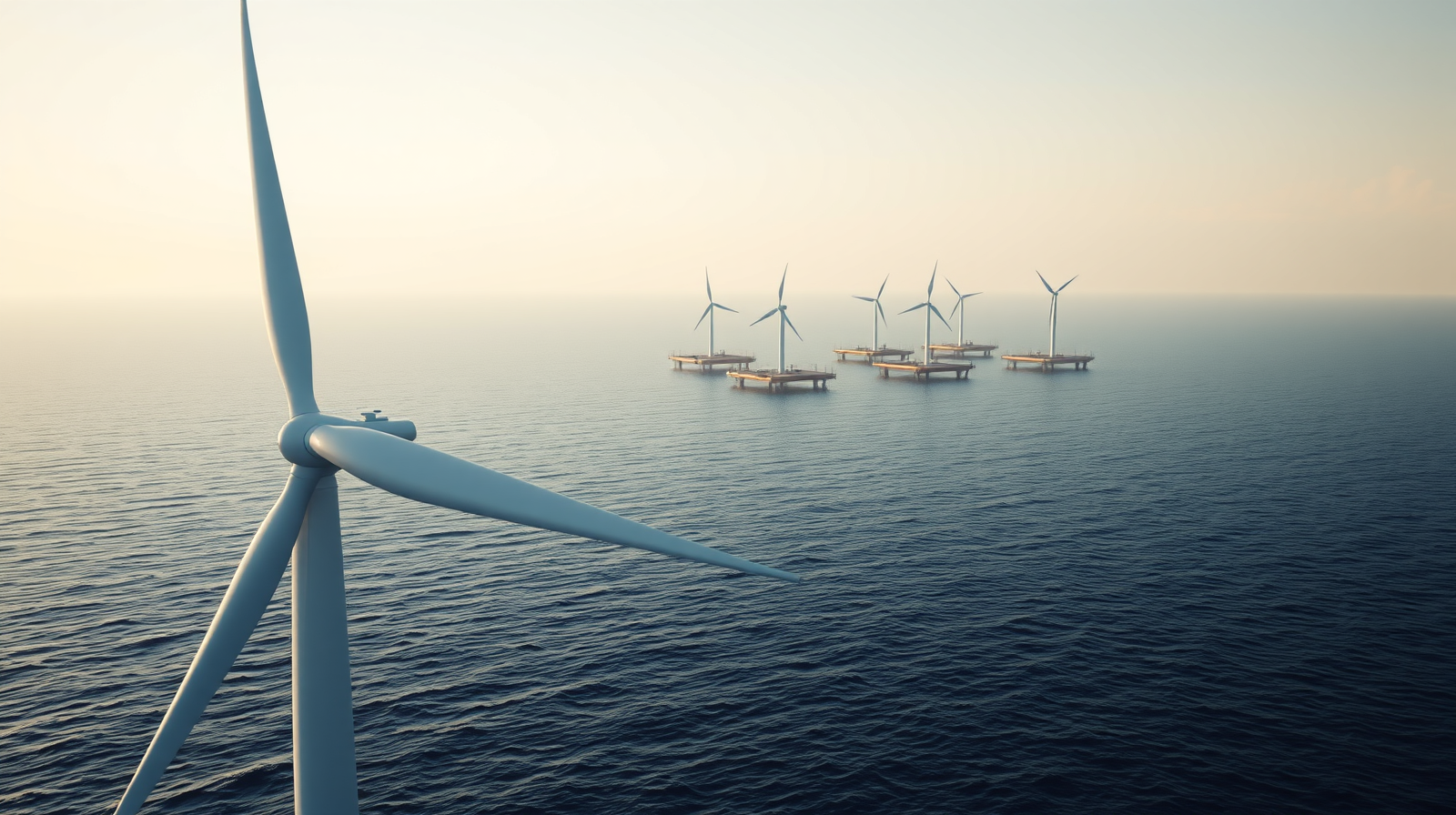
The tech sector loves a heroic engineering narrative. Right now, the media is swooning over Japan’s plan to anchor massive wind turbines in the deep waters of the Pacific. The conventional wisdom says Japan has no choice. Its coastline drops off into a profound abyss, making standard bottom-fixed marine turbines impossible. The consensus solution? Bolt those megawatts onto floating platforms, tether them to the seabed with miles of steel cable, and watch the green energy flow.
It sounds brilliant. It is also an absolute economic and logistical fiction.
I have spent years analyzing energy infrastructure investments, watching utilities blow tens of millions of dollars on shiny tech that ignores fundamental physics and supply chain realities. Japan’s deep-water wind strategy is not a masterstroke of climate innovation. It is an incredibly expensive distraction that misdiagnoses the country's actual energy bottlenecks.
The Fatal Flaw of the Deep Water Narrative
The mainstream press focuses entirely on geography. They point out that Japan’s continental shelf is narrow, meaning waters deeper than 50 meters sit just a few miles from the coast. Because traditional turbines must be driven directly into the seabed, the tech press concludes that floating structures are the only viable path forward.
This logic completely misses the structural engineering math.
When you move a turbine from a fixed foundation to a floating hull, you are not just changing the anchor. You are introducing massive dynamic loads.
$$F = m \cdot a$$
Every wave, current, and typhoon-force wind applies force to a structure that is constantly shifting. To keep a 15-megawatt turbine stable enough to generate electricity efficiently, the floating foundation must be enormous. We are talking about semi-submersible steel or concrete structures weighing upwards of 10,000 tons just to support a single tower.
The materials required per megawatt skyrocket. More steel means more upfront capital expenditure. More moving parts—like dynamic subsea cables that must flex constantly with the waves—mean operational expenses that will bleed developers dry.
The Cost Reality Check
Let us look at the actual numbers rather than the hype. Traditional bottom-fixed offshore wind has achieved a Levelized Cost of Energy (LCOE) that competes with fossil fuels in parts of Europe. Floating wind is nowhere near that curve.
| Turbine Type | Average LCOE ($/MWh) | Material Intensity | Maintenance Frequency |
|---|---|---|---|
| Bottom-Fixed | $50 - $80 | Medium | Scheduled / Seasonal |
| Floating Deep-Water | $150 - $250 | Extremely High | Continuous / High-Risk |
The advocates claim scale will drive these numbers down. They cite the cost curves of solar panels and lithium-ion batteries. But that is a flawed comparison. Solar and batteries benefit from semiconductor-style manufacturing efficiencies. Floating wind platforms are massive, bespoke maritime construction projects. They are bound by the stubborn commodities markets for steel, concrete, and heavy port infrastructure. You cannot code your way out of the price of a ton of steel.
Typhoons and the Myth of Ocean Endurance
Even if you ignore the balance sheets, you cannot ignore the meteorology. The North Sea, where much of our offshore wind expertise originated, is rough and windy. But it does not regularly face Category 5 typhoons.
Japan's exclusive economic zone sits squarely in Typhoon Alley.
Imagine a scenario where a cluster of 50 floating turbines, each the size of a skyscraper, faces 150-mile-per-hour winds and 40-foot rogue waves. A fixed turbine transfers those extreme lateral forces directly into the earth. A floating turbine relies on mooring lines and anchors embedded in deep mud.
If a single mooring line snaps during an extreme weather event, the asymmetric load can cause the entire platform to capsize. Even if the platform survives, the internal components—the main bearings, the massive gearboxes, the delicate power electronics—suffer immense fatigue from being whipped back and forth at the top of a tilting 400-foot tower.
Insurance companies are not stupid. The premiums required to underwrite deep-water wind farms in typhoon zones will destroy project economics before the first anchor is dropped.
The Real Bottleneck is on Dry Land
The premise that Japan needs to head out to deep water to find space is a fundamental misunderstanding of the country's grid topology. Japan does not have an energy generation problem; it has an energy transmission problem.
The country's electrical grid is split right down the middle. Eastern Japan (including Tokyo) operates on a 50 Hz frequency, while Western Japan (including Osaka) operates on 60 Hz. This historical quirk means power cannot easily be shifted across the nation.
Furthermore, the regions with the highest wind potential—like Hokkaido and the northern tip of Honshu—are thousands of miles away from the massive industrial load centers of Tokyo and Yokohama.
Building floating wind farms off the coast of Tohoku or Hokkaido does nothing to help Tokyo if there are no high-voltage direct current (HVDC) subsea cables to bring that power south. The trillions of yen earmarked for floating platforms should be aggressively redirected into modernizing the terrestrial grid and building cross-strait interconnectors.
Dismantling the Common Defenses
Whenever I point out these realities to industry insiders, they scramble to defend the status quo with the same tired talking points. Let us address them directly.
"Can't we just use cheaper concrete hulls instead of steel?"
Concrete reduces material costs, but it drastically increases draft requirements. Most Japanese ports are not deep enough to assemble and tow out concrete floating structures of that scale. You would need to spend billions deep-cleaning and rebuilding ports before you even manufacture a single blade.
"What about Japan's net-zero commitments?"
Chasing a high-cost, high-risk technology because it looks good in a sustainability report is performative environmentalism. If the goal is rapid decarbonization, the fastest path is the immediate restart of Japan's idled nuclear fleet, paired with massive investment in geothermal energy. Japan sits on one of the largest geothermal reserves in the world, a baseload power source that does not care about typhoons or deep ocean trenches.
"The technology will mature just like onshore wind did."
Onshore wind scaled by optimizing a known paradigm. Floating wind introduces entirely new engineering failure modes—dynamic cable wear, mooring line creep, marine growth balance shifts. It is an entirely different asset class disguised as wind power.
Stop Funding the Floating Mirage
We are watching a classic sunk-cost fallacy play out on an international stage. Government subsidies are propping up test pilots, giving the illusion of progress while masking the underlying commercial unviability.
The maritime industry loves large-scale construction contracts, and politicians love announcing grand engineering projects that promise energy independence. But the math does not care about press releases.
If Japan continues down this path, it will end up with an incredibly fragile, wildly expensive network of floating white elephants that require constant maintenance and produce electricity at rates no heavy industry can afford.
The smart money needs to walk away from the deep ocean. Fix the grid. Build interconnectors. Dig for geothermal. Stop trying to build skyscrapers on water.