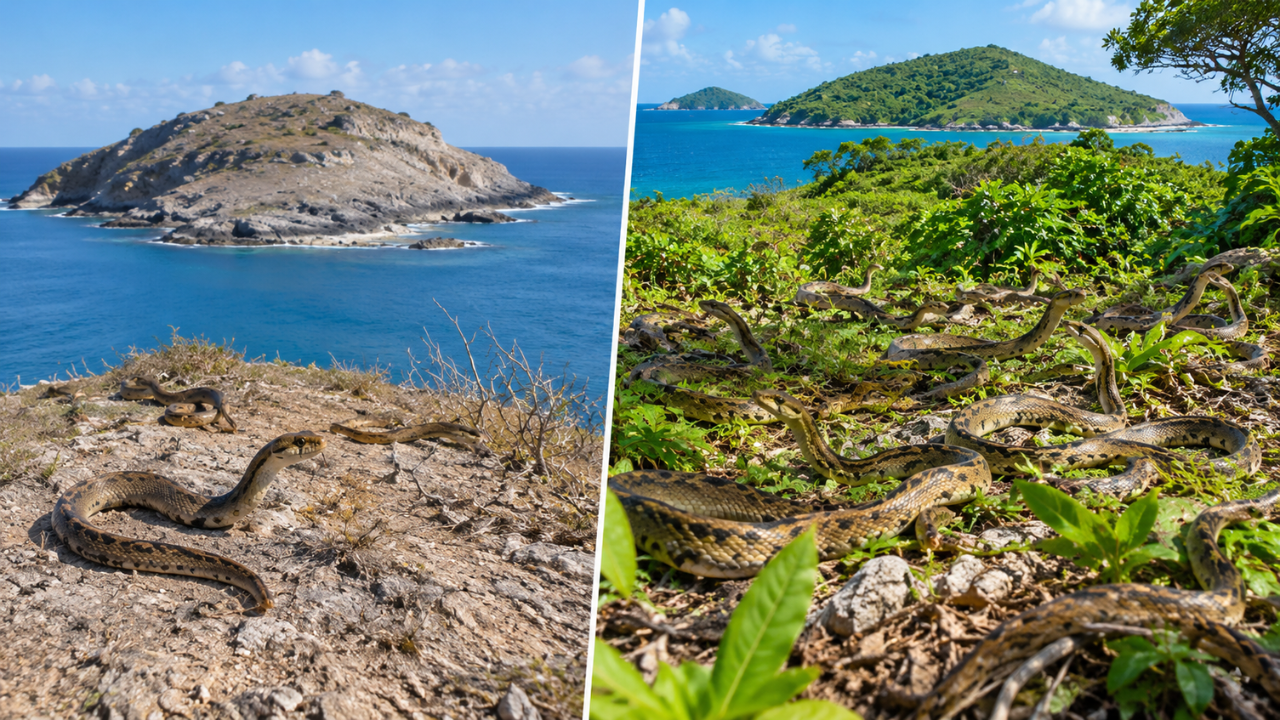
The wind off the Caribbean carries a dry, salt-stung heat that clings to your skin long after the sun has dipped below the horizon. If you stood on the limestone ridge of Great Bird Island thirty years ago, you would have felt something else in the air, too. An absolute silence. Not the quiet of a sleeping forest, but the hollow stillness left behind when a species is whispering its final breath.
In 1995, the world possessed just fifty-one Antiguan racer snakes. Not fifty-one thousand. Fifty-one individual lives. Every single one of them squeezed onto a tiny, sun-bleached outcrop of rock where they had been pushed by centuries of human interference, invasive predators, and sheer bad luck. If a single severe hurricane had swept across the channel, or if a lone rat had carried an aggressive pathogen ashore, the entire lineage of Alsophis antiguae would have vanished into the fossil record before most people even knew they existed. For a more detailed analysis into similar topics, we suggest: this related article.
Snakes rarely win public relations campaigns. Fluffy mammals with wide eyes get the calendars, the plush toys, and the prime-time documentaries. A slender, brown-and-yellow ground snake that eats lizards does not inspire the same instinctive warmth in the human heart. Yet, in the humid undergrowth of the Lesser Antilles, a handful of biologists looked at those fifty-one survivors and saw an entire world teetering on the edge.
To understand how a species gets down to fifty-one individuals, you have to look backward. For thousands of years, the Antiguan racer thrived across the larger islands of Antigua and Barbuda. They were part of a complex, functioning ecosystem where predator and prey kept a fragile, ancient rhythm. Then came the arrival of ships, sugar plantations, and, most destructively, the introduction of the black rat and the small Asian mongoose. To get more background on the matter, extensive analysis can be read on NPR.
Mongooses are diurnal hunters with speed and a taste for cold-blooded life. Rats raided nests, eating eggs before they could hatch. Combined with habitat destruction from goats and human development, the snakes were systematically erased from the mainland. By the late twentieth century, Great Bird Island—a mere twenty-five acres of scrub and stone—was the last fortress standing. And it was failing.
Imagine walking that island in the mid-1990s. The scrub brush is dense, tangled with cacti and thorny acacia. The ground is loose, powdery limestone. Every step kicks up a dry white dust. Researchers like those from conservation groups spent grueling days combing through the brush, turning over rocks, and scanning the leaf litter. They weren't looking for herds of animals; they were looking for a needle in a haystack, and the needle was vanishing.
One researcher, standing under the glaring midday sun with sweat stinging his eyes, might spot a sudden, fluid ripple in the grass. A racer. Maybe five feet long, slender as a whip, with dark markings breaking up its olive-brown skin. It freezes, tongue flicking the air to taste the sweat and salt of a stranger. In that single moment of eye contact, the stakes become profoundly real. This isn't data on a spreadsheet. This is a living animal that has survived odds that would crush human imagination.
The strategy to save them was audacious in its simplicity, yet terrifying in its execution. You cannot protect fifty-one snakes by putting them in cages; a captive breeding program for a wild island species often leads to genetic bottlenecks and stress-induced failure. The snakes needed their home back. But to give them their home, the invaders had to go.
The eradication of rats from Great Bird Island was a masterclass in patience and biological warfare. It required months of meticulous baiting, monitoring, and waiting. Every trap checked twice. Every foot of coastline surveyed. It was unglamorous, sweaty, mosquito-bitten labor. There were no shortcuts. If a single pregnant rat remained, the population would bounce right back.
When the rats were finally gone, the environment breathed a sigh of relief. But the work had only just begun. The snakes were breeding, yes, but slowly. Their genetic pool was dangerously shallow. Every egg laid in the sandy soil under a rotting log was a fragile promise.
Consider the perspective of a female racer navigating her domain. She doesn't know about conservation status, international treaties, or red lists. She only knows the warmth of the sun-warmed rocks, the scurry of an anole lizard in the brush, and the sudden shadow of a passing frigatebird. Her world is immediate and visceral. Every day is a negotiation with survival.
Conservationists didn't just sit back and watch. They monitored every individual. They named them, tracked their movements, and mapped their lineages like royalty in a crumbling kingdom. They realized that Great Bird Island was too small to hold an expanding population forever. If the snakes stayed confined to those twenty-five acres, a single localized disaster could wipe them out in an afternoon.
The next phase of the plan required profound trust in nature's resilience. Biologists began translocating snakes to neighboring islands—Green Island, York Island—where rats had also been cleared. This was the moment of truth. Would the snakes adapt to new terrain? Would they find enough food? Would the local human populations accept their scaly neighbors without panic?
Public education became just as important as trapping rats. Local school children in Antigua were brought face-to-face with the racers. They learned that these snakes were not venomous threats, but native treasures—the living heritage of their islands. Fear was replaced by curiosity. Ignorance was replaced by pride. When a community takes ownership of its wildlife, conservation stops being an outside project and becomes a cultural identity.
Years passed. The calendar turned from the nineties into the two-thousands, and then past the 2010 mark. The math of survival began to shift. Where there were once fifty-one individuals, there were hundreds. Then five hundred. Then eight hundred.
Twenty-one years after that terrifying census in 1995, researchers returned to the islands and tallied a population that topped eleven hundred.
Eleven hundred. It sounds like a modest number in a world of billions of humans. But in the fragile calculus of extinction, it is a triumph of monumental proportions. It represents thousands of individual moments of resilience: an egg hatching in the dark earth, a young snake dodging a hawk, a biologist wiping sweat from their forehead while marking a healthy adult scale.
The story of the Antiguan racer is not a fable about humans swooping in to play god. It is a humbling reminder of what happens when we step in to undo our own damage. We broke the ecosystem, and for a long time, we watched it shatter. Then, we decided to pick up the pieces, one rat trap, one educational workshop, and one careful translocation at a time.
Stand on Great Bird Island today, and the air still carries that dry Caribbean heat. The salt breeze still rustles through the acacia. But the silence is gone. Now, there is the rustle of dry leaves, the quick dart of a lizard, and the silent, graceful movement of a predator that refused to disappear.
The lesson left behind in the limestone dust is remarkably clear. Extinction is not an inevitable law of nature; it is frequently just a failure of will. When we choose to pay attention, when we do the exhausting, unglamorous work of repair, even fifty-one fragile lives can become a chorus that echoes across the sea.