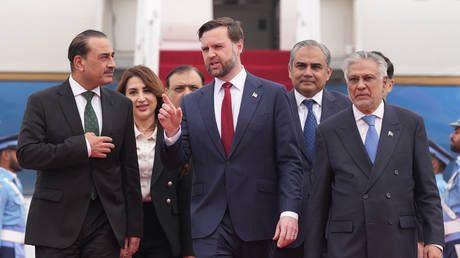
The recent flurry of diplomatic activity in Islamabad was never about a breakthrough. While mainstream analysts scrambled to decode every handshake and half-smirk between American and Iranian representatives on Pakistani soil, they missed the fundamental reality of the room. This was not a negotiation. It was a controlled demolition of old expectations. The primary takeaway from the Islamabad talks is that both Washington and Tehran have moved past the era of grand bargains, shifting instead toward a permanent state of managed friction designed to satisfy domestic hardliners while avoiding total regional collapse.
To understand why the "breakthrough" narrative failed, one must look at the geography of the meeting itself. Islamabad serves as a unique gray zone. It is a place where interests intersect without the heavy baggage of European capitals or the sterile neutrality of Oman. By meeting in Pakistan, both sides signaled a shift toward regionalizing their dispute. They are no longer looking for a global solution facilitated by the P5+1. They are looking for a local truce that keeps the lights on and the missiles in their silos.
The Illusion of the Nuclear Pivot
Most reporting focused heavily on the revival of nuclear constraints. This is a mistake. The nuclear file has become a convenient ghost that both sides haunt when they need to appear busy. In reality, the technical milestones reached by Tehran have made a return to the 2015 framework impossible. You cannot unlearn the physics of advanced centrifuges.
The talks in Islamabad focused on the far more volatile currency of regional militias and maritime security. Washington needs the Persian Gulf to remain navigable without committing a full carrier strike group to every tanker. Tehran needs the economic breathing room that comes with "blind eye" enforcement of secondary sanctions. The quiet understanding reached in Pakistan was not about signing a treaty; it was about defining the borders of tolerable provocation.
The Security Dilemma in the Backchannel
We often treat diplomacy as a chess match, but this was more like a high-stakes protection racket. The Iranian delegation brought a list of frozen assets; the Americans brought a list of drone coordinates.
The real friction point remains the "gray zone" operations. These are the actions that fall below the threshold of open war but high enough to cause political bleeding. By using Islamabad as a conduit, the U.S. attempted to draw a hard line around specific trade routes. Tehran, in turn, leveraged its influence over local proxies to demonstrate that the price of American "maximum pressure" is a permanent state of insecurity for global energy markets.
Why the Regional Actors are Terrified
While the world watched the two primary antagonists, the real story was the anxiety radiating from the neighbors. Saudi Arabia and the UAE were not at the table, but their presence was felt in every pause. For years, these Gulf powers relied on the idea that the U.S. would eventually "solve" the Iran problem.
Islamabad proved that the U.S. is no longer interested in solving the problem. It is interested in outsourcing the management of it.
The Pakistani intermediaries are not mere hosts. They are stakeholders with a crumbling economy and a desperate need for regional stability. By facilitating these talks, Pakistan attempted to prove its relevance as a bridge, yet it simultaneously highlighted the vacuum left by retreating American hegemony. When the superpower stops leading and starts "managing," the local players begin to hedge their bets. We are seeing a rapid shift toward a multipolar Middle East where local security pacts matter more than a signature from the State Department.
The Economic Shadow War
Sanctions are often described as a blunt instrument. They are actually a living ecosystem. In the corridors of the Islamabad meetings, the discussion surrounding "sanctions relief" was actually a discussion about "sanctions management."
There is a growing realization in Washington that the total economic isolation of Iran is a fantasy. Oil continues to flow through "dark fleets" and ship-to-ship transfers. The talks centered on the transparency of these flows. The U.S. is essentially offering a structured indifference to certain Iranian exports in exchange for a reduction in kinetic attacks on Western interests.
The Shell Game of Frozen Assets
Money is the only language that remains fluently understood by both sides. The technicalities of how funds move from South Korean or Qatari banks to humanitarian channels are the modern equivalent of troop withdrawals. These are the "confidence-building measures" that actually matter.
Critics argue this is nothing more than ransom. Diplomats call it liquidity management. Regardless of the label, the Islamabad sessions confirmed that the U.S. is willing to use financial flexibility as a leash rather than a collar. This is a tactical retreat from the moral high ground of "zero enrichment" and "zero exports," moving instead toward a pragmatic, if cynical, acceptance of the status quo.
The Domestic Audience Factor
Neither Joe Biden nor Ebrahim Raisi can afford a "deal." In the current political climate of both nations, a comprehensive agreement is a suicide note.
The Islamabad talks were structured to produce nothing that requires a legislative vote or a public signing ceremony. This is "stealth diplomacy." By keeping the outcomes vague and the agreements verbal, both administrations can deny they made any concessions at all.
- For Washington: It avoids a bruising battle in a divided Congress.
- For Tehran: It maintains the revolutionary image of "resistance" while pocketing the proceeds of eased maritime pressure.
- For the World: It provides a temporary, fragile calm that could be shattered by a single miscalculation by a rogue militia commander.
The Failure of the Intelligence Consensus
One of the most significant overlooks in the Islamabad coverage was the disconnect between intelligence assessments and diplomatic goals. The prevailing intelligence view is that Iran is closer to a breakout than ever before. Yet, the diplomatic approach in Islamabad behaved as if time were standing still.
This suggests a dangerous decoupling. If the diplomats are negotiating based on a 2023 reality while the technicians are living in a 2026 reality, the gap between the two becomes a kill zone. The Islamabad talks didn't bridge this gap; they merely papered over it with vague promises of future cooperation.
We must acknowledge that the traditional tools of statecraft—treaties, ambassadors, and public summits—are being replaced by these transient, third-party mediated huddles. It is a more honest form of interaction, perhaps, but it is also significantly more dangerous because there is no public record to hold either side accountable.
The New Rules of Engagement
The Islamabad era of US-Iran relations will be defined by three brutal truths that most analysts are too polite to mention.
First, the nuclear program is now a permanent fixture. It will not be dismantled. It will only be monitored, and even then, only partially. The leverage has shifted. Tehran knows that the West’s appetite for a new Middle Eastern war is non-existent, and they are pricing that into every demand.
Second, the "proxy" model of warfare has won. By refusing to hold Tehran directly accountable for the actions of its regional affiliates during the Islamabad talks, the U.S. effectively institutionalized the use of non-state actors as legitimate diplomatic leverage. This sets a terrifying precedent for other regional powers who are watching and learning.
Third, the dollar is losing its sting. The complexity of the "dark fleet" and the involvement of non-Western clearing houses in the Islamabad discussions show that the era of total financial dominance is waning. When a sanctioned state can negotiate the terms of its own "illegal" trade in a major regional capital, the system of global enforcement has fundamentally fractured.
The Mirage of De-escalation
Everyone wants to believe that talking is the same as progressing. It isn't. The Islamabad sessions were a masterclass in "de-escalation" as a stalling tactic.
By cooling the temperature just enough to prevent a direct confrontation, both sides have bought themselves time. But time to do what? Tehran is using the time to further harden its nuclear infrastructure and diversify its trade routes through the Global South. Washington is using the time to pivot toward the Pacific, hoping the Middle East remains quiet enough to ignore.
This is not peace. It is a strategic pause in a conflict that has no foreseeable end. The Islamabad talks didn't fix the relationship; they simply updated the terms of the divorce.
The danger of this managed friction is that it relies on perfect actors. It assumes that every drone launch, every cyberattack, and every seized tanker is a calculated move directed by a central command. It ignores the reality of the "fog of peace." In the absence of a formal framework, a single mistake by a mid-level officer in the Strait of Hormuz can render every hour spent in an Islamabad boardroom irrelevant.
The world is watching a high-wire act performed by two players who have stopped trusting their safety nets. They are no longer trying to reach the other side. They are just trying to stay on the wire.
Stop looking for the signing ceremony. It isn't coming. The new reality is a series of quiet handshakes in neutral cities, where nothing is written down, everything is denied, and the only goal is to survive until the next meeting.