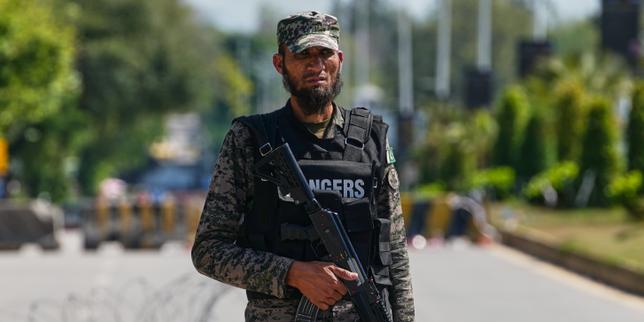
The whispers coming out of Pakistan’s capital are no longer just rumors. Behind the heavy gates of Islamabad’s diplomatic enclave, a high-stakes gamble is unfolding that could fundamentally redraw the map of the Middle East. While official channels in Washington and Tehran remain frozen in a posture of public hostility, a shadow bridge is being built. This is not about a sudden surge of goodwill. It is about a desperate, calculated necessity driven by collapsing economies and the terrifying proximity of a regional conflagration that neither side can actually afford to win.
Pakistan has emerged as the unlikely host for these secret negotiations. Its unique position—maintaining a brittle but functional relationship with the Pentagon while sharing a porous, 500-mile border with Iran—makes it the only realistic stage for this brand of brinkmanship. The goal is a "grand freeze," a tactical pause in the shadow war that has defined the last decade. But for this to work, both players have to offer up concessions that their own hardliners will view as nothing short of treason.
The Pakistani Conduit
Geography dictates destiny. Islamabad finds itself in the eye of a storm, acting as a postman for messages that cannot be sent via the Swiss embassy. The Pakistani military intelligence apparatus, which has spent decades mastering the art of the double-game, is now the essential gear in this machinery. They are the only ones capable of guaranteeing the physical security of such a meeting while ensuring that the details remain shielded from the prying eyes of regional spoilers.
Why now? The answer lies in the math. Iran is suffocating under a sanctions regime that has effectively severed its jugular. The rial is in a tailspin, and domestic unrest is a constant, low-frequency hum that threatens the stability of the clerical establishment. Conversely, the United States is staring down an election cycle with no appetite for a third front in the Middle East. A direct conflict with Iran would send oil prices into a vertical climb, vaporizing any hope of a soft landing for the global economy.
The Nuclear Elephant in the Room
Any conversation between these two powers eventually hits the same wall: the centrifuges. Washington wants a return to a framework that mirrors the defunct 2015 deal, but with more teeth and a longer expiration date. Tehran, having watched the previous agreement get shredded by a change in U.S. administration, is demanding guarantees that no future president can simply walk away.
This is the central friction point of the Islamabad talks. The U.S. delegation is reportedly pushing for a "less for less" approach. This would involve a modest lifting of specific oil sanctions in exchange for Iran halting its 60% enrichment of uranium. It is a band-aid on a gunshot wound, but in the current climate, a band-aid is better than bleeding out.
The technical reality is sobering. If we look at the enrichment levels, the math of breakout time is relentless. The formula for calculating the work required for enrichment, known as the Separative Work Unit (SWU), shows that the jump from 20% to 90% is much shorter than the jump from natural uranium to 20%.
$$U_{nat} \rightarrow 20% \approx 90% \text{ of the work completed}$$
Tehran knows this. They are using their proximity to weapons-grade material as their primary bargaining chip. They aren't just negotiating for sanctions relief; they are negotiating for their very survival as a regional power.
The Proxy Problem
Even if a nuclear roadmap is sketched out, the "Gray Zone" remains. Iran’s influence is not just measured in centrifuges, but in the reach of its proxies across the Levant and the Arabian Peninsula. The U.S. is demanding a verifiable reduction in the shipment of advanced drone technology and ballistic missile components to non-state actors.
This is where the negotiations usually fall apart. For Tehran, these groups are their "forward defense." Giving them up would be akin to the United States dismantling its carrier strike groups. The Islamabad talks are exploring a middle ground: a "de-escalation corridor." This would involve Iran reigning in specific types of attacks—specifically those targeting U.S. personnel—in exchange for a blind eye being turned to certain regional trade routes.
It is a cynical, cold-blooded trade. It acknowledges that peace is not the goal; management is.
The Role of the Gulf Monarchies
Riyadh and Abu Dhabi are not at the table, but their presence is felt in every room. For years, the Gulf states pushed for a maximum pressure campaign. Now, there is a palpable shift. The Saudi-Iran normalization deal, brokered by China, changed the calculus. The Saudis have realized that if a war breaks out, their multi-billion dollar "Vision 2030" projects will be the first targets for Iranian cruise missiles.
They are now quietly rooting for the Islamabad talks to succeed. They want a predictable Iran, even if it is an influential one. This alignment of interests between the U.S., Iran, and the Gulf states is the most significant geopolitical shift in twenty years. It creates a narrow window for a deal that didn't exist during the Obama or Trump eras.
Internal Sabotage
The greatest threat to these negotiations doesn't come from the other side of the table; it comes from within. In Washington, any hint of a "deal" with Iran is met with immediate legislative pushback. The political cost of appearing "soft" on Tehran is a price many in Congress are unwilling to pay.
In Tehran, the Revolutionary Guard (IRGC) views any rapprochement as an existential threat to their budget and their ideological purity. They have a history of "kinetic messaging"—launching a provocation or a rocket attack precisely when a diplomatic breakthrough seems imminent. These hardliners benefit from the status quo of "neither war nor peace." It allows them to maintain a grip on the domestic economy through black-market smuggling necessitated by sanctions.
The Economic Ghost
Let’s look at the raw numbers. Iran’s oil exports have fluctuated wildly, but they have managed to keep a baseline of roughly 1.5 million barrels per day moving, mostly to China, through a "ghost fleet" of tankers.
| Year | Estimated Oil Exports (mbpd) | Inflation Rate (CPI) |
|---|---|---|
| 2021 | 0.8 | 43% |
| 2022 | 1.1 | 49% |
| 2023 | 1.3 | 45% |
| 2024 | 1.5 | 40% |
These figures show a nation that is surviving, but not thriving. The inflation rate is a slow-motion wrecking ball for the Iranian middle class. The negotiators in Islamabad are staring at these charts. They know that if they can’t provide some form of relief soon, the domestic pressure in Iran might force the regime into a corner where their only options are total capitulation or total war.
The Pakistan Factor
Pakistan isn't doing this for free. Islamabad is currently grappling with its own economic nightmare and an uptick in domestic terrorism. By playing the role of the honest broker, they are buying themselves diplomatic capital with the West. They are also ensuring that their western border remains stable. A war between the U.S. and Iran would flood Pakistan with millions of refugees and potentially radicalize its own Shia population.
The Pakistani intermediaries are focusing on the "low-hanging fruit" first. This includes prisoner swaps and the unfreezing of humanitarian funds. These are the lubricants of diplomacy. They build enough trust to allow the parties to sit in the same room without reaching for their metaphorical holsters.
The Shadow of the 2026 Timeline
Time is the one commodity neither side has in abundance. The 2026 horizon is critical because of the expiration of various "sunset clauses" in previous international agreements. There is a sense of urgency that didn't exist eighteen months ago. If a framework isn't established now, the path to a nuclear-armed Iran becomes almost a mathematical certainty by the end of the decade.
The Islamabad talks represent a pivot away from the "maximum pressure" of the past and toward a "maximum realism." It is an admission that neither side can achieve its total objectives. The U.S. cannot force a regime change through sanctions alone, and Iran cannot drive the U.S. out of the Middle East through proxies.
We are witnessing the beginning of a cold peace. It will be ugly, it will be fragile, and it will be constantly under threat from extremists on both sides. But the alternative is a regional war that would make the conflicts of the last twenty years look like a prelude. The diplomats in Pakistan are not trying to solve the Middle East; they are trying to prevent it from exploding.
The reality of these negotiations is found in the silence. When the rhetoric in Washington and Tehran becomes most heated, that is often when the most progress is being made in the shadows. Watch the oil prices and the movement of the ghost fleets. They tell a story that the official press releases never will. The Islamabad backchannel is the last exit on the road to a much darker reality.