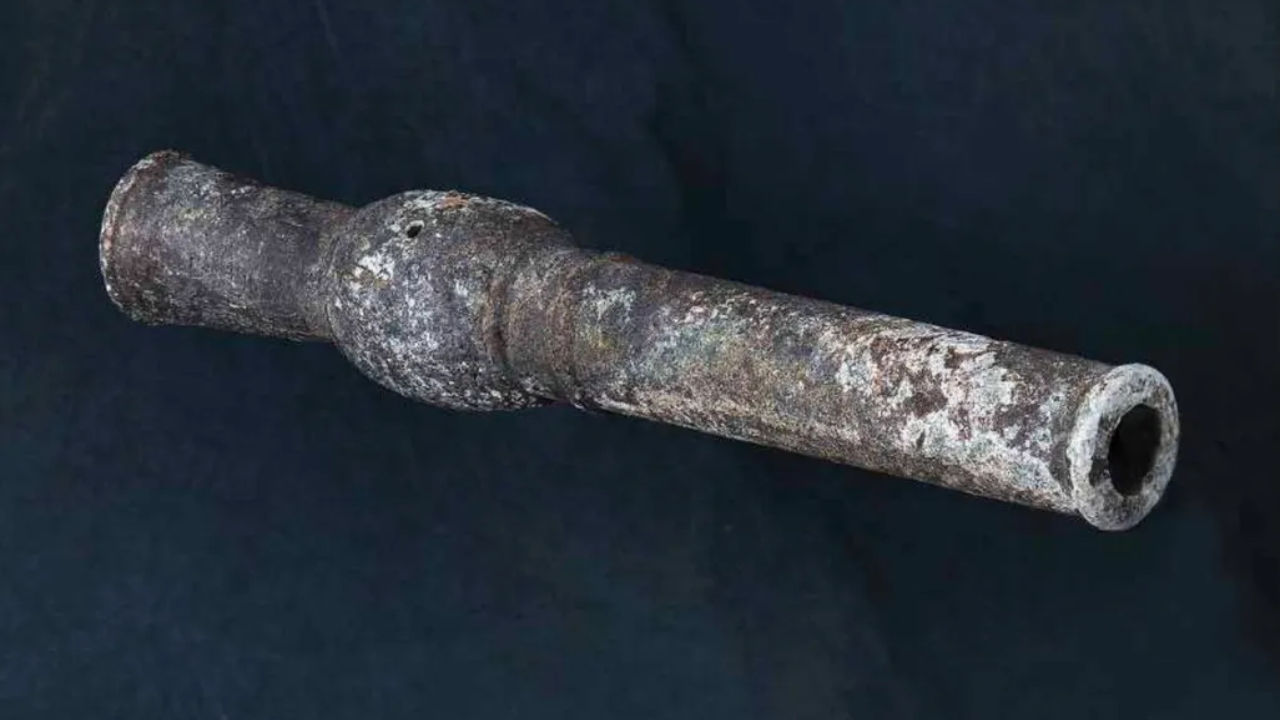
History has a macabre sense of humor. On the slopes of Mount Geumseong in southwestern South Korea, military units assigned to a hazardous mine-clearing operation weren't looking for antiquities. They were hunting lethal remnants of twentieth-century geopolitical paranoia—buried explosives designed to tear flesh and shatter bone. Instead, their metal detectors buzzed on a small, oxidized bronze tube resting barely four inches beneath the topsoil.
That heavy little metal cylinder, weighing just over two pounds, turned out to be the Hwangja Hwatong: the oldest confirmed gunpowder weapon ever discovered in South Korea.
The find short-circuits six centuries of linear military history. It transforms an active security zone into an archaeological window, proving that the ground beneath the Korean peninsula has been contested, fortified, and saturated with dangerous hardware for ages. Yet the mainstream media narrative—focusing purely on the neat irony of soldiers hunting modern land mines only to find medieval ordnance—misses the structural reality of what this artifact actually represents. This is not just a quirky human-interest story about a lucky metal-detecting sweep. It is a rare physical anchor to an era of desperate technological adaptation, state-sponsored industrial espionage, and asymmetric warfare against maritime raiders.
To understand why a two-pound bronze tube matters, one has to examine the geopolitical panic of the late Goryeo and early Joseon dynasties. During the late fourteenth and early fifteenth centuries, the Korean coastline faced relentless, devastating raids by Japanese pirates known as Wokou. These marauders operated with impunity, burning coastal settlements, slaughtering villagers, and cutting supply lines. Traditional bows, spears, and fortification walls were failing against mobile, ruthless invaders who struck fast and vanished back into the sea.
Korea needed a technological leap. And it needed it immediately.
Enter the state obsession with gunpowder. Historical records show that acquiring black powder technology was not a casual endeavor; it was an act of high-stakes industrial espionage and state monopoly. The Chinese dynasties guarded gunpowder formulas and metallurgical techniques jealously. Smuggling recipes or importing functional firearms meant risking execution. Despite these prohibitions, Korean innovators and emissaries worked aggressively to reverse-engineer the chemistry of combustion and the foundry techniques required to cast metal barrels that wouldn't explode in the user's face.
The newly analyzed artifact bears an inscription that reads like a bureaucratic fingerprint. Etched into the shaft socket are 28 characters detailing its provenance: manufactured in the twelfth month of a Jeongsa year, weighing one geun and 14 nyang, supervised by an administrative official named An Hyu-bo, and cast by an artisan named Seok.
The video above provides a look at how early bronze hand cannons were cast and fired in medieval East Asia.
Yet this inscription has sparked an intense academic debate that highlights the friction of historical dating. The cyclical nature of the traditional East Asian sexagenary calendar means the Jeongsa year designation points to two distinct possibilities: 1377 or 1437.
Sixty years separates those dates. That gap is massive in terms of metallurgical evolution. If the weapon dates to 1377, it places the artifact squarely within the tumultuous twilight of the Goryeo dynasty, right around the time the government established the Hwatong Dogam—a dedicated state agency created solely to manufacture firearms to combat the pirate menace. If it dates to 1437, it falls during the reign of King Sejong the Great, a golden age of Korean scientific and cultural advancement where military hardware was systematically standardized and refined.
Metallurgical testing and X-ray imaging reveal that the Hwangja Hwatong is an early, primitive design. Composed of a copper, tin, and lead alloy with a tin content kept strictly below ten percent, the barrel lacks the sophisticated internal features—such as the wooden plug known as a gyeokmok used to optimize explosive pressure in later models. It was designed to launch an arrow-like projectile using a volatile charge packed into a rear chamber, fired via a touch-hole by a soldier standing dangerously close to the blast.
Mount Geumseong in Naju, where the weapon was recovered, has served as a strategic military installation for centuries. It is high ground overlooking critical river basins—ideal for signaling, observation, and defense. When the bronze tube was dropped or abandoned there six hundred years ago, it was part of an desperate defense network. Soldiers of the medieval era stationed on that peak were grappling with the terrifying, unpredictable power of early chemical propellants, much like the modern conscripts sweeping for high-explosive land mines on the very same mountain centuries later.
The recovery of the Hwangja Hwatong reminds us that the earth beneath our feet is stratified with forgotten industrial revolutions. Every era believes its own weapons are the pinnacle of devastation, entirely blind to the primitive origins of the technology they inherit. A land mine scanner designed to detect twentieth-century TNT stopped short on a fifteenth-century bronze tube, bridging a vast chasm of time through the shared, violent human compulsion to master the physics of combustion.


