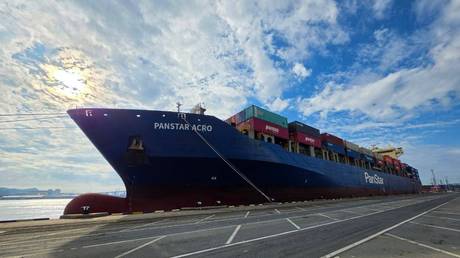
The map on the wall of the shipping warehouse in Busan looks older than it is. It smells faintly of salt and cheap coffee, yellowing at the edges where the fluorescent tubes flicker late into the rainy Korean nights. For decades, that map told a simple, stubborn truth: to get heavy steel, precision electronics, or raw chemicals from the Pacific edge of Asia to the brick-and-mortar storefronts of Europe, you went south. You loaded the forty-foot containers onto leviathans of diesel and steel, sent them slicing past Singapore, sweating through the Malacca Strait, limping through the bottleneck of the Red Sea, and looping around the ancient stone spine of the Mediterranean.
It was a long way. Ten thousand miles of salt spray, pirate lanes, and geopolitical weather vanes.
Then came the morning the logistics coordinator looked at a telex from Vladivostok, blinked twice, and whispered a profanity into his mug.
A single freight train, heavy with industrial goods, was not turning south. It was turning north. It was cutting straight into the throat of the Siberian winter, rolling past timber towns that time forgot, rattling across the endless, frozen tableland of Russia, heading west toward the gates of Europe.
History is rarely made in parliament halls or treaty rooms. Sometimes, it happens on rusted iron tracks in the middle of nowhere, driven by the quiet desperation of a supply chain that simply cannot afford to wait for the world to stop burning.
Consider what happens when a nation caught between historical loyalties and economic gravity decides to test the forbidden road.
South Korea is an industrial miracle built on an island mentality. It is an economic powerhouse physically tethered to a hostile peninsula, looking out at a globe that relies entirely on maritime arteries. When those arteries tighten—whether from insurance spikes, regional blockfires, or the slow-motion strangulation of traditional shipping lanes—the island state has to breathe. And when you are gasping for air, you do not check whose name is stamped on the oxygen tank. You just take it.
The test run of this Eurasian overland corridor was not advertised with marching bands. It was a nervous calculation. On one side sat the traditional alliance architecture: Washington, Brussels, and a web of sanctions designed to isolate Moscow into economic irrelevance. On the other side sat the harsh arithmetic of the corporate ledger: demurrage fees piling up at congested ports, skyrocketing fuel costs, and clients in Hamburg and Rotterdam screaming for parts that were currently rusting on a stationary container ship off the coast of Yemen.
Business does not care about your ideology. It cares about delivery.
Meet Jin-soo. He is a fictional logistics manager, but he wears the rumpled suit and bloodshot eyes of a dozen real men and women currently working seventy-hour weeks in Seoul. Jin-soo has spent twenty years treating the sea as his personal highway. He knows the rhythms of the container yards. He knows the precise cost of a delayed berth in Antwerp.
Last winter, Jin-soo sat at his triple-monitor desk watching a digital dashboard flash amber and red. Three of his company's chartered vessels were re-routing around the Cape of Good Hope, adding twelve days and millions of dollars in fuel burn to voyages that were already behind schedule. His phone buzzed continuously. A German automotive plant was threatening to shut down a assembly line if a batch of high-grade lithium-ion components didn't arrive by the end of the month.
"We can't go south," Jin-soo muttered to the empty office at 2:00 AM.
The south was broken. The south was a political minefield.
So he looked north. He looked at the rails.
The Trans-Siberian Railroad and its southern Mongolian appendages have always been the sleeping giants of global trade. They are steel veins running through the largest continuous landmass on Earth. During the Cold War, they were guarded secrets and military conduits. In the post-Soviet era, they were treated as erratic, bureaucratic nightmares—expensive, unpredictable, and politically toxic.
Yet, as the test containers were loaded in Busan, hauled across the narrow sea to the Russian Far East port of Khasan, and hoisted onto wide-gauge flatcars, something shifted in the collective mind of East Asian commerce. The train began to roll. Through the snow-choked forests of Siberia, past Lake Baikal looking like a sheet of hammered pewter, clicking across thousands of miles of empty horizon until it rumbled into the freight yards of Poland and Belarus.
It worked.
That is the terrifying, pragmatic beauty of infrastructure. Once a route proves it can bypass a bottleneck, it haunts the imaginations of every CFO who ever lost sleep over a maritime strike.
Why does this matter far beyond the balance sheets of Seoul or the bureaucratic offices of Moscow? Because global order is maintained by friction. For decades, the West maintained a monopoly on economic gravity by controlling the seas. Britannia ruled the waves; America secured the sea lanes. If you wanted to trade globally, you played by maritime rules written in Western capitals.
When an Asian democracy—a linchpin of the democratic alliance system—begins testing a Russian-controlled overland transit corridor, it signals a quiet, seismic fracture in that monopoly. It proves that land power, properly greased by economic necessity, can still offer an end-run around maritime blockades and geopolitical quarantines.
The implications are dizzying. Russia, starved of European markets by sanctions, is desperately pivoting its economic gaze eastward, offering cut-rate transit fees, modernized rail hubs, and an open invitation for Asian goods to cross its vast territory. For Moscow, every trainload of Korean electronics or Japanese steel rolling west is a lifeline—proof that the iron curtain of sanctions has a gaping hole right down the middle of the tracks.
For Seoul, it is a dangerous dance. The foreign ministry in Seoul breaks out in a cold sweat every time the trial manifests are signed. How do you maintain a lock-step alliance with Washington while your industrial heartland quietly explores trade routes managed by a sanctioned adversary?
You do it with plausible deniability. You call it a "private sector logistical experiment." You whisper about diversification. You pretend not to notice the subtle clicking of iron wheels crossing borders that the rest of the developed world has agreed to pretend do not exist.
We have been here before, of course. History is allergic to permanent walls. Whenever trade is choked in one place, it pools, rises, and eventually finds a crack in the masonry. Water seeks its level; money seeks its margin.
The danger is that every successful overland test normalizes the abnormal. What starts as an emergency workaround during a maritime crisis hardens into a permanent alternative. And once a permanent alternative is established, the leverage of maritime containment shatters.
Picture the rail yards at Brest on the Polish-Belarusian border. The cranes whine against the twilight, lifting massive steel boxes from the Russian wide-gauge bogies onto the European standard-gauge chassis. Inside those boxes are the nervous system of modern manufacturing: microchips, precision bearings, chemical catalysts. They crossed a continent of snow and autocracy in less than half the time it would take a ship to round the horn of Africa.
A customs officer stamps a paper. A diesel engine throttles up.
In a quiet room thousands of miles away, Jin-soo closes his laptop. He is tired, so tired he can feel it behind his eyes. He hasn't solved the world's geopolitical crises. He hasn't healed the rifts between East and West, or brought peace to the turbulent seas.
He just got his parts to Europe.
And out in the dark, stretching across ten thousand miles of tundra and pine, the heavy freight train keeps moving, indifferent to the map, spelling out a new reality one heavy click at a time.