The morning sun in the borderlands of South Lebanon does not just shine; it reveals. It glints off the corrugated metal roofs of tobacco sheds and illuminates the ancient olive groves that have seen empires rise and crumble into the limestone dust. But lately, that light feels heavier. It carries the weight of a silent, steel presence that exists beneath the soil and behind the stone walls. This is the reality of living on a fault line where the geography of a home has been permanently mapped onto the geography of a war.
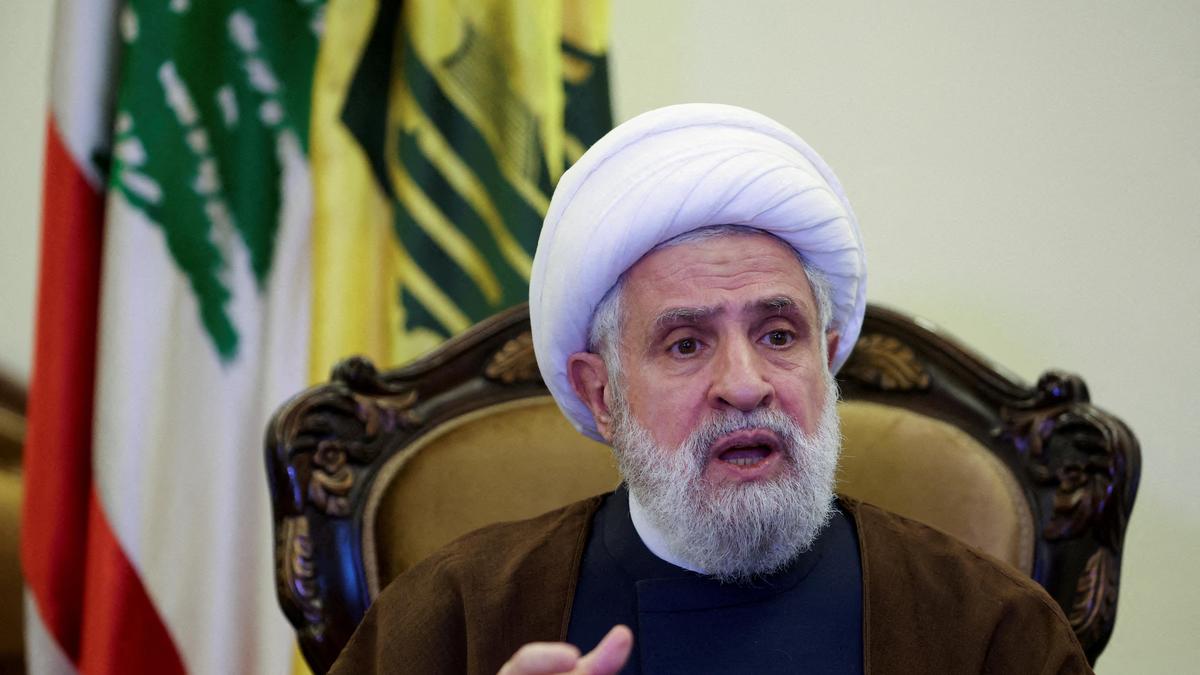
Naim Qassem, the man who now holds the steering wheel of Hezbollah, recently spoke to the world. His words were not a request. They were a boundary. He stated that the group’s vast arsenal—a collection of rockets and precision missiles that has turned the region into one of the most densely armed patches of earth on the planet—is not up for discussion. Not in a ceasefire. Not in a boardroom. Not ever.
To understand why a man would look at a smoking horizon and refuse to put down his shield, you have to look past the political podiums. You have to look at the dirt.
The Weight of the Unspoken
In the diplomatic hubs of Paris or Washington, weapons are pieces on a chessboard. They are "assets" to be de-escalated or "inventories" to be monitored. But for the people living in the shadow of the Litani River, these weapons are something else entirely. They are a permanent fixture of the landscape, as immovable as the mountains themselves.
Imagine a farmer named Yusuf. This is a man who knows the temperament of his soil by the way it feels under his fingernails. For Yusuf, the presence of Hezbollah’s rockets isn’t a headline; it is the reason he believes his village hasn't been leveled yet. He remembers 2006. He remembers the sound of the sky tearing open. In his mind, the rockets are the only thing keeping the sky intact. This is the psychological anchor that Qassem is tapping into. It is a logic built on the scars of the past, where the only thing worse than being armed is being vulnerable.
The "Iron Orchard" refers to this invisible forest of weaponry. Thousands of projectiles are tucked into garages, buried in reinforced tunnels, and hidden in plain sight among the civilian infrastructure. This isn't just a military strategy. It is a way of life that has integrated the machinery of death into the architecture of survival.
The Stalemate of the Soul
When Qassem declares that these weapons are off the table, he is responding to an intense international pressure to move his forces north, away from the blue line that separates Lebanon from Israel. The world wants a buffer. They want a space where two enemies can breathe without smelling each other's sweat.
But Qassem’s stance suggests that for Hezbollah, a buffer is a vacuum. And in this part of the world, vacuums are filled with fire.
The core of the issue isn't just about the number of missiles. It’s about the Iran-backed group’s fundamental identity. To disarm, or even to negotiate the terms of their weaponry, would be to admit that they are a political party first and a militia second. It would mean surrendering the "Resistance" brand that has defined them for decades.
Consider the sheer scale of the mismatch in perspective. A diplomat sees a missile as a threat to regional stability. A Hezbollah commander sees that same missile as the only reason his family has a roof over their heads. You cannot negotiate away someone’s sense of existential safety with a signed piece of paper.
The Invisible Stakes
There is a specific kind of silence that falls over a village when the drones start their overhead hum. It is a mechanical, buzzing sound—the sound of a hornet that never tires. Underneath that hum, the logic of the "Iron Orchard" becomes clear. The weapons are not just for firing; they are for looming.
The strategy is one of mutual assured exhaustion. By refusing to include the weapons in negotiations, Qassem is betting that the world will eventually grow tired of the tension before he grows tired of the weight. He is banking on the idea that the status quo, however bloody and unstable, is preferable to a surrender that leaves his flank exposed.
But what does this mean for the person who just wants to buy bread?
The tragedy of this stance is the erasure of the middle ground. When the weapons are non-negotiable, the people living near them become non-negotiable too. They are folded into the target. Their schools, their clinics, and their backyards become the front lines because the "Shield" is stored under their floorboards. It is a heavy price to pay for a sense of security that feels more like a hostage situation with every passing day.
The Echo in the Halls of Power
Across the border, the perspective is a mirror image of fear. The Israeli government looks at the "Iron Orchard" and sees an intolerable countdown. They see a neighbor who has turned their basement into a silo. This is why the negotiations are so fraught. One side demands the removal of the threat as a prerequisite for peace, while the other side views the threat as the only guarantee that peace will hold.
Qassem’s speech wasn't aimed at Israel, really. It was aimed at his own base and his patrons in Tehran. It was a signal of endurance. He is telling his followers that the sacrifices of the last several months—the thousands of displaced families, the leveled homes, the lost sons—were not in vain because the core power of the group remains untouched.
He is trying to project a mountain’s resolve while the ground beneath him is shaking.
The Reality of the "Permanent"
We often speak of wars ending. We talk about "post-conflict" eras and "reconstruction." But in the South, there is no "post." There is only the "during." The refusal to negotiate the weapons ensures that the conflict is not an event, but a climate. It is a season that never ends, a winter that occasionally gets warmer but never melts away.
The weapons are the center of gravity. Everything else—the politics, the economy of Lebanon, the shipping lanes in the Mediterranean—orbits around the fact that one group holds the power to start a fire that no one can put out.
As the sun sets over the hills, casting long, jagged shadows across the valley, the "Iron Orchard" remains. The rockets are still there, silent and cold. The diplomats will return to their hotels. The generals will update their maps. And Yusuf, the farmer, will sit on his porch, looking at the olive trees, wondering if the roots are tangled with the steel of a rocket that might one day save him, or one day bury him.
The tragedy isn't that the negotiations are failing. The tragedy is that for those in power, the weapons have become more precious than the peace they were supposedly built to protect.