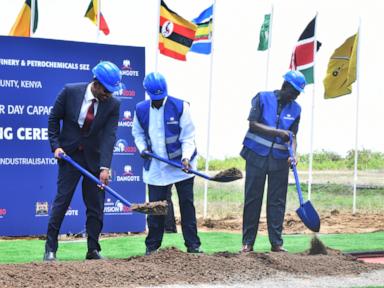
The ground does not simply hold weight here; it endures history.
For generations, the rhythm of morning in certain corridors of the continent was measured by a quiet, persistent paradox. Millions of barrels of thick, dark crude flowed out of local earth every single day, shipped thousands of miles across oceans only to return months later as refined gasoline, jet fuel, and diesel at a price that bled local treasuries dry. It was an economic gravity defying all logic: export the raw lifeblood, import the refined cure.
Then came the shovels.
When African heads of state recently gathered to break ground on a staggering sixteen-billion-dollar oil refinery project, the cameras captured the polished brass, the ceremonial hard hats, and the steady grip of silver spades turning sun-baked earth. But beneath the televised handshakes lay a much deeper, more raw human pulse. This was not merely about concrete, steel, and distillation columns. This was about the end of an era defined by a frustrating riddle.
Consider what happens next: a continent that has long supplied the raw engine of global industry finally decides to build its own fire.
The Weight of an Empty Barrel
To understand why a sixteen-billion-dollar industrial titan matters, you have to look past the macroeconomics and step into the dusty heat of a roadside transport hub.
Imagine a man named Ibrahim. For twenty years, Ibrahim has steered a heavy transport truck across thousands of miles of asphalt, hauling goods from coastal ports to landlocked interior markets. His livelihood depends entirely on the price at the pump. When global crude prices spike, or when currency fluctuations send import costs soaring, Ibrahim’s profit margin evaporates. He works fourteen-hour days not to get ahead, but simply to afford the fuel required to make the next trip.
(Note: Ibrahim is a hypothetical composite character designed to illustrate the daily realities faced by millions of commercial operators across the region.)
Ibrahim’s struggle is a mirror of national budgets. For decades, major oil-producing nations across Africa suffered from a staggering structural vulnerability. They possessed the resource, yet lacked the domestic processing capacity. Consequently, they remained tethered to external refining hubs, vulnerable to every geopolitical tremor, supply chain bottleneck, and currency devaluation halfway across the globe.
When you export crude and import fuel, you are essentially outsourcing your economic sovereignty. You pay for the shipping twice. You pay for the foreign labor. You pay for the markup. And worst of all, you export the most valuable commodity a developing nation can generate: skilled engineering jobs and technological independence.
The ground-breaking ceremony for this massive refinery complex represents a direct challenge to that old script. It is an assertion that the continent's mineral wealth should feed its own factories, power its own cities, and build a self-sustaining industrial foundation.
Anatomy of a Mega Project
Sixteen billion dollars is a number so large it risks becoming invisible. Let us break down the reality of what that capital actually buys when translated into steel and steam.
Modern refining is not just boiling oil in a giant kettle. It is a masterclass in chemical choreography. Crude oil is a chaotic soup of hydrocarbons—everything from light gases and volatile naphtha to heavy asphalts and lubricating oils. To separate them with precision requires complex atmospheric and vacuum distillation units, catalytic crackers, and hydrotreaters that operate under extreme pressures and temperatures.
When completed, a mega-refinery of this scale is designed to process hundreds of thousands of barrels per day, turning sour or sweet crude into ultra-clean gasoline, diesel, aviation kerosene, and petrochemical feedstocks like polypropylene.
Think of it as a massive biochemical kitchen. Without it, you are constantly sending your raw ingredients out to be cooked by a neighbor who charges you top dollar to bring them back. With it, you control the kitchen, the menu, and the fire.
The geopolitical and economic ripple effects of this transformation are profound:
- Foreign Exchange Conservation: Local currency values stabilize when nations stop bleeding billions in foreign reserves solely to purchase imported petroleum products.
- Job Creation and Transfer of Skills: Thousands of direct engineering, metallurgical, and operational roles emerge, turning theoretical technical education into hands-on industrial mastery.
- Regional Integration: Domestic production unlocks local supply chains, lowering transportation costs for manufacturing, agriculture, and retail sectors.
Yet, building the hardware is only half the battle. The true test lies in the operational execution, navigating regulatory mazes, securing steady feedstock inputs, and ensuring that the financial dividends trickle down to the everyday citizen rather than pooling in administrative silos.
The Human Horizon
History reminds us that grand infrastructure projects are frequently haunted by delays, cost overruns, and skepticism. Critics often point to past missteps—ambitious blueprints that withered under the weight of bureaucratic friction or volatile commodity cycles. That caution is fair. It is born from a legacy of broken promises and unfulfilled potential.
And yet, standing at the edge of the newly turned earth, the mood among local engineers and workers is distinctly different this time. There is a palpable sense of urgency. The population is younger, better connected, and less willing to accept the old narrative of perpetual dependency.
When the massive steel towers rise against the horizon, they will cast long shadows over old habits. They will stand as physical monuments to a shifting global balance—a declaration that the future of energy processing belongs closer to the soil from which it was born.
The engines are turning. The foundations are set in stone and ambition. And somewhere down the highway, Ibrahim checks his mirrors, looks ahead at the open road, and watches the horizon shift just a little bit closer to home.