Bronze is heavy. When they cast it, the metal smells of old smoke and hot sulfur, cooling slowly in dark workshops while the city outside forgets its own name. For centuries, we gave that weight to generals. We gave it to poets with broken noses, to statesmen who died in debt, to cartographers whose ink-stained fingers mapped empires that crumbled before the parchment dried.
Then came the white coats.
They stood in sterile corridors under fluorescent tubes that hummed at frequencies only dogs could hear, counting subatomic particles and measuring the curvature of spacetime. They did not get medals. They got footnotes. They got dusty lecture halls with three students in the back row eating cold sandwiches.
Until the day the code took the crown.
Imagine standing inside a modern laboratory at three in the morning. The coffee is gone. The whiteboard is a chaotic storm of calculus that looks less like science and more like a desperate cry into the void. Elon Musk stood in that kind of air once. Not in the sleek showrooms of electric sedans or behind the mahogany desks of aerospace hangars, but in the quiet, terrifying hours when rockets blow up on concrete pads and the stock price drops fifty points before breakfast.
We forget the cost of creation. We see the polished chrome of the capsule returning from the blackness of orbit, and we applaud the man on the screen. We forget the metal fatigue. We forget the algorithms chewing through terabytes of telemetry data, hunting for a single miscalculated decimal that could turn a billion-dollar machine into a fireball over the Atlantic.
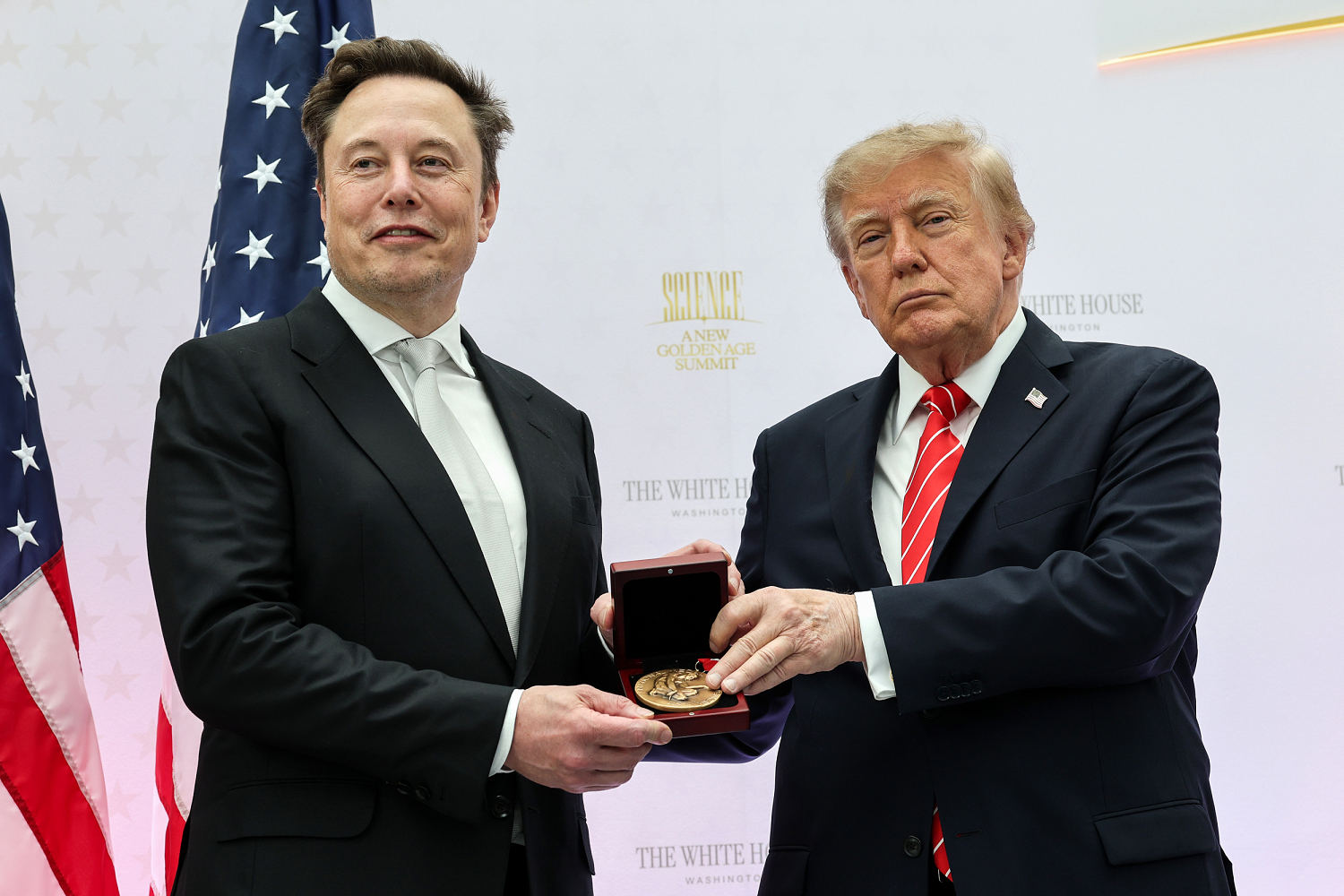
When the National Medal of Science is handed out, it carries the ghost of Thomas Edison’s soot-stained thumbs and the quiet dignity of Barbara McClintock counting kernels of corn in a lonely field. It is the nation's highest scientific honor. It is not an award for popularity. It is a scar, pressed flat and minted in gold.
Lately, the line between the engineer and the emperor has blurred until it is nearly invisible.
Consider what happens when the architect of private spaceflight and autonomous machine learning steps into the East Room of the White House. The flashbulbs pop. The cameras catch the slight slump of shoulders that have carried the weight of orbital mechanics and viral social networks simultaneously. Behind him stand other architects—men and women whose names do not trend on Saturday nights, whose life work consists of twenty-year studies on neural pathways or material sciences that make fiber optics look like a child's toy.
There is a strange vertigo in watching this convergence.
For generations, science was an ivory tower. You climbed it by publishing obscure papers in journals read by twelve people. You waited for old men to die so you could take their chairs. It was slow. It was methodical. It was safe from the grease of commerce.
Silicon Valley broke those walls down with a sledgehammer made of venture capital and relentless ambition.
When technology titans receive honors traditionally reserved for quantum physicists and molecular biologists, the cultural tectonic plates shift. The purists scoff. They argue that building reusable rockets or training large language models is engineering, not science. They say it is applied mechanics, not fundamental discovery. They look at the balance sheets and sneer at the intrusion of market forces into the sacred temple of peer review.
They are missing the plot entirely.
Science without application is a Stradivarius violin locked in a glass case. Beautiful. Silent. Useless. The men and women who build the systems scaling across our civilization are forcing empirical truths into the wild at a scale the founders of the National Science Foundation could never have hallucinated in their wildest fever dreams. When an algorithm predicts protein folding in minutes instead of decades, or when a constellation of low-Earth orbit satellites maps every square inch of melting permafrost in real-time, the boundary between pure research and applied supremacy ceases to exist.
The ceremony itself was quiet. Or at least, the parts that mattered were.
Protocols dictate the stride, the precise angle of the handshake, the flash of the photographer's lens. But look into the eyes of the recipients who have spent forty years in basement laboratories looking through electron microscopes. Then look at the tech leaders who have bet their entire fortunes on artificial intelligence and interplanetary transport.
One group spent a lifetime asking why. The other spent a lifetime asking how fast.
Right now, those two questions are colliding. We are standing at the edge of a precipice where the tools we use to understand the universe are merging with the tools we use to rewrite it.
The medal hangs from a blue ribbon. It rests against the fabric of a suit that cost more than a graduate student’s annual stipend. That juxtaposition is uncomfortable. It makes us squirm because we want our heroes to be pure. We want them to live in garrets, subsisting on tea and pure intellectual curiosity, untainted by the vulgarity of market capitalization.
History has never worked that way.
Galileo had patrons. Newton managed the Royal Mint and hunted counterfeiters with a cold, terrifying efficiency. The great leaps forward have always been funded by power and driven by obsession. The only difference today is the velocity. The feedback loop between an abstract mathematical concept and a commercial product deployed to two billion people is no longer measured in centuries. It is measured in weeks.
We are living through the iron age of the algorithm.
Every time a rocket clears the tower at Starbase, screaming against gravity with thirty-3 Merlin engines roaring in unison, it is a physical manifestation of physics applied at maximum violence. It is math made manifest. It is the laws of thermodynamics dragged kicking and screaming into the commercial marketplace.
That is why the medal matters. Not because it validates a billionaire's ego, but because it acknowledges a fundamental truth of our era. The people who are bending the future are no longer sitting behind university lecterns alone. They are in the crucible of industry, where failure means bankruptcy and success changes the baseline reality of human existence.
The flashbulbs fade. The room empties. The dignitaries retreat to secure vehicles idling on Pennsylvania Avenue.
Back in the laboratories, the supercomputers keep running. The cooling fans whine in the dark, sucking in dust and electricity, spitting out answers to questions we haven't even learned how to ask yet. Somewhere in Texas, a test stand cools down, the metal pinging in the night air like small bells. The work continues, indifferent to gold ribbons, untouched by applause, moving inexorably toward the dark.