The heat doesn't invite itself in; it forces its way through the cracks. It settles into the floorboards and hangs heavy in the bedroom corner, a thick, suffocating weight that makes the mattress feel like a furnace. You flip the pillow. Cool side. Ten minutes later, that side is spent too.
Most people view buying a cooling fan as a transaction born of desperation. It is July, the bedroom is eighty-five degrees, and Walmart or Amazon is a click away. You buy whatever is white, plastic, and promises to push air. But there is a silent fraternity of people who look at this desperate ritual and shake their heads. These are the product engineers, the HVAC technicians, and the appliance testing experts—people who spend their days measuring decibels, airflow velocity, and motor efficiency.
When these experts go home to their own stifling apartments and houses, they do not rely on the rattle and hum of a twenty-dollar box fan. They know something the rest of us ignore: a bad fan doesn't cool you; it just beats the hot air into submission while keeping you awake.
Consider Sarah. She is a hypothetical composite of every product reviewer who has ever spent eight hours a day in a testing lab measuring wind speed with an anemometer. In her lab, fans are stripped down to their bearings. She sees how the plastic degrades, how the motor housing traps heat, and how the blade pitch affects the pitch of the whine.
When Sarah goes home, she wants silence. She wants a gentle, consistent drop in skin temperature that mimics a late-night breeze off a lake, not a jet engine taking off on her nightstand.
The Anatomy of a Secret
The average consumer looks at a fan and sees blades. An expert looks at a fan and sees fluid dynamics.
The biggest mistake we make when trying to escape the heat is prioritizing raw power over aerodynamic efficiency. Cheap fans use flat, poorly angled plastic blades driven by cheap Alternating Current (AC) motors. To move air, these blades have to spin at incredibly high revolutions per minute. The result is a choppy, turbulent wall of air that hits your face like a physical blow. It dries out your eyes, irritates your sinuses, and creates a chaotic racket.
In the bedrooms of the people who design these things, you will almost exclusively find fans powered by Direct Current (DC) brushless motors.
The difference is mechanical poetry. A DC motor allows for infinite, micro-adjustments to speed. More importantly, it operates with frictionless efficiency. Where an AC motor hums because of the constant cycling of electrical currents, a DC motor glides. This technology allows blades to be shaped with complex, organic curves—resembling whale fins or airplane wings—that slice through the air rather than slapping it.
This is why experts consistently point toward brands like Dyson and Vornado, but for entirely different reasons.
The Sculptor of Air
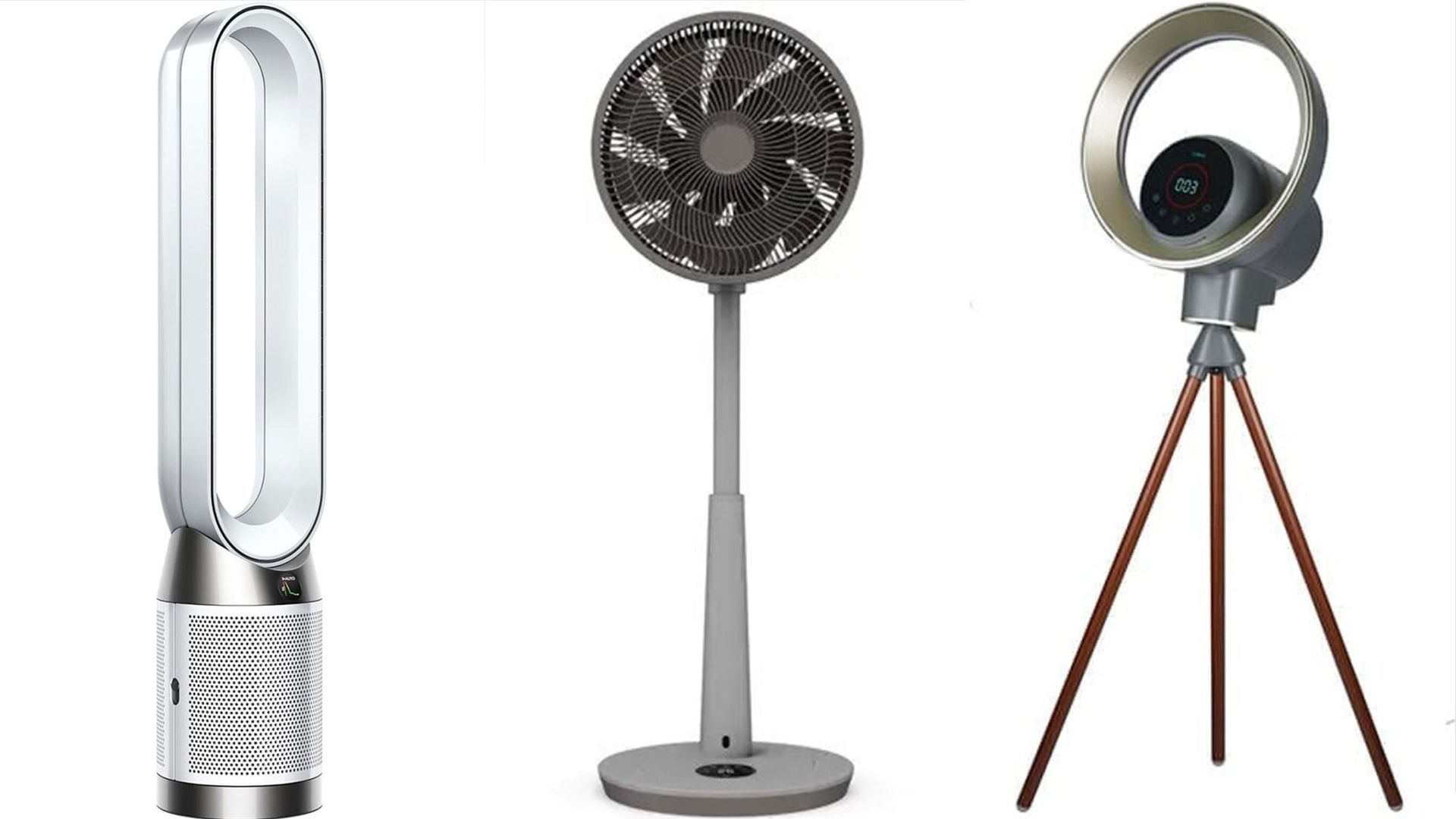
In the living room of an engineer who values aesthetics as much as fluid dynamics, you will often find a Dyson Purifier Cool. It is an expensive piece of machinery, a sculptural loop of plastic that seems to defy the laws of physics.
The secret here isn't magic; it is turbocharging. Air is drawn into the base through a mixed-flow impeller, passed over an airfoil-shaped ramp, and accelerated through a tiny aperture around the loop. This creates a vacuum that draws the surrounding room air into the stream.
When you use one, the sensation is eerie. There is no buffeting. The air doesn't chop. It moves as a single, continuous column. For an expert, the value isn't just in the breeze; it is in the integration of HEPA filtration. It solves two human miseries at once: the oppressive summer heat and the invisible, floating pollen that makes summer mornings miserable for allergy sufferers. It is a machine designed for the modern apartment where space is a premium and breathing clearly is a luxury.
But go to the home of a veteran HVAC technician, someone who spent thirty years balancing the airflow in massive commercial buildings, and you will likely find something far more industrial-looking. You will find a Vornado.
The Whole-Room Illusion
The Vornado does not look like the future. It looks like a heavy-duty relic from mid-century America. Yet, its internal geometry is a masterclass in physics.
Standard fans are designed to be pointed directly at your body. If you move out of the stream, you are hot again. The Vornado operates on a principle called whole-room circulation. It uses a deep-pitch blade coupled with a unique spiral grill that twists the air into a tight beam.
Instead of blowing it at their faces, experts aim a Vornado at the opposite wall or the ceiling.
The column of air travels across the room, hits the wall, and reflects outward, creating a continuous, looping vortex throughout the entire space. The air in the corners moves. The hot pockets near the ceiling are pulled down and mixed. Suddenly, the entire room feels three degrees cooler, not because the machine has chilled the air, but because it has broken up the stagnant thermal layers that trap heat against your skin.
It is the difference between standing in front of a hair dryer and walking into a well-ventilated gallery.
The Hidden Cost of Cheap Comfort
It is tempting to look at the price tags of these expert-approved models and retreat to the safety of a bargain bin. A fan is a fan, right?
But comfort has a hidden ledger. A cheap fan vibrating on a hardwood floor creates a low-frequency rumble that disrupts REM sleep, even if you think you have tuned it out. Your brain hears it. Your nervous system responds to it. You wake up sluggish, your neck stiff from the targeted blast of a rigid oscillating unit that spent the night drying out one side of your body at a time.
Then there is the energy calculus. A traditional AC box fan can draw up to a hundred watts of power on high, running constantly through the sweltering months. A modern DC motor fan can move the same volume of air while drawing less than twenty watts. Over three summers of relentless use, the premium option often pays for itself in the quiet subtraction from your electric bill.
The true luxury of an expert-vetted fan is that you forget it exists.
The Midnight Benchmark
The ultimate test of any appliance happens at 3:00 AM.
The house is dead silent. The world outside is frozen in the sticky grip of a summer heatwave. You are suspended between sleep and wakefulness, highly sensitive to every click, rattle, and buzz.
In that moment, the cheap fan reveals its true nature. The plastic housing expands and contracts with the ambient temperature, causing tiny, rhythmic squeaks. The dust gathered on the unshielded blades throws the center of gravity off, creating a rhythmic wobble that vibrates through the floorboards.
In the next room, the expert sleeps through the night. Their fan, perhaps a sleek Kamome or a premium GreenFan by Balmuda, sits on its pedestal like a silent sentinel. Its blades, engineered using data from submarine propellers, turn at a speed that creates a sound frequency below the threshold of human irritation. The breeze it delivers doesn't feel like a mechanical product. It feels like the window was left open to a cool, midnight valley.
We spend a third of our lives trying to rest. We buy expensive mattresses, high-thread-count sheets, and blackout curtains, only to ruin the entire environment with a noisy, inefficient piece of plastic because we didn't think a fan mattered.
The people who know better don't view a fan as a temporary summer fix. They view it as an architectural tool for the home, an instrument that shapes the very atmosphere of the spaces where we seek refuge. When the heat rolls in this year, look past the bargain displays at the front of the store. Look for the engineering, look for the silence, and invest in the air you have to breathe.