The sea does not care about politics, but the men who sail it must.
Imagine a rusted merchant vessel, the Mare Liberum, idling in the heavy, humid air of the Gulf of Oman. Under the blistering mid-July sun, the deck plates are hot enough to fry fish. Below deck, the hum of the auxiliary generator is the only sound keeping the crew from going mad. The captain, a seasoned mariner named Andreas, stares at the radar screen. A dozen green blips hover nearby—other commercial ships waiting, watching, and hesitating.
They are all staring at the same invisible line in the water.
At exactly 4:00 p.m. Eastern Time on July 14, 2026, that invisible line became an iron wall. Under direct orders from Washington, United States Central Command (CENTCOM) officially resumed its naval blockade of all maritime traffic entering and exiting Iranian ports. Just like that, the fragile peace of a summer ceasefire evaporated back into the salt air.
The Ghost of Versailles
To understand how we arrived at this moment, we have to look back to June.
Only weeks ago, there was hope. A high-profile agreement signed in the gilded halls of the Palace of Versailles had seemingly brought the grueling spring conflict to a halt. The United States lifted its initial, strangling blockade, which had successfully choked Iran’s oil exports to a historic six-year low. For a brief moment, the tankers sailed again. The global shipping lanes breathed a collective sigh of relief as commercial giants sent their massive vessels back through the Strait of Hormuz.
But peace in this stretch of water is as unstable as nitroglycerin.
The deal unraveled not in a diplomatic boardroom, but on the water. Over the last week of July, seven commercial vessels were struck in a barrage of attacks, leaving nearly a dozen mariners dead, injured, or lost to the sea. Washington pointed the finger directly at Tehran.
The response was swift and total. The U.S. Navy didn't just send warships; they brought the heavy hand of global finance back down with them. Simultaneously, the U.S. Treasury Department blacklisted a massive shipping and oil-trading network spanning from Singapore to Switzerland, freezing over $130 million in digital assets linked to the Central Bank of Iran.
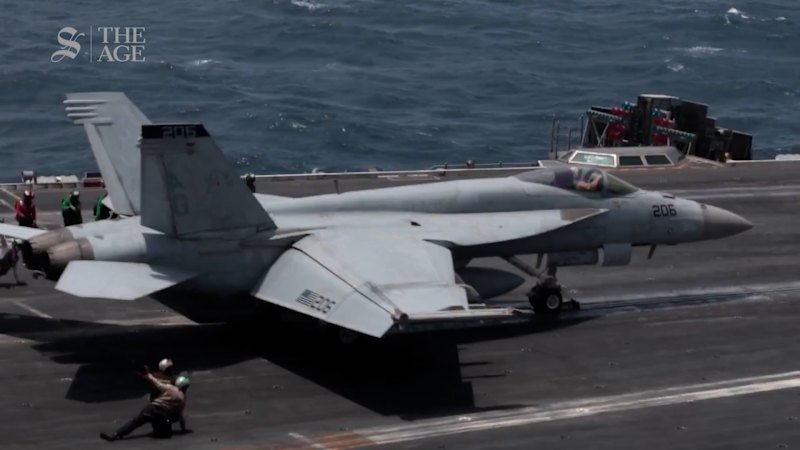
Now, nineteen American warships—including two aircraft carriers and more than ten destroyers—patrol the northern Arabian Sea. They are the new gatekeepers of the Gulf.
The Price of Safe Passage
For the merchant sailors aboard these ships, the blockade is not a chess game of geopolitical dominance. It is a matter of survival.
If Andreas decides to steer the Mare Liberum toward an Iranian port to deliver its cargo, he risks interception, diversion, or worse. During the first iteration of the blockade earlier this year, U.S. forces disabled nine non-compliant vessels. They redirected 140 more.
But staying in neutral waters brings its own financial ruin. A delayed supertanker can cost its operators upwards of $100,000 every single day it sits idle, consuming fuel and paying crew wages while doing nothing.
Then comes the proposed toll.
The White House floated a staggering proposition: charging commercial shippers a 20% fee on the value of their cargo to offset the costs of American "safety and security" in the Strait. To a shipping industry already operating on razor-thin margins, such a fee is a death sentence for profitability.
Iran's leadership was quick to mock the proposal, claiming they have always been the true "guardians" of the Strait, while hinting that they might begin levying their own, more "fair" tolls on any vessel transiting the waterway without their explicit permission.
Caught in the middle of this monetary mudslinging are the shipping companies, the insurers, and ultimately, the consumers who will pay more for every gallon of gas and every manufactured good that relies on global trade.
A Coastline Under Siege
The rules of engagement are clear, yet terrifyingly unpredictable.
The blockade covers the entirety of the Iranian coastline. CENTCOM has clarified that neutral transit through the Strait of Hormuz to non-Iranian destinations—like Kuwait, Qatar, or the United Arab Emirates—is legally permitted. But in a narrow choke point where maritime traffic is squeezed into shipping lanes only a few miles wide, the margin for error is nonexistent.
One wrong turn, one misunderstood radio transmission on bridge-to-bridge channel 16, and a peaceful merchant ship becomes a suspected hostile target.
And the stakes are rising by the hour. Fresh military strikes have already targeted Iranian infrastructure to degrade their capability to attack merchant ships. Warnings have flown from Washington that if diplomatic negotiations do not resume, the strikes will target critical bridges and power plants within Iran itself.
Back on the bridge of the Mare Liberum, Captain Andreas listens to the static crackle of the radio. A U.S. Navy destroyer is hailing a container ship a few miles ahead. The tone is polite, professional, but carrying the unmistakable weight of overwhelming firepower.
The green blips on the radar screen remain still. Nobody wants to be the first to test the resolve of the grey hulls patrolled by the horizon. The blockade is back, the gates are locked, and the world holds its breath to see who will try to force them open.