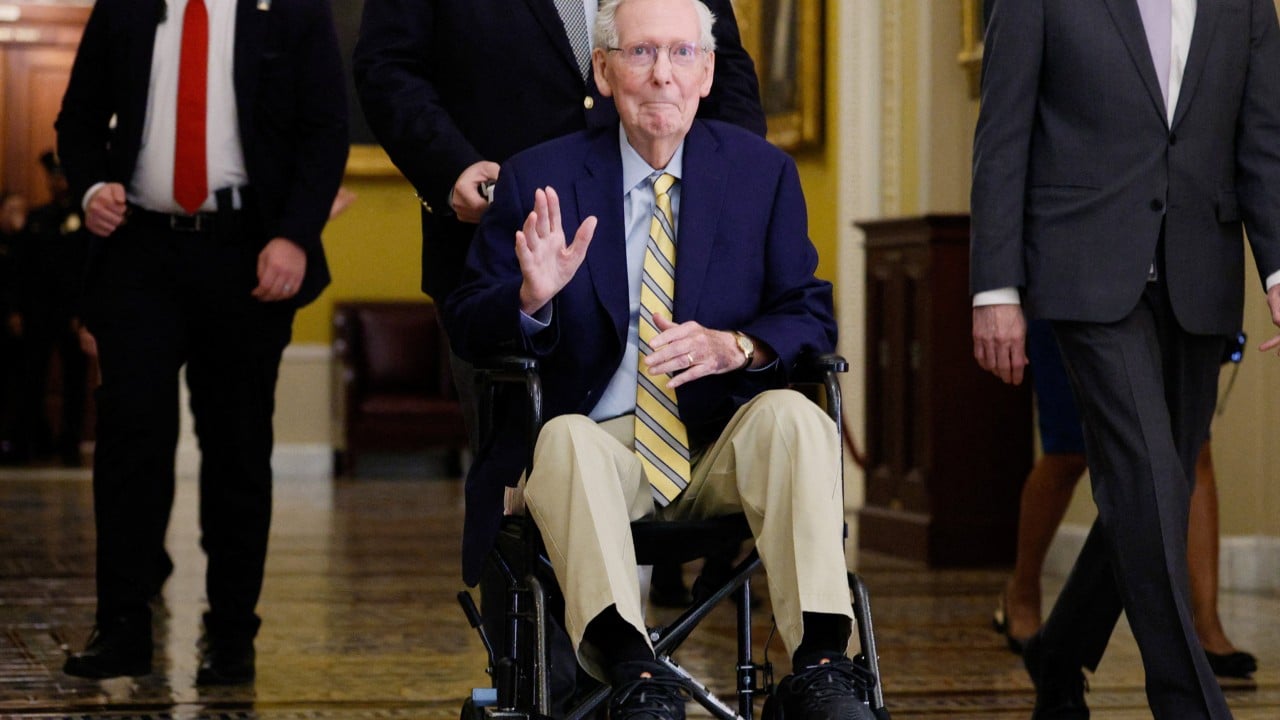
Legislative productivity in modern representative democracies relies on a continuous quorum and predictable voting blocs. When a senior legislator experiences a prolonged medical absence, the operational capacity of the institution faces a structural bottleneck. The return of Senator Mitch McConnell to the United States Senate following a three-month health hiatus offers a clear case study in how legislative bodies absorb acute human capital shocks without altering their underlying institutional output. Evaluating this event requires shifting the focus away from episodic journalism and toward the operational mechanisms of legislative management, proxy voting constraints, and the opportunity costs of prolonged absenteeism in a polarized chamber.
The Cost Function of Absenteeism in a 51-49 Chamber
In a legislative body characterized by narrow partisan majorities, individual attendance ceases to be a routine administrative detail and becomes a critical variable governing operational output. During periods of extended medical leave, the mathematical margin required for procedural votes narrows to zero tolerance for defection or concurrent absences.
The primary cost function of an absent senator is measured along three distinct axes:
- Procedural Gridlock: Committee work stalls when tie-breaking mechanisms fail or when bipartisan quorums cannot be reached. Judicial and executive branch nominations require committee reporting before floor action; an absence freezes this pipeline.
- Whip Operations Overhead: Party leadership must expend finite political capital to maintain absolute attendance discipline among remaining members, preventing routine travel or minor illnesses from cascading into procedural defeats.
- Information Asymmetry: An absent principal relies on staff briefings, creating a lag in strategic alignment during rapidly evolving negotiations over appropriations or emergency measures.
When McConnell returned, the immediate institutional effect was not a policy pivot, but a restoration of baseline operational bandwidth. The administrative friction required to manage a razor-thin majority was temporarily alleviated, returning the chamber to its standard equilibrium of friction-laden negotiation.
Institutional Adaptation and the Limits of Proxy Workarounds
Modern corporate governance utilizes remote participation and proxy voting to mitigate the impact of executive absence. The United States Senate, however, operates under constitutional and self-imposed procedural rules that resist technological adaptation. The physical presence requirement for floor votes preserves a traditional model of deliberation, yet it transforms individual health crises into systemic institutional vulnerabilities.
[Health Shock]
      │
      ▼
[Absence of Principal]
      │
      ▼
[Narrowed Majority Margin (51-49)]
      │
      ├──────────────────────────┐
      ▼                          ▼
[Committee Gridlock]     [Increased Whip Overhead]
      │                          │
      └────────────┬─────────────┘
                   ▼
     [Operational Paralysis Risk]
Without constitutional provisions for remote voting, political parties develop informal workarounds. Committee assignments are temporarily reallocated, and floor votes are sometimes delayed to accommodate medical travel. These adaptations are inefficient. They rely on the good faith of opposing leadership to pair votes or delay non-essential business, an agreement that frays rapidly in highly polarized environments.
The return of a senior leader signals the termination of these ad-hoc workarounds and the reinstatement of formal hierarchical command and control structures. Institutional memory, concentrated in long-serving members, re-enters the active operational loop, reducing the transaction costs associated with routine legislative administration.
The Succession Pipeline and Leadership Velocity
Extended absences among senior leadership force an implicit stress test on the institutional succession pipeline. In hierarchical organizations, leadership concentration creates operational risk. When the primary decision-maker is incapacitated, decision-making velocity declines precipitously unless clear delegation protocols exist.
In the legislative context, delegation is complicated by the competitive nature of internal party politics. Deputies and committee ranking members often hesitate to assume formal leadership roles during a temporary absence for fear of signaling premature ambition or undermining the returning principal. This creates a leadership vacuum characterized by conservative risk aversion. Routine maintenance legislation passes, but strategic long-term bargaining pauses.
The return of the principal resolves this ambiguity instantly, though it often accelerates subterranean succession planning among junior factions seeking to position themselves for the post-tenure era. The mechanics of leadership transition thus shift from a frozen stalemate back to a managed, albeit tense, equilibrium.
Strategic Allocation of Senate Capital
Deploy legislative resources through a prioritized triage model based on institutional necessity rather than ideological preference during recovery phases:
- Mandatory Approvals: Isolate must-pass items such as continuing resolutions and debt ceiling adjustments from partisan riders to secure bipartisan quorums without relying on strict party-line attendance.
- Committee Decongestion: Prioritize executive nominations and judicial confirmations that have cleared initial vetting, utilizing floor time efficiently while leadership stamina is rebuilt.
- Communication Decentralization: Distribute messaging responsibilities across regional and thematic subcommittee chairs to reduce reliance on a single central voice during the post-absence transition window.