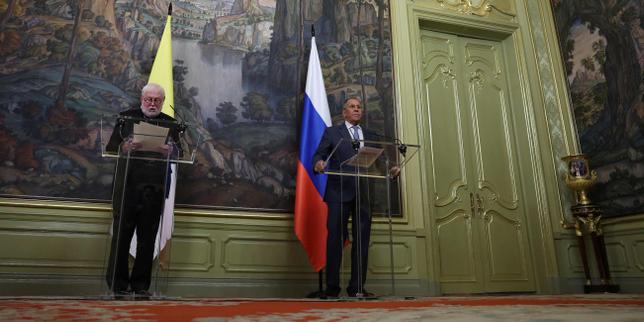
The Holy See's chief diplomat touched down in Moscow with a clear directive to halt the carnage in Ukraine, marking the first high-level Vatican visit to the Russian capital since late 2021. Archbishop Paul Richard Gallagher sat across the table from Russian Foreign Minister Sergei Lavrov, carrying the weight of papal authority into a room calcified by geopolitical ambition. It was an exercise in high-stakes ecclesiastical statecraft. Yet, beneath the diplomatic handshakes and public declarations of humanitarian cooperation, the encounter laid bare the stark limitations of moral persuasion against an entrenched war machine.
For decades, Vatican foreign policy has operated on the premise that moral suasion can bridge chasms where traditional state diplomacy fails. Archbishop Gallagher’s mission to Moscow was no exception. He reiterated the Holy See's standing offer of "good offices", pushing for a framework that bypasses immediate battlefield victories in favor of prolonged political dialogue. But reality in the Kremlin is measured in artillery shells, territorial control, and survival strategies, not theological appeals.
The Anatomy of a Stalemate
Diplomacy requires mutual concessions. At present, neither Moscow nor Kyiv possesses the internal incentive structure to compromise. When Gallagher urged Russian leadership to create conditions for serious negotiations, he ran into a wall of absolute intransigence. The Kremlin views the conflict through an existential lens, framing its military actions as a defense against a hostile security architecture.
Consider a hypothetical example of corporate mediation. Two rival firms locked in a catastrophic patent war will not settle simply because an arbiter reminds them that cooperation is morally superior. They settle when bankruptcy looms or when market conditions render continued fighting more expensive than surrender. State warfare operates similarly, but on a macro scale fueled by national pride and mobilized economies.
The Vatican's approach deliberately ignores the mechanics of modern attrition. By insisting that military action can never yield a permanent solution, the Holy See speaks an abstract truth that offers zero operational utility to generals managing supply lines. Moscow listened politely, agreed to coordinate on narrow humanitarian concerns like the welfare of affected families and children, and steadfastly refused to budge on core strategic demands.
Why Moral Diplomacy Hits a Wall
The Holy See finds itself trapped in a historical anachronism. During the Cold War, Vatican intermediaries could leverage secret channels between Washington and Moscow because both superpowers feared mutual nuclear annihilation and recognized a shared ideological baseline. Today, that baseline has evaporated. Russia operates outside the Western-led normative framework, treating international law and moral admonitions as secondary to hard security guarantees.
Archbishop Gallagher's press conference alongside Lavrov underscored this disconnect. While the Vatican envoy emphasized spiritual and diplomatic support for a negotiated settlement, Russian state media framed the visit through its own domestic lens, using the presence of a senior Western dignitary to project diplomatic normality. The optics benefited Moscow far more than they advanced peace.
Independent analysts tracking the talks note that the Holy See's refusal to align explicitly with Western sanctions architecture, while noble in its pursuit of universal neutrality, ultimately blunts its leverage. You cannot mediate effectively if both sides suspect your neutrality stems from moral equivalence rather than strict impartiality.
The Cost of Neutrality
True neutrality demands a price. By keeping equal distance from Washington, Kyiv, and Moscow, the Vatican shields its ability to act as a backchannel, but it sacrifices the capacity to shape the terms of eventual peace. When major powers draft security architecture—whether through bilateral backchannels or economic coercion—the moral voice in the room is often reduced to a footnote.
The mission to Moscow achieved what it was structurally capable of achieving: keeping a diplomatic lifeline open. It secured nominal agreements on humanitarian dialogue while leaving the architecture of the war entirely untouched. The machinery of state violence rolls onward, indifferent to the quiet prayers whispered in apostolic palaces.