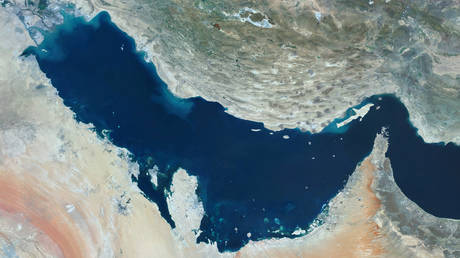
When President Donald Trump publicly dares Iran to breach a United States naval blockade, the rhetoric reads like standard geopolitical brinkmanship designed for television cameras and domestic political rallies. Beneath the surface, however, such a standoff represents one of the highest-stakes maritime gambles in modern military history. A naval blockade is not merely a dramatic sanction with warships attached; under international law, it is an explicit act of war that tests the physical limits of the United States Navy, the fragility of global energy markets, and the asymmetric warfare capabilities that Iran has spent four decades perfecting in the Persian Gulf.
To understand what actually happens when Washington threatens to seal off Iranian maritime traffic, you have to look past the podium speeches and examine the geography, the legal thresholds, and the cold mathematics of naval warfare. The Strait of Hormuz is barely twenty-one nautical miles wide at its narrowest point. Every day, roughly one-fifth of the world's petroleum liquids pass through that bottleneck. Daring Tehran to run a blockade in those waters does not just threaten Iranian oil exports—it places a loaded gun against the temple of the global economy.
The Legal Reality of a Maritime Blockade
In political commentary, terms like "embargo," "sanctions," "quarantine," and "blockade" are often thrown around interchangeably. In admiralty law and military doctrine, they are worlds apart. Economic sanctions rely on financial penalties, insurance blacklists, and diplomatic pressure to convince third parties to stop doing business with a target nation. A naval blockade, by contrast, is a belligerent act of kinetic interdiction. It involves stationing warships outside an adversary's ports and coastlines to physically prevent all vessels—regardless of the flag they fly—from entering or leaving.
The distinction matters immensely. During the Cuban Missile Crisis in 1962, President John F. Kennedy famously insisted on calling the US Navy's perimeter around Cuba a "quarantine" rather than a blockade specifically because a formal blockade constitutes an act of war under the United Nations Charter and international customary law. By issuing a public dare for Iran to breach a blockade, the White House elevates a maritime interdiction operation from a law-enforcement or sanctions-enforcement posture into a direct military confrontation.
Once a blockade is declared, the rules of engagement shift dramatically. Under the San Remo Manual on International Law Applicable to Armed Conflicts at Sea, a blockade must be effective to be legally recognized—meaning it cannot be merely a paper declaration, and it must be enforced impartially against ships of all nations. If a merchant vessel registered in Panama, China, or Greece attempts to cross the line, the blockading force is legally obligated to stop it, board it, and, if it resists, disable or sink it. That single requirement turns a bilateral dispute between Washington and Tehran into an immediate diplomatic and military crisis with every major shipping nation on earth.
Asymmetric Warfare in a Shallow Bathtub
Military planners at the Pentagon have spent decades wargaming conflict scenarios in the Persian Gulf, and the results rarely resemble the lopsided victories seen in open-ocean engagements. The US Navy is built around nuclear-powered aircraft carriers and guided-missile cruisers designed to project power across vast expanses of blue water. The Persian Gulf is not blue water. It is a shallow, cramped, littoral bathtub full of islands, oil platforms, fishing dhows, and commercial supertankers.
In this environment, size becomes a liability rather than an asset. A Nimitz-class or Ford-class aircraft carrier operating inside the Gulf has almost no room to maneuver, making it a massive radar signature surrounded by hostile coastlines just minutes away by missile flight time. Consequently, during periods of heightened tension, US carrier strike groups typically remain outside the Strait of Hormuz in the Gulf of Oman or the North Arabian Sea, leaving smaller surface combatants—such as Arleigh Burke-class destroyers and coastal patrol craft—to handle forward operations.
Iran's Islamic Revolutionary Guard Corps Navy (IRGCN) was engineered specifically to exploit this geographic reality. Rather than trying to match the US Navy ship for ship, Tehran invested in anti-access and area denial (A2/AD) systems tailored to the narrow confines of the waterway. If ordered to break or contest a blockade, Iran does not need to defeat the Fifth Fleet in a traditional naval battle. It only needs to make the cost of maintaining the cordon unbearably high.
The Swarm Doctrine and Saturation Attacks
The core of Iranian naval strategy relies on saturation. Instead of relying on a few high-value warships, the IRGCN operates hundreds of fast-attack craft—small, agile boats armed with anti-ship cruise missiles, heavy machine guns, and torpedoes. In a confrontation, these vessels operate in coordinated swarms, emerging simultaneously from hidden coves along Iran's jagged coastline and fortified islands like Qeshm, Hormuz, and Abu Musa.
A modern US destroyer equipped with the Aegis Combat System can track and engage dozens of incoming targets simultaneously, yet every ship carries a finite number of interceptor missiles in its vertical launch cells. Once those cells are depleted, the ship must withdraw to a friendly port to reload—a process that cannot be done at sea. If Iran launches a synchronized wave of fast-attack boats, low-flying drones, coastal anti-ship ballistic missiles, and midget submarines, the objective is simple—overwhelm the defenders' magazine depth. Even if ninety percent of incoming munitions are intercepted, the remaining ten percent hitting a billion-dollar warship or a fully loaded oil tanker changes the political calculus in Washington overnight.
Naval Mines and the Invisible Threat
Long before a single missile is fired, the quietest weapon in Iran's arsenal does the heaviest lifting. Naval mines are cheap, easy to deploy from commercial vessels or submarines, and extraordinarily difficult to clear. Historically, mines have damaged more US Navy vessels since World War II than missiles, torpedoes, and aerial bombs combined.
In April 1988, during the Tanker War, the guided-missile frigate USS Samuel B. Roberts struck an Iranian M-08 contact mine in the central Persian Gulf. The blast blew a fifteen-foot hole in the hull, broke the ship's keel, and nearly sank the vessel, prompting the US military to launch Operation Praying Mantis in retaliation. That single mine cost roughly fifteen hundred dollars to manufacture; repairing the frigate cost nearly ninety million dollars. If Tehran responds to a blockade by seeding the shipping lanes with acoustic, magnetic, and pressure-activated mines, global maritime insurers will immediately revoke coverage for every commercial vessel in the region. You do not need to sink twenty tankers to shut down the Strait of Hormuz—you only need to damage two, and Lloyd's of London will close the waterway for you.
The Chinese Variable and Shadow Fleet Economics
A blockade is only as effective as its enforcement against the target's largest customers. For Iran, that customer is overwhelmingly China. Over the past several years, despite sweeping US sanctions, Iranian crude exports have repeatedly reached multi-year highs, with independent "teapot" refineries in China's Shandong province absorbing the vast majority of those barrels.
To move that oil without triggering Western financial penalties, Tehran and its buyers rely on a sprawling dark fleet of aging tankers that disable their Automatic Identification System (AIS) transponders, conduct ship-to-ship transfers in the dead of night off the coasts of Malaysia and the United Arab Emirates, and frequently change names and flags of convenience. Intercepting these vessels via sanctions paperwork is one thing; physically stopping them at gunpoint in international waters is another matter entirely.
If US warships enforce a strict blockade by boarding and seizing tankers bound for Chinese ports, Washington triggers a direct confrontation with Beijing. Even if the vessels are technically flagged in Panama, Liberia, or Gabon, the cargo belongs to Chinese entities, and Beijing views energy security as a core national interest. A prolonged interdiction campaign forces China to choose between accepting a US-enforced cutoff of discounted crude or escorting tankers with People's Liberation Army Navy destroyers—a scenario that introduces two nuclear-armed superpowers into the same cramped maritime theater.
The Energy Shockwave and Domestic Blowback
Political leaders often treat foreign policy crises as isolated chess matches, forgetting that global oil markets price in risk instantly. Crude oil is a fungible global commodity; you cannot remove two to three million barrels per day of Iranian supply—much less threaten the transit of seventeen to twenty million barrels per day from Saudi Arabia, Iraq, Kuwait, and the UAE—without triggering an immediate price spike across every energy exchange on earth.
Consider a hypothetical scenario where US destroyers intercept two Iranian-linked tankers on a Tuesday morning, and Iran retaliates by seizing a Marshall Islands-flagged commercial vessel and firing warning salvos near shipping lanes that afternoon. Within hours, Brent crude futures would surge by twenty to thirty dollars a barrel. Within days, retail gasoline prices in the American Midwest, Europe, and Asia would climb sharply, fueling inflation and eroding the exact economic metrics that incumbents rely on to survive elections.
This economic reality creates a fundamental asymmetry of pain. Iran's economy has been battered by sanctions, currency collapse, and domestic unrest for decades; its leadership is accustomed to operating under siege conditions and absorbing severe economic deprivation without surrendering core regime objectives. Western democracies, by contrast, have an exceedingly low tolerance for sudden energy inflation and prolonged military entanglements in the Middle East. When Trump dares Iran to breach a blockade, he is betting that Tehran will blink before the oil markets panic. Tehran's entire strategic doctrine is built on the opposite wager—that Washington cannot stomach the economic and military fallout of an actual shooting war in the Gulf.
The Trap of Credibility Commitments
In international relations theory, publicly issuing an ultimatum creates what analysts call audience costs. When a president draws a red line in private diplomatic channels, both sides retain room to negotiate a face-saving off-ramp. When a president issues a public dare in front of cameras, backing down becomes politically humiliating, while following through locks the military into an escalatory ladder with no obvious exit.
Iranian leadership understands this dynamic intimately. Tehran rarely responds to American naval pressure with an immediate, frontal assault that justifies massive US retaliation. Instead, the IRGCN excels at calibrated ambiguity—actions that fall just below the threshold of conventional war while demonstrating that the blockade is porous and unenforceable.
They might deploy dozens of small boats to harass a US destroyer without firing a shot, force a commercial tanker into Iranian territorial waters over a supposed maritime collision, or launch drones from proxy forces in Iraq and Yemen against regional bases rather than attacking warships directly. Each incident forces the White House into a lose-lose dilemma: either escalate militarily and risk a full-scale regional war that spikes oil prices, or absorb the provocation and watch the much-vaunted blockade lose credibility in real time.
What History Tells Us About Gulf Brinkmanship
We have seen variations of this movie before. During the final years of the Iran-Iraq War in 1987 and 1988, the US Navy launched Operation Earnest Will, reflagging Kuwaiti oil tankers under the American flag and escorting them through the Persian Gulf to protect them from Iranian attacks. While the operation eventually succeeded in keeping the sea lanes open, it required a massive naval commitment, resulted in the near-sinking of the USS Samuel B. Roberts, the accidental shootdown of Iran Air Flight 655 by the USS Vincennes—killing 290 civilians—and constant low-intensity combat that pushed the two nations to the brink of full-scale war.
More recently, in 2019, following the US withdrawal from the Joint Comprehensive Plan of Action and the imposition of "maximum pressure" sanctions, Tehran demonstrated how easily it could disrupt regional energy infrastructure without ever engaging the US Navy head-on. Limpet mines damaged four commercial tankers off Fujairah, British-flagged tanker Stena Impero was seized in the Strait of Hormuz, and a coordinated drone and cruise missile strike knocked out half of Saudi Arabia's oil processing capacity at Abqaiq and Khurais in a single morning. Washington did not respond with a kinetic strike on Iranian soil, recognizing that an open war would devastate global markets.
History demonstrates a consistent pattern in the Persian Gulf: overwhelming naval superiority guarantees the ability to win battles, but it does not guarantee the ability to compel compliance or control escalation. Daring an adversary to breach a blockade assumes that both sides share the same definition of victory and the same threshold for pain. In the narrow, mine-strewn waters off the Iranian coast, the side with the biggest ships rarely holds all the cards, and the ultimate price of calling a bluff is paid at the gas pump long before the smoke clears at sea.